Q. Most of the 300 plus historical monuments you have researched are temples. What makes the terracotta temples of Bengal so special?
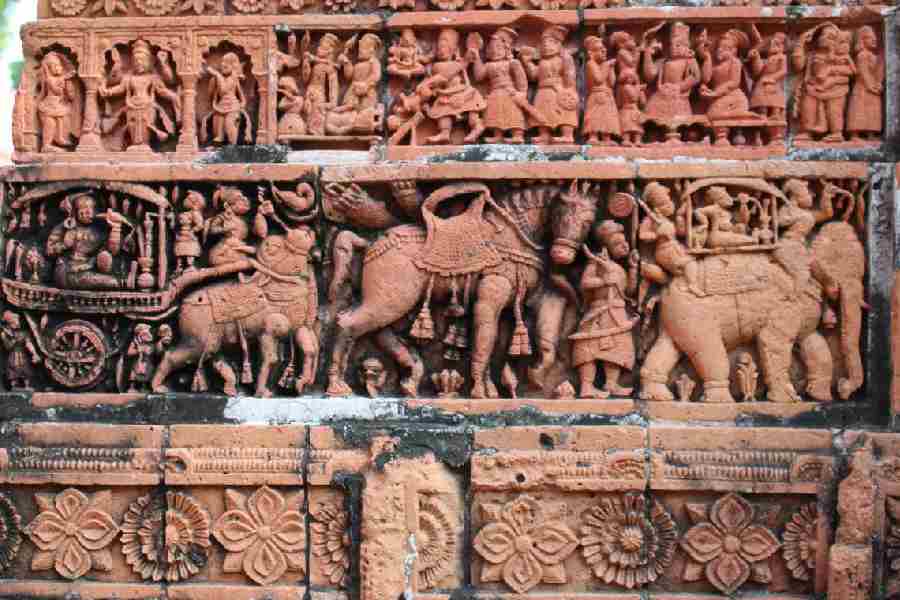
To begin with, their hybridity. These buildings have Persian domes, arches and vaults, surface decoration and motifs adopted from Buddhist viharas, ridged rekha deuls or turrets inspired by the temples of Odisha, curved cornices borrowed from the village huts of Bengal and Corinthian columns typical of European structures. Second, the patrons who were not just kings and zamindars, but also merchants, weavers, priests, administrators and even farmers. Third, the agency of the travelling artisans’ guilds who built the temples. These rural craftsmen or sutradhars actively shaped Bengal’s temple architecture in the 18th and 19th centuries. The sites spanning India and Bangladesh are excellent candidates for the Unesco World Heritage Transnational Serial Properties tag. It would be a remarkable achievement if the two governments could work together and build a case.
Q. The English scholar David McCutchion documented Bengal’s temples in the 1960s. And yet, to begin with, he was trained in the modern languages. You are a software engineer based in London. How did you even get into this temple run?
Not just temples. I visited viharas, Sultanate mosques and tombs too. My intellectual interests have always been in the humanities. As a student, history was the subject that fascinated me most, and my interest in South Asian historical architecture was sparked early on by books like John Keay’s India: A History and India Discovered and George Michell’s Blue Guide: Southern India. After studying and working in the US, I returned to India to do an MBA and then worked in Bengaluru for some years. During this time that early fascination translated into travel and research. Every weekend, I would travel on state buses and trains across South India, visit Sultanate, Hoysala, Vijayanagara and Pallava sites. This initial period of immersive field study trained my eye to recognise how history, politics, religion and art intersect in architecture. Around 2006, while working on a project in Jamshedpur, my focus shifted to Bengal.
Q. Did Bengal have any surprises in store for you?
Like many others, I used to think Bishnupur epitomised Bengal’s terracotta architecture. But what I have discovered since is that the story of Bengal’s architecture is wonderfully diverse across time, geography, styles, regions, patronage and craftsmanship, and this is what I aim to bring to light through my book. Over the last five years, I have transitioned from documentation to conservation work.
Q. Did you visit all the temples McCutchion studied?
I did. I also visited many that he did not document.
Q. The Malla kings of Bishnupur sponsored scores of elaborate temples in Bankura and Medinipur, didn’t they?
The Mallas became prominent when they supported Raja Man Singh’s Mughal campaign in Bengal and were rewarded with titles and lands around Bishnupur. Mughal suzerainty also structurally integrated the Mallas into the trade networks of the Mughal Empire. The second event was Bir Hambir’s conversion to Gaudiya Vaishnavism and the subsequent influence of Gaudiya gosains in directing Malla resources towards temple construction in new styles that enabled congregational rituals. Over the next several decades, successive Malla rulers added territory, expanded agricultural output by building waterworks and tanks, and set up silk and textile hubs by encouraging weavers and merchants to settle in Bishnupur. The most prolific patron was Raghunath Singha whose greatest creations — the Shyam Rai and Keshta Rai temples — were funded from his successful military campaigns in north Medinipur.
Q. Did the patrons ever credit the creators of these temples?
Sometimes they did. In the temples of Medinipur, I have seen panels with the name and village of the sutradhar. This practice started in the late 18th century. These worked like advertisements. After all, the guilds depended on new commissions. In Alangiri village in Medinipur, the Das family recounted stories of sutradhars passed down from generation to generation. These sutradhars travelled with their catalogue scrolls of temple designs, complete with price tags for patrons.
Q. What if I asked you to identify the top five architectural gems?
Selecting only five monuments is difficult. But here are five lesser-known ones. Radha Govinda Temple in Antpur, Hooghly. Built by the Mitra zamindars, its facade is covered with scenes from the Ramayana, Mahabharata and Krishnalila, Devi Mahatmya, and scenes of daily life of common people along with rich vegetal decoration throughout. Gokulchand Temple in Gokulnagar, Bankura. This laterite temple is one of the earliest double-storey temples. Char Bangla Temple Complex in Baranagar, Murshidabad, which was built by Rani Bhabani, the famous zamindar of Natore. Kantaji Temple in Bangladesh. Its outer and inner walls are covered with intricately sculpted panels. And the Eklakhi Mausoleum in Malda’s Pandua. It is the earliest monument with all the hallmarks of Bengali pre-modern architecture.
Q. Is your book a nod to McCutchion?
Of course. I am indebted to many others as well. Tarapada Santra, who compiled meticulous monument lists in a series of books. The theme of this series was jela purakirti or district antiquities. Santra wrote brilliant articles on temple inscriptions, sutradhars and local culture. Then there is Amiya Kumar Bandyopadhyay, who was district magistrate of Bankura in the mid-1960s. It was he who spearheaded the Jela Purakirti series. Hitesranjan Sanyal, who wrote about the sociological aspects of temple patronage; Pranab Ray, who documented the temples of Medinipur; Shambhunath Mitra, who made detailed lists of the temples in Burdwan and Hooghly. And then of course, there is George Michell, who brought out the book Brick Temples of Bengal in 1983. Many heritage enthusiasts quietly and tirelessly continue to travel, photograph and document historical monuments in the districts, and write about them in Bengali newspapers, journals and social media. Some of them — Ajoy Konar, Chinmoy Das and Biplab Barat — have generously shared their time and knowledge with me.
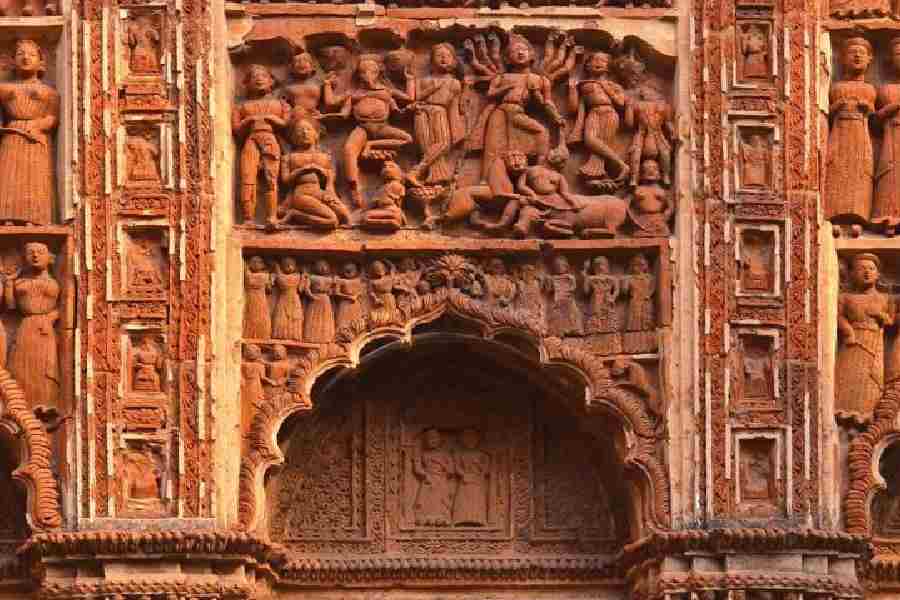
Sonamukhi Temple in Bankura. Photo courtesy Amit Guha
Q. How is your book different from Michell’s?
In Brick Temples, Michell presents the key aspects of McCutchion’s work on the evolution and classification of Bengal’s temples. He supplements this with essays by himself and other scholars on temple structure, iconography, builders and related arts. It is a scholarly work, primarily meant for researchers and art historians. My book is for anyone who wishes to know about Bengal’s temple architecture. The aim is to encourage readers to visit these sites, to help them understand the historical and social contexts of the monuments, appreciate their structural complexity and artistic brilliance, and to decipher the stories depicted on the facades.
Q. Do you have any suggestions about how we should protect and conserve our temples?
Brick structures when neglected, deteriorate rapidly. We know that when sutradhar guilds were active, they regularly visited temples for repair work. They also left instructions on how to remove plants and treat temple surfaces for water damage, lichen and salt deposits. With the decline in temple patronage, however, sutradhars dispersed into other trades. By the mid-20th century, the knowledge of building and repairing brick monuments was lost. Today, the only organisations with expertise to scientifically conserve brick monuments are the government archaeological departments. They have restored temples in many places, but despite these efforts, hundreds of monuments remain endangered. Given the scale of conservation needed, sustainable initiatives must be based on community involvement. Tourism can also be a catalyst for conservation.
Tapestries in Brick: A Guide to the Architecture of Bengal is being published by HarperCollins