My first overseas reporting trip was to Iran nearly half a century ago. Coincidentally, it was also my first overseas trip. I have the Iraqis to thank for it. I was a reporter with New Delhi magazine (which shut shop in 1981) in its namesake city. In 1979, soon after the Islamic revolution toppled Shah Mohammad Reza Pahlavi of Iran, I wrote a piece about it titled “Iran: A Return to Medievalism?”
In December 1980, soon after the start of the Iran-Iraq war, I got a call from the Iraqi embassy in New Delhi asking if I would like to go on a conducted trip to the battle front. The offer also included a meeting with Saddam Hussein in Baghdad. It was an offer too good to refuse. I soon had an Iraqi visa stamped in my passport. However, the day after I got my visa, the Iraqi embassy called my editor to instruct him to have me return to the embassy because they wanted to revoke my visa. The ambassador had noticed an article in the magazine that he did not like.
I returned dejected to my office. A couple of hours later, I got a call from the Iranian embassy offering me a visa to make an unchaperoned visit to their country, no strings attached!
Soon, I had an Iranian visa in my passport next to the cancelled Iraqi one. I bought a Farsi phrase book and a shaggy woollen overcoat. India had strict foreign exchange controls in those days. When I went to the Reserve Bank of India to buy my paltry allowance of US dollars, enough to fund a week in Iran, a friendly clerk advised me to purchase British pounds instead. Nobody likes dollars in Iran, he advised.
By happy coincidence, Iran Air had resumed weekly flights from Bombay to Tehran after a disruption caused by the revolution. I was one of the very few passengers on an almost empty Boeing 747. As I walked into the terminal at Mehrabad Airport, I heard the sound of smashing glass, a man's voice raised in anger, and smelled a cloud of alcoholic fumes. It turned out the customs officers were seizing and smashing any alcohol brought in by hapless passengers. The air in the arrival hall was intoxicating!
I was to see the ghosts of times past everywhere I went for the next few weeks in Iran. And there were many signs of how good the times had been for people who had some money when the Shah was in charge of their destiny. At my very first meal in my Tehran hotel, the waiter approached me with a suggestion that I try some of their excellent caviar. I'd never had caviar before in my life, and it would have been too expensive to contemplate on my modest Indian journalist’s salary. In Tehran, I discovered that caviar was plentifully available at throwaway prices. I became quite familiar with discussions about whether the sturgeon in the Caspian Sea, close to Iran's shores or close to Russian shores farther away, were better. In the streets, I saw people looking like a curious mix of Western and Islamic fashion. There were variations of scarves called chadors and hijabs, as well as women wearing skirts and high boots. The men were all smartly dressed too.
When I went to the bank to exchange my British pounds, I realized the wisdom of the RBI clerk's advice. The bank manager sidled up to me and, in a conspiratorial whisper, asked me to accompany him to his office. There he offered me an exchange rate four times the official one, with no receipt and everything in cash. I asked him, startled, how he was doing this. He said he needed to collect enough foreign exchange to spirit his family out of the country. Thanks to this bonanza, I had enough money to extend my one-week trip to three.
My visa was renewed week after week without demur at the immigration office. I was able to visit the cities of Shiraz and Isfahan. It afforded me the time to travel from city to city by luxury buses and absorb local flavours. I wandered the streets of Tehran unhindered. I was never stopped by anybody or questioned.
Life seemed normal, and there were few signs of the war with Iraq that had broken out a few months earlier. There were no air raid sirens and no blackouts. The television in my hotel room showed a lot of propaganda for the revolution with the Imam Ayatollah Ruhollah Khomeini's brooding face popping up quite frequently, and the daily calls to prayer echoing over the airwaves. The cinemas seemed to be showing American movies dubbed in Farsi. This was odd because the 52 Americans held hostage at the US embassy were just a stone's throw away. Their captivity had, by then, extended more than a year, but besides the posters and banners adorning the embassy walls, there was very little sign of patriotic fervour. On Christmas Day, 1980, as I was walking past a newsstand near my hotel, I spied and purchased a copy of Time magazine with John Lennon on the cover. The Beatles singer had been assassinated in New York early that month. In the United States, Ronald Reagan had been elected President, and there was increasing talk of the hostages being released just before he took office in January. This seemed more of a calculated insult to Jimmy Carter, who had dispatched a disastrous rescue mission to Iran in the spring of 1980.
In that pre-Google era, my main reporting tool was my shoe leather. Aside from conversations with the man on the street, shopkeepers and academics, I benefited from the deep knowledge of Iran’s history, culture, and people, held by India’s ambassador in Tehran, Akbar Mirza Khaleeli, as well as the All India Radio’s Tehran correspondent, C.V. Raman.
The department stores in Tehran seemed to be in a hurry to get rid of their pre-revolution stocks. I bought an entire set of excellent stainless steel cutlery and a tomato slicer (a novelty in India at the time) at rock bottom prices. Although I enjoyed eating the local food, especially the noons, as well as chelo kebabs and other delicacies, I also discovered, to my delight, that deep in the heart of Tehran I could get unlimited free Indian vegetarian food at the Hare Krishna temple, which had been left unscathed by the revolution.
There were other incongruities. In the beautiful cities of Shiraz and Isfahan, which boasted stunning mosques, I saw people selling a lot of their household possessions on the pavements, probably in preparation for fleeing the country. On a sidewalk in Isfahan, I purchased a dog-eared copy of H.G. Wells' War of the Worlds, which seemed an appropriate title for the times I was witnessing.
Throughout this period, nobody from the government suggested I visit the war front. The stories of young Iranian soldiers being trucked to the trenches where they were slaughtered by the hundreds, being presented with baskets of pomegranates on the way by cheering villagers, were graphic enough. It was still early in the war, which dragged on for eight years before it entered a bloody stalemate in 1988.
I filed several dispatches for Business Standard newspaper, which was then published from Calcutta by the Ananda Bazar Patrika group, which also owned New Delhi magazine. I wrote a longer piece for the magazine on my return to India.
There was frequent snowfall and ice on the sidewalks. Early one morning, on a particularly cold day, I was heading towards a street corner where a handcart vendor was selling steaming mounds of beets, a favourite with the Tehranis. I didn't notice that there was a four-foot-deep gutter running alongside the avenue, a common sight in the city. I slipped on the ice and fell into the ditch. As I was trying to clamber out of it with little success, two revolutionary guards called Pasdaran came strolling by and saw I was in trouble. They hauled me up.
In my broken Farsi, I explained that my glasses were still at the bottom of the ditch. Both the young men handed me their assault rifles and clambered down to retrieve my glasses. For a few minutes I was left holding weapons of mass destruction. We all parted with friendly smiles and thanks.
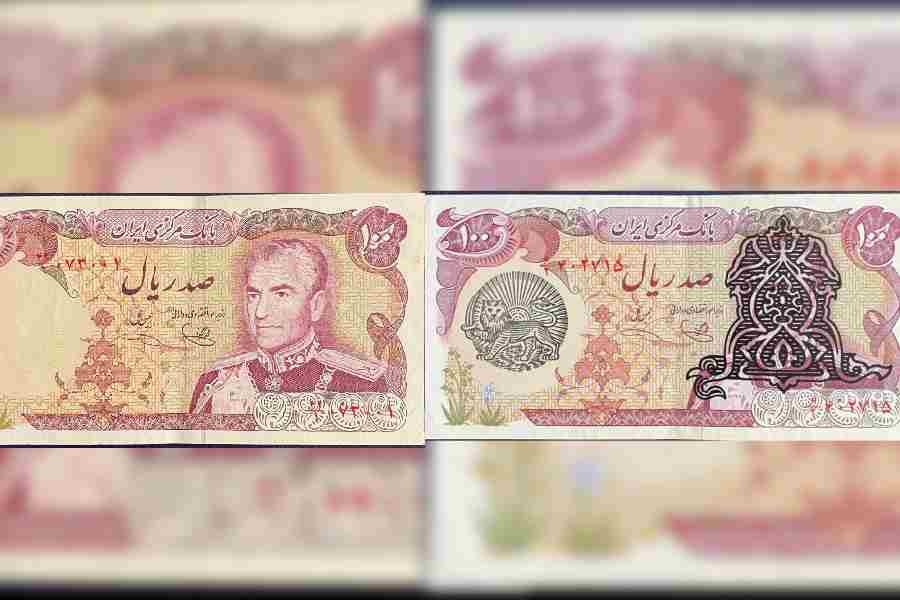
Everywhere I went, I paid in cash for things I purchased. I had never owned a credit card until then and nobody asked for one. The revolutionary government had had no time to print new currency notes. Most had the Shah's face on them still. Many of the notes now also had the Shah’s visage defaced by symbols of their culture. I brought back one of each, and you can see the picture above.
Iran already had a relationship of several decades of love and hate with America by then. If you read my dispatches on my archival website www.chaitanyakalbag.com/tag/iran/, you will see many echoes of what you are hearing, seeing, and reading today: oil, sanctions, and civilizational differences. I was frequently reminded by Iranians I met of their long and remarkable cultural and artistic history, something that they are proud of even today, despite nearly five decades of Islamic rule.
I was starting to run out of money and booked my return seat on an Iran Air flight. I bought a few packets of pistachio nuts to take back as gifts for family and friends. My flight back to India was uneventful. When I reached Bombay airport late at night, I found myself at the tail end of a long queue of Indian workers returning from the Gulf with big suitcases and rolls of bedding being given a tough inspection by customs officers. I dozed off on my baggage cart.
I was shaken awake by a uniformed officer who asked me where I was coming from. I said I had flown in from Tehran. He asked me to accompany him to the head of the queue and told one of his colleagues to process my arrival first. The other officer made me open my suitcase, took a cursory glance inside, fished out a fistful of pistachio nuts, shoved them into his drawer, and waved me on. “Let him go”, he said to his colleagues, “he is coming from Iran”.
Chaitanya Kalbag has covered many historical world events in his five decades as a journalist for several national and international publications and news organisations. Here are his pieces from Iran, then:
Iran – towards Islamic medievalism
New Delhi magazine
Published April 1979
https://www.chaitanyakalbag.com/iran-towards-islamic-medievalism/
Iran loses out in hostage deal
Business Standard
Published January 22, 1981
https://www.chaitanyakalbag.com/iran-loses-out-in-hostage-deal-iran-pays-the-piper/
Iran – Westward Ho again?
Business Standard
Published January 23, 1981
https://www.chaitanyakalbag.com/iran-goes-west-iran-westward-ho-again/
Iraq’s oil outlets badly crippled, Iran sitting pretty
Business Standard
Published January 24, 1981
https://www.chaitanyakalbag.com/iraqs-oil-outlets-badly-crippled-iran-sitting-pretty/
Iran haunted by Shah’s ghost
Business Standard
Published January 25, 1981
https://www.chaitanyakalbag.com/construction-work-hit-haunted-by-shahs-ghost/
Life in Iran – Joyless and hopeless
New Delhi magazine
Published Feb 2 to Feb 15, 1981
https://www.chaitanyakalbag.com/life-in-iran-joyless-and-hopeless/
Inside Khomeini’s Iran—heading for an anti-Mullah revolt?
New Delhi magazine
Published Feb 2 to Feb 15,1981
https://www.chaitanyakalbag.com/inside-khomeinis-iran-heading-for-an-anti-mullah-revolt/