What a magnificent piece of woodwork — that would have been the first thought of anyone who set their eyes on it in the autumn of 2024.
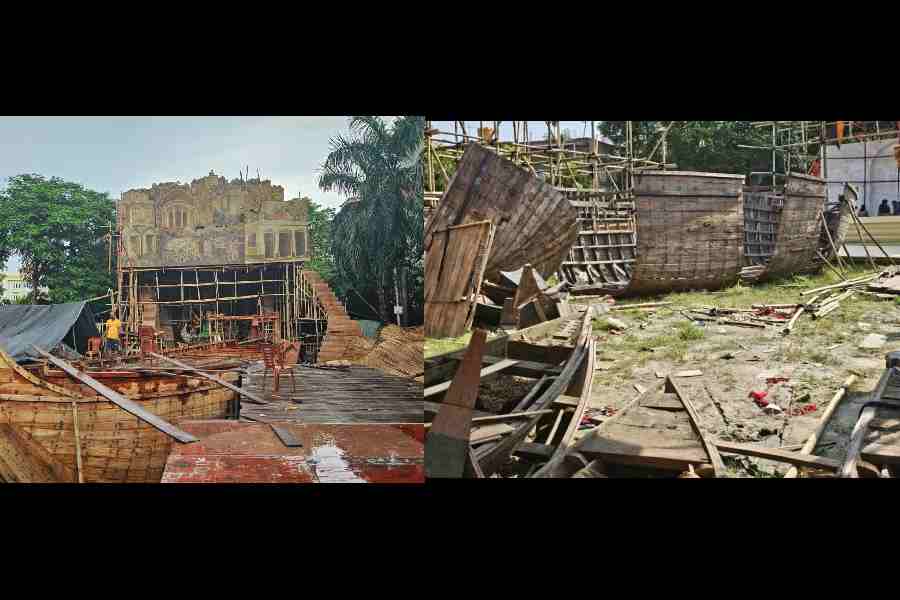
Polished and positioned as the prime piece of décor in a Durga Puja pandal, the boat with double sail on a single mast was 14 metres long and 4 metres wide. Parts of it had been hewn out of Lombu wood, heated and thereafter, kept tied tight for a day to bend it to shape on site in Ultadanga.
It was sturdy and built to bear the load of human beings, scores of them. In the pandal, they walked over it and then climbed down from a height of 3 metres to ground level to pay obeisance.
The theme of Ultadanga Bidhan Sangha that year was “banijye basote Lakshmi”. It is a Bengali saying that means, prosperity dwells in trade and commerce. The pandal too was designed to resemble a port city. There was a dock area dotted with a grocery store, a tea shop, a cloth house and a barber’s spot. Then there was a lighthouse and an anchored boat. The whole scene recalled the fable of Chand Sadagar of Manasamangal Kavya.
Back to the boat. Built over 35 days by a Basirhat boat-maker, the boat was a proper, buoyant vessel, capable of carrying about 120 tonnes.
Pandal designers Moloy-Subhamoy had consulted Swarup Bhattacharya, who is known for his research on indigenous boats, before coming up with the design. The make Bhattacharya suggested was betnai, used in the Sundarbans area to transport golpata and goran, species of mangrove trees.
Once the government banned the collection of mangrove forest resources, this type of boat went into disuse. So the display of a newly crafted specimen at the pandal was in a way all about swimming against the tide.
When the pandal was dismantled, the boat too went out of sight. It reappeared in Calcutta in 2025 at the time of Kali Puja.
By then, it was a weather-beaten shadow of its former stately self. The bow had come apart, the polish was gone, and a few planks were missing from the keel.
Placed upside down on one side of the ground in front of the pandal of Netaji Sangha in Rajarhat, it was undergoing repairs.
An elderly member of the pandal-making team shared the route of its year-long voyage.
“From the Durga puja in Ultadanga, it went to Barasat for Kali Puja, and from there to Bansberia for Kartik Puja. From Bansberia, it was a four-hour journey to Kalna where it was used for Saraswati Puja. And now here it is. Each time it is moved, we need a crane to haul it onto a truck,” he said, with a toothy grin.
At the Rajarhat pandal, the theme had accommodated the boat in its current condition. The pandal was a tribute to the rupokar or maker. A spare idol was to get crafted in full view of visitors. Next to it would be the façade of a factory floor, symbolising makers of the industrial sector.
The repairs on the boat were supposed to continue into the puja days, with the labourers and their activities being co-opted into the ambit of the exhibit.
“The boat had cost ₹5 lakh. It could still be put to some use,” said one of the karigars with a fond look in his eyes.
Where is the boat now? Restored and still being hauled from pandal to pandal doing the rounds of festivals? Or is it resting, not as a wreck on a riverbed like some of its storm-embattled ancestors but in a shed somewhere, waiting to be taken apart as firewood?
Look out for it, will you.