 |
| Still at it: It?s never too late to get fit |
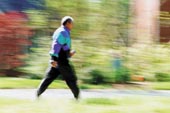
Throw away those knitting needles and that walking stick. Buy some running shoes and get on to the treadmill. That seems to be the new mantra for the old ? for more and more health-conscious aged people are doing just that.
At a time when fit is another word for building up extremes of a lean-mean or a heavily pumped-up form, elderly gentlemen and women are chalking out new paths. While the young aspire for the perfectly-toned J-Lo/Tom Cruise bods, the older folk are content to remain simply fit. They use exercise to combat several illnesses that come with old age.
Before retiring four years ago, 62-year-old Ranjeev Pathak held a high-stress job as a management consultant at a prominent Mumbai firm. His job took him outside the country at least four times a month. He built up stress and developed insomnia, which in turn affected his heart. And then, he came across an article in a medical journal on combatting stress. He checked into a neighbourhood gym and enrolled for an exercise programme three times a week. The programme included riding a stationary speed bike, part-walking, part-jogging, on the treadmill followed by a vigorous workout (as his body would permit) on the cross trainer. In time, Pathak was off medication for sleeplessness and showed marked improvements in blood vessel dilation. ?My doctor made a simple observation. He said that the routine exercise not only worked for my physical well-being by boosting blood vessel function of the heart, but freed what he thought was my emotional dependence on work,? says Pathak. ?I have been sleeping much better since.?
Leena Mogre, COO Gold?s Gym and director of LM Fitness Academy, Mumbai, says, ?When people cross the age of 50 they experience a depletion in lean muscle tissue. This leads to one of the commonest complaints of old age ?? joint pains. A studied routine of a mix of cardio-vascular exercises as well as weight-training helps combat this. While cardio improves the heart, weight-training helps strengthen muscles and tissues round the bones.?
One of Mogre?s clients (a 55-year-old) recovered from a niggling back problem after he knocked off 15 kgs in seven months, with supervised training. Sabira Merchant, 63, is a regular at the Gold?s Gym on Naepean Sea Road six days a week. She spends an hour at the gym everyday and does a combination of 35 minutes on the treadmill, floor exercises for 20 minutes and another 15 minutes of weights, and has a personal trainer to help her with breathing exercises. A few years ago she was advised by her doctor to exercise to strengthen the lower part of her body. To achieve this, her personal trainer has prescribed a combination of floor work and weights to strengthen her knees and the pelvic area.
?Exercise has helped cure my osteoporosis and hypertension. I am free of pain in my joints, particularly the knees. Walking on the treadmill has helped check high blood pressure as well. It has helped me relax a lot and generate a general sense of physical well-being,? says Merchant.
?Exercise has helped many people, even with diabetes. Many of our members have reduced the quantity of insulin pills they used to take prior to exercise,? says Subodh Bagayatkar, manager of Talwalkar?s Health Republic in Thane.
But the lesson for most of us is that we need not wait for the ?right time? to get on the nearest treadmill. An early start towards good health would help keep all anxiety at bay.
FAQs of the elderly
 |
Q: Is it safe for me to exercise?
A: It is safe for most adults older than 65 years to exercise. Even patients with chronic illnesses such as heart disease, high blood pressure, diabetes, and arthritis, can exercise safely. Many of these conditions are improved with exercise. But ask your doctor first.
 |
Q: How do I get started?
A: It is important to wear loose, comfortable clothing and well-fitting, sturdy shoes. Your shoes should have a good arch support, and an elevated and cushioned heel to absorb shock. If you are not already active, you should begin slowly. You do not have to exercise at a high intensity to get most health benefits. Walking, for example, is excellent to start with.
 |
Q: What type of exercise should I do?
A: There are several types of exercise that you should do. You will want to do some type of aerobic activity for at least 30 minutes on most, and preferably, all days of the week. Examples are walking, swimming, and bicycling. You should also do resistance, or strength-training two days per week. Warm up for five minutes before each exercise session. Walking slowly and stretching are good warm-up activities. You should also cool down with more stretching for five minutes when you finish exercising.
But wait a bit
 |
Exercise is only good for you if you are feeling well. Wait to exercise until you feel better if you have a cold, flu, or any other illness. And if you miss exercise for more than two weeks, be sure to start slowly again.
If your muscles or joints are sore the day after exercising, you may have done too much. If the pain or discomfort persists, talk to your doctor. Be careful if you have any of the follow- ing symptoms while exerc- ising: chest pain or pressu- re, trouble breathing or excessive shortness of breath, light-headedness or dizziness, difficulty with balance, nausea.
Treadmill and cross trainers are not advised for those who have had heart attacks, while those who have had bypass surgeries are not admitted to the gym. Bagayatkar says that those afflicted with arthritis gain the maximum benefit from this routine. Empha- sis is put on stretching exercises to strengthen the ligaments and tendons.
Those experiencing pain in the joints and knees should exercise with caution. They are advised to do leg extensions and leg curls, but keep away from squats and lunges and pressure movements.