 |
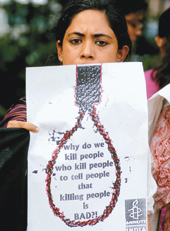
| Protest poster: An anti-death penalty activist (Photo: PTI) |
In the annals of contemporary history, there will be some names that will always spark an uneasy memory of an unhappy time. Dhananjoy Chatterjee is one such name. Some will remember him for what he did, some for what was done to him.
Chatterjee was hanged to death last year in August for a brutal crime committed in 1990. Chatterjee?s execution was an issue that raised national hackles last year. The issue died out, only to be resurrected by a leading rights group earlier this month.
The People?s Union for Democratic Rights (PUDR) has released a document that questions the Indian government?s figures on executions in the country. New Delhi has often held that executions in India are few and far between. Chatterjee?s case, it was widely reported, was the 55th one in the country. But the PUDR differs. ?The continued suppression of information by the various agencies of the State is a deliberate attempt at misinformation and raises concerns,? it says in its report.
The PUDR has figures ? collated from the government ? to bolster the view. Contrary to popular belief, it says that several hundred people have been executed over the years in India. ?We fear the total number since Independence would be high in the thousands,? says the report.
Chatterjee was not the 55th person to be executed. The PUDR findings show that 1,422 executions were carried out in 16 states in India between 1953 and 1963.
?The average of over 140 executions a year is itself shocking. But more than that, this data completely shatters the myth of 55 executions and the general belief that few executions are actually carried out in India,? says a PUDR spokesperson. ?This also raises serious questions about the Indian government?s silence on previous executions.?
PUDR and other activists fighting against the death penalty have often lamented the lack of information about executions in India. During the debate triggered by Chatterjee?s execution, it was felt that the arguments would be incomplete unless figures were made public.
It was this lack of information that set the PUDR working. ?During the Dhananjoy Chatterjee execution, there was a lot of media coverage about how the government did not release figures or statistics on executions. This got our attention and we started examining the issue in more detail,? says the spokesperson, declining to be named.
The PUDR found what it was looking for in a report of the Law Commission. Activists from the organisation went through hundreds of pages of data, looking for more information on the death penalty. The figures were finally found in an appendix of the 35th report of the Law Commission of 1967.
?This report examined whether capital punishment should be abolished and is fairly well known, though it?s almost 40 years old now,? the PUDR spokesperson explains. ?Most people have, however, only focused on volume one.?
But volumes two and three eventually gave the researchers a glimpse of the magnitude of the problem. The information that 1,422 deaths were carried out in a decade was found in appendix 34 ? which, the PUDR says, was ?rather misleadingly? shown as dealing with homicide cases.
?Even though we were looking for data on executions, the sheer extent of the material and the numbers of executions carried out surprised us,? says the spokesperson.
Madras state recorded 485 executions during this period, Uttar Pradesh 397, Punjab 140 and Andhra Pradesh, 119. West Bengal had 15.
What is significant about the PUDR?s findings is the fact that the government does have information about the extent of the use of the death penalty. But all this while, though the National Crime Records Bureau had data of executions post 1995, little was known about the number of executions.
?These figures are further conclusive proof that the government has data of executions,? the PUDR spokesperson emphasises. ?Now, the question to be asked is ?Why does the government not want this data to be made public???
The PUDR hopes to take the issue up at different fora to ?spread information and awareness? about the figures of executions. ?The next step is to confront the government with this and seek complete information.?
The PUDR plans to either get the issue raised in Parliament or through a right-to-information application. ?Either way, the government needs to provide complete information and ensure transparency with respect to the death penalty,? the spokesperson maintains.
The Law Commission?s figures demonstrate that the death penalty is not rare in a country where, it was often claimed, an average of one execution a year was carried out. ?This recent information provides a completely new context within which the debate on death penalty can now take place,? says the PUDR. ?The State constantly argues that the death penalty has a deterrent effect, but can there even be deterrence if people are unaware of executions which have been carried out??