 |
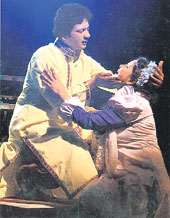
| A scene from Meghabati |
It hardly makes sense to stage yet another production of Antigone unless the director is offering some new interpretation and unless it is executed very well. Baharampur Ritwik’s production of Meghabati ? part of the Ganakrishti Natya Utsav (July 22-27) in association with the Eastern Zonal Cultural Centre ? a Bengali-adaptation of Sophocles’ play (Sisir Mancha, July 24), is executed well enough, but there is no contemporary rendition.
The classical dramatic potential of the plot of Antigone makes it a director’s delight, and Goutam Roychoudhury takes full advantage of it. And he doesn’t take the easy way out by having those scenes enacted on stage that have the potential to be the most physically dramatic ? like the death of Meghabati (Antigone), the suicide of her lover, etc.
The king has forbidden the burial of the ‘traitor’. His corpse is to lie rotting in the streets, torn apart by dogs and cats, crows and vultures. Anyone disobeying his orders would be put to death. But in the quiet of the night, a sentry catches the sight of the shadow of a woman tip-toeing across, to place flowers on his body. Meghabati is captured and brought to the king, who happens to be her uncle, who once doted on her. What follows is a terrible conflict of individual notions of righteousness and pride, as king and his niece try to justify his/her own position vis-?-vis the rules governing life and death.
Shipra Sen has stage presence and fits right into the character of the fearless, defiant Meghabati, and Biplab Das plays convincingly the tragic hero. Yet, the play leaves no mark other than offering just another translation of the famous play.
Allahabad Rupkatha’s plays, Shatabdir Panchali (Bengali) and Sarju Par Ki Dastan (Hindi), (Rabindra Sadan, July 25) were two boring, badly-acted plays, which lacked even a single redeeming feature. The former, an adaptation from Jim Anderson’s Tough Crisis For The New Century tried to be clever and camouflage didactic instruction-giving with a situational comedy. But that would’ve worked if the cast knew how to act or deliver the punch-lines properly. They didn’t.
Even a simple husband-wife spat couldn’t be conveyed with enough conviction. A monolo-gue, set in a dark, gloomy stage, was more like an enumeration of all the ways that women and the poor are exploited, rather than having any dramatic value.