| So far, we have presented some very simple yogic practices of the Bihar School of Yoga. We assume that having done them regularly, your body and mind are now ready to try out more demanding practices, which require greater flexibility and control. In this article, we present Vajrasana, the only asana which can be done after a meal for better digestion, and Gomukhasana, which, if you have become sufficiently flexible, will help you to relax even more. These are somewhat more advanced practices and should be attempted with caution. Be gentle with yourself. It helps! Also, we introduce an important pranayama which has proved beneficial for all ages and health conditions. | ||
| VAJRASANA (Thunderbolt pose) | ||
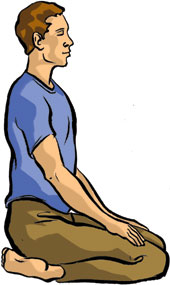
This asana should be performed daily after each meal, for three minutes. It can also be done on an empty stomach. For those suffering from digestive disorders, the Bihar School of Yoga recommends sitting in Vajrasana for 100 breaths, both before and after meals. Kneel down on a folded blanket and bring the big toes together. Separate the heels outwards and gently lower the buttocks to sit inside the space between the heels. Place the hands on the knees with the palms facing downwards. The back should be relaxed but erect, the head held straight and the eyes gently closed. You should be breathing normally, aware of the flow of air in and out of the nostrils. If your thighs hurt, then try separating the knees slightly. If the pain in the knees is mild, then place a cushion between the thighs and calf muscles before sitting down fully. If the pain is in the ankles, then place a cushion under the ankles. But, if the knees really hurt or you have knee pain or injuries, then do not take the risk of attempting to sit in Vajrasana as you may cause injury to the knee joints, which will not only be very painful, but will also affect your mobility. However, if you fail, then do not feel discouraged. Instead, prepare the knees gradually by practising Janu Naman, Janu Chakra and Utthanasana for a month and then try Vajrasana again. If done regularly, Vajrasana improves digestive efficiency, prevents hernia and relieves piles, hyperacidity and peptic ulcers. It reduces blood flow to the genitals and is useful for treatment of hydrocele and menstrual disorders. It assists women in labour. It is a very popular meditative posture and is a central practice for Muslims and Zen Buddhists. It is an excellent substitute for those who find it difficult to sit in cross-legged meditative postures like Padmasana or Siddhasana. | ||
| Gomukhasana (Cow’s face pose) | ||
This asana is an excellent relaxation practice, but it assumes that your body has become sufficiently flexible through basic yoga practices. Sit comfortably as shown in the picture, with the right knee directly above the left knee. Take the left hand behind the back so that it is in contact with the spine. Take the right hand over the right shoulder and try to clasp the fingers of the left hand, as shown. The right elbow should be raised as much as possible, so that the arm and the head touch each other. Keep the spinal column erect and the head upright and gently close your eyes and remain in this position for two minutes. Then unclasp the hands, straighten out the legs and repeat the practice by placing the left knee directly above the right knee and the left arm over the left shoulder. To get the full benefits of this asana, you will need to hold the final posture for about five minutes on each side. Gomukhasana removes tiredness, anxiety and tension. It relieves backache, stiffness of the shoulders and neck, improves posture, removes cramps in the legs and stimulates the kidneys. Without sufficient flexibility and the ability to relax the whole body, you may not be able to reach the final position. If you do not succeed, then continue doing practices like Skandha Chakra, Shroni Chakra and Shavasana, till you get the needed flexibility and relaxation. In a few months’ time, you will be sitting comfortably in Gomukhasana. | ||
| BHRAMARI PRANAYAMA (Humming bee breath) | ||
Sit in a comfortable posture with the spine erect, head straight and hands on the knees in jnana mudra or chin mudra (see pictures). Close the eyes and mouth gently and keep the teeth slightly separated. Relax the jaws and try to still the body. Become aware of the natural breath flowing in and out of the nostrils and maintain this awareness for a while. Raising both arms sideways, bend the elbows and plug your ears with the index fingers. If you like to keep long nails, then instead of inserting the index fingers, just press the ear flaps to close the ears. Keeping the body still, take the awareness to the point between the two eyebrows inside the head and take in a long deep breath. Now, as you exhale, steadily make the humming sound of a bumble bee. The volume of humming should be loud enough for you to feel the vibrations in the brain. The sound should be steady and not wavering like a motorcycle starting up. It should be effortless and mellow. This is one round. At the end of the exhalation, stop humming, breathe in deeply once again and repeat the whole process for five to 10 rounds more. Then keeping the eyes gently closed, lower the arms and place the palms on the knees once again. Feel the vibrations in the brain subside gradually, do palming a few times and then gently open the eyes. Bhramari must not be done lying down. Those with ear infections should recover from the infection before trying Bhramari. Those with heart disease should not hold the breath inside. Bhramari relieves stress and cerebral tension, alleviates anger, anxiety and insomnia and helps to reduce blood pressure. It induces a feeling of introversion and the sound vibrations have a very soothing effect on the nervous system and the mind. Do it before you go to sleep at night. You will sleep peacefully. |
 Thursday, 14 May 2026