 |
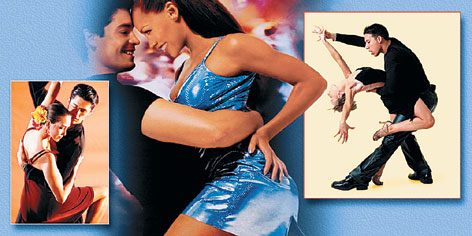
| Style and substance: Dancers execute intricate moves (below and far right); a still from Dance With Me |
Why dance when you can salsa? Hordes of urban Indian enthusiasts, who are shaking a leg ? la the Hollywood flick Dance With Me, would love to answer that question. Not necessarily in words. For in the salsa, it’s the body that does the talking. Remember Chayanne and Vanessa Williams and their unforgettable twists and turns on the floor?
If you are desperately seeking an excuse to justify dancing those nights guiltlessly away, the salsa is perhaps the perfect indulgence for you, because it is also the perfect exercise. ?It’s one of the best ways to keep yourself fit,? says instructor Kaytee Namgyal, on the sidelines of the first Indian Salsa Festival being held in New Delhi through the month. That holds true for all dance forms, but consider this. ?Even in aerobics, a dancer moves to about 160 beats per minute. Serious salsa could go up to 200 beats per minute,? says Namgyal. ?So if aerobics helps you burn calories, there’s no saying what the salsa can do for you.?
Several people seem to hear Namgyal on that one. Having started his Salsa India Dance Company in 2000 with barely six students, Namgyal today boasts of 300 salsa-dancer aspirants on his rolls. A resident of Delhi, he has six studios in the city that buzz with activity round the clock. ?A lot of people come to keep themselves in shape. And pick up one of the liveliest dances in due course of time,? smiles Namgyal.
In vogue all over the world for over five decades now, the dance form is greatly characterised by its fluid movements. Needless to say, it comes with its own nuances, most of which demand great physical attention. ?It’s like having each part of your body respond to a different instrument that plays on while you dance,? says Namgyal. ?So a lot of coordination is required to execute a single movement. It needs a lot of fitness, most of which is attained during the initial learning stages. After that, it only gets better.?
Reema Gidwani, who has been doing the salsa for two years now, agrees. ?Salsa makes you flexible by working your muscles,? she says. ?It may not be as vigorous as jazz or hip-hop, but it has its own complexities.? A teacher by profession, Gidwani feels one needs to practise the salsa at home every day, irrespective of how many formal classes one attends in a week. ?It may appear to be a smooth dance, but it is not easy,? she says.
So much for the body. But hold on, there’s more. If there’s any dance that works wonders for the mind, it’s the salsa ? or so its proponents insist. Ashwin Mushran, a Mumbai-based salsa instructor and actor, speaks of the difference it made to him. ?When I was first introduced to the dance, I was an introvert with few interactive skills,? Mushran recalls of his earlier days. Those were days when football made more sense to him. But it was salsa, he says, that helped him overcome social inhibitions. ?It made me confident enough to walk up to a lady and invite her to dance. Salsa changed the way I look at life,? reflects Mushran.
Clearly, if there’s an exercise that keeps both the head and the heart mint-fresh, it’s the salsa. And what’s better is that age is no bar when it comes to jiving. ?A lot of people I teach are in their 40s and come just to socialise and let their hair down,? says Mushran. ?One stands to get a lot out of salsa.?
Going by the popularity the salsa is fast gaining as a fitness-cum-destress medium, Latino magic is set to cast its spell on the masses like never before.
What it takes
 |
 Characterised by complex physical patterns, which need to be executed with style, salsa demands a great amount of dedication from its learners. A class typically begins with a warm-up session that lays stress on basic footwork, which forms the basis for the rest of the session. Proper hip movements are emphasised.
  |
A lot of sweat is generally shed in the first few classes! And one returns with a few sore muscles. But that only gets the learner in shape for the road ahead, and pays off when it comes to learning other forms like the rumba, cha-cha-cha or samba.
Learning the salsa is not a matter of days. While picking up the basics could take upto one month or more, intermediate learning could stretch to about six months. For those interested in advanced learning, there’s simply no end to it.
 |
The cost of learning the salsa could vary from reasonable to steep. While, in Delhi, Mushran charges anything from Rs 2,200-3,200 for 16 classes a month, a one-to-one special lesson with Mumbai’s Namgyal could cost a learner Rs 1,000 an hour. A minimum of 16 to 20 classes, instructors say, is required for one to pick up the fundamental aspects of salsa.
In the groove
 |
• Salsa is said to have originated from Cuba and mainland Latin America. In Spanish, salsa means sauce — in this case, flavour or spice of life. Salsa music was first aired on the radio in the 1950s, and established itself as a popular dance form in the Seventies.
• The groove for the salsa is generally a recurring eight-beat pattern, comprising two bars of four beats each. The steps go with the first three beats on each bar, the last being matched by a tap, click or flick.
• Current versions of the salsa borrow from several Latin American and African dance forms.
• Salsa is usually danced in pairs. Contrary to other traditional ballroom dances, the pair does not “walk” over the floor, but tends to occupy a fixed area.
• The parent form of salsa is the Cuban style, or an ‘on one’, characterised
by the second person mirroring the first’s steps.
• Salsa is generally danced with the partners holding hands. However, advanced forms include ‘shines’ or show-offs, which involve fancy footwork and body actions, danced in separation.