 |
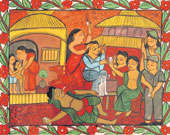
| Earth colours: A Village Drunkard’s Life, a patachitra by Swarno Chitrakar (Pic: Tapan Das) |
How traditional and contemporary Indian artists react to each other’s art and collaborate over joint projects was the enquiry of a workshop organised by CIMA earlier this summer. Another show, which was on till July 28, offered viewers a taste of this unusual creative interface.
What’s immediately apparent was the ambiguity of labels. For example, contemporary art bears the legacy of a tradition, too. That of an evolved complex of ideas and idioms, primarily Western mainstream, partly folk and tribal, and ultimately individualistic. On the other hand, the traditionalists are contemporary in time, but from rural backgrounds and have, in all probability, inherited rather than chosen their art which is practised within clearly defined parameters. Hence, the appetite of urban artists for promiscuous experimentation is alien to them. No doubt a symbiotic kinship between the two can only grow over time. But the dynamics of even a brief workshop alliance are worth exploring, as contrary artistic temperaments come together.
An artist who evokes interest is Rameshwar Karmakar for seeking to extend the dialect of dhokra with technical bravura. Going beyond the usual focus of the craft on human and animal forms, Karmakar’s wall plates ? episodic in their montage of images and epic in vision ? recounted the pageantry of life. On the other hand, his partner Gopinath Roy’s Landscape was a lesson in reticence. And it is this muted approach that dominated their joint sculpture Tsunami.
A spirit of amused sport buoyed the semi-abstract wall sculpture of Abhijit Gupta titled Baby Cyclops doing a Balancing Act, which built up a rhythm of vertical spaces enclosed by woo-den frames. His partner Shan-kar Das displayed what he had always been comfortable with: a carved head in wood. Their collaboration was a wry fusion of the contrary sensibilities as Ga-nesh was reduced to a stylised trunk resembling a table leg.
Pranab Bhaskar’s traditional wood carving of a village scene carried the period charm of litho prints in old books. But what turned out in partnership with Bimal Kundu rejected representation for an articulate geometry. Sribas Chandra Chand is a maker of little lacquer pieces. His forte quite seamlessly merged with Samir Aich’s fluent imagination in Where have all the Flowers Gone, which subverted a romantic symbol ? “shiuli” scattered on the ground ? by turning it into a political statement.
Popular culture engaged Manas Acharya and Subrata Sen who recreated a huge cinema poster of Mugal-e-Azam, complete with a line of tiny blinking bulbs. And Kartick Sutradhar joined forces with Hiran Mitra to make two impressive heads. Mitra himself experimented with paper pulp and contrasts of black and red offset by white.
One of the most striking examples of collaboration came from Swarno Chitrakar and Tapos Konar. The patachitra palette of radiant primaries, particularly red, was imported into their painting. But the earth colours of the village artist were replaced with acrylic while the figures, breezily stylised, bore the touch of both. Particularly noticeable in this context were Konar’s lithe, impromptu images on stretched leather that is made into village drums and lit from behind.