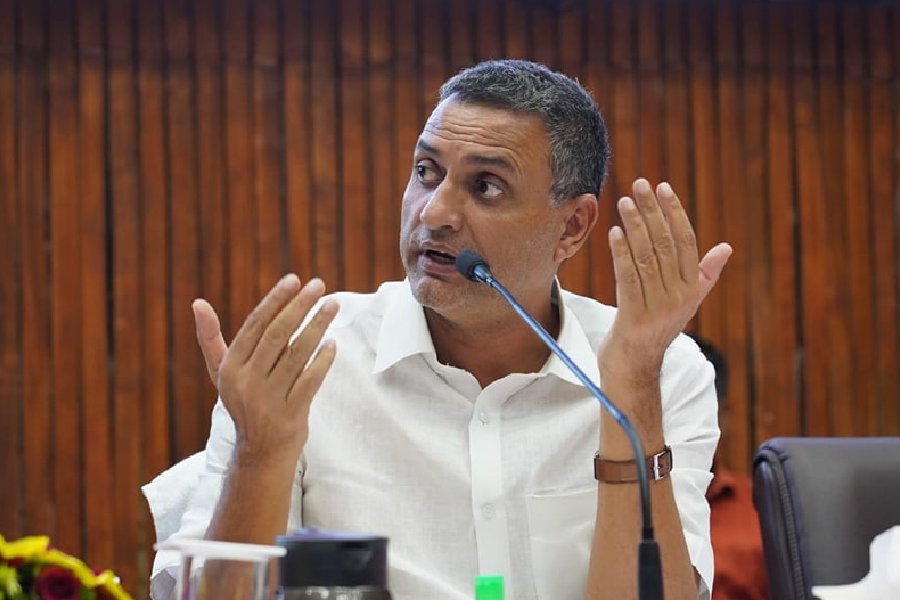
Over the past two and a half decades, Sunil Kumar Singh, now the additional collector of Ranchi, has established himself as an authority on land reforms and land revenue, having already authored six books on the subject.
Singh’s published works include Land Ownership in India, Dictionary of Land Revenue Terms in India, Compendium of Land Revenue Terms, Jharkhand 2002, Jharkhand 2003 and Land Revenue Laws in Jharkhand. His second book, Dictionary of Land Revenue Terms in India, has been published by the Lal Bahadur Shastri Academy of Administration, Mussourie, and has been prescribed as a “must read” for all IAS trainees.
Singh had cleared the allied services examinations in 1982. But family problems and father’s illness forced him to give up the prestigious job.
A 1978 batch Bihar public service commission officer, Singh was made the assistant settlement officer at Gaya in 1984 and two years later was shifted to Patna as town circle officer. He enrolled for a PhD at Bodh Gaya University and the Magadh University awarded him a doctorate degree for his work, Land Reforms in India.
He has served as a member of the Bihar fitment committee, as a Ranchi subdivisional officer and even as a faculty at the Administrative Training Institute, Ranchi. Following the creation of Jharkhand, Singh also served as a private secretary to former finance minister Mrigendra Pratap Singh.
Talking to Rudra Biswas in his office located off Kutchery Road, Singh recounts how he came to love the subject.
“It was during my posting at Gaya that I first came across numerous land revenue terms and the various Acts relating to land revenue. I tried my best to learn their meaning from dictionaries without any success. I found to my horror that apart from the meanings that have descended by word of mouth over the years, not a single term was included in any lexicon. The numerous land cases and the plight of the people further aroused my interests in land laws. That was the beginning,” he said.
What are the various types of lands existing in Jharkhand?
Broadly, there are two categories of lands in the state — those owned by the state and those possessed by private individuals. There are a long list of sub-categories — gairmajrua malik, gairmajrua aam, gairmajrua khas, kaiser-e-hind, lands acquired by the state and those donated to the state, brahmottar lands, bhuinhari, pahnai and mundari khuntkatti lands among others.
Compared to other states, Jharkhand and Bihar have the highest sub-categories of lands.
In addition, there are two tenancy laws in force in the state — the Chhotanagpur Tenancy Act (CNT) and the Santhal Parganas Tenancy Act (SPT). The former is quite moderate, the latter extremely stringent as far as land right transfers are concerned.
What problems do you encounter in land management given the numerous categories of lands and the existence of two tenancy Acts in one state?
The various categories of lands and the two tenancy Acts often pose a problem in equitable management of lands. The first land survey in Jharkhand region was conducted from 1902 to 1910.
The population and the pressure on lands have grown since then. Different procedures are laid down under the Acts for preparing the Record of Land Rights.
There is an urgent need to streamline and rationalise these procedures.
How much does the state collect from land revenues every year?
Collections from land revenue are low. In Ranchi, collections range from Rs 20 lakh to Rs 25 lakh per annum. The figures are quite low because the CNT Act does not contain any provision for fixing and collecting rents at commercial rates. Collection of rents from bhuinhari lands is vested with private individuals called bhuinharidars.
For mundari khuntkatti lands, collections are done by mundari khuntkattidars. The collection of rents is not vested on the state. Private collectors retain a portion of rents for themselves and deposit the balance to the state. As no commercial rents exist, the state only collects agriculture rent on all lands. In case the rules are revised, collections from Ranchi alone could go up to Rs 5 crore per annum.
The biggest problem in the state capital is encroachment. What action is being taken to stop steady encroachments on state-owned lands?
Once in a while, we carry out surveys, measure and demarcate state lands and conduct raids to drive out encroachers. Unfortunately, for the past 50 years, our manpower has not changed. Even undertaking land measurements and managing state assets have become a problem now.
Till date, the state has not been able to allot lands to the 45 plus entrepreneurs who have signed MoUs with the state. What action is being to speed up the process?
The department is trying to make the lands available for speedy industrialisation. Efforts are also on to set up land banks in the districts.
The state is also finalising its rehabilitation policy whereby people would know what they would get in case they opt to give lands to the state. But it is impossible to mop up all the needed lands through this process.