 |
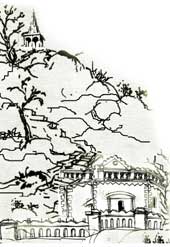
| A sketch of the Tagore Hills by artist Haren Thakur |
If for a few moments one is tempted to believe in what many have always believed, that it?s here under the meditation canopy atop the Tagore Hill that Rabindranath Tagore composed some of his poems which won him the Nobel prize, it?s understandable. Such is the beauty of the place.
But, the truth is that Rabindranath Tagore didn?t ever visit the hill and that is surprising considering this is just the kind of place he could have fallen in love with. More importantly it is surprising because it was here that his brother Jyotirindranath, his ?Nutanda? of whom he was extremely fond of, lived for many years, till his death in 1925.
While the more famous Tagore was composing works that won him world acclaim and was perhaps visualising his own Santiniketan, it was here that Jyotirindranath set up his more humble Shanti Dham and composed and painted his own dreams. His dreams may not have caught the world?s fancy like Rabindranath?s did, but they deserve attention nonetheless. His works overshadowed by his more illustrious brother, his association with Shanti Dham, too, had over the years almost faded from public memory, so much so that the hill came to be associated more with Rabindranath than him.
Neglected, the hill-top house had almost come to resemble a haunted manor. Not many people would visit it either, as it was not considered ?safe?. Had things remained so, it would indeed have been most unfair on the fifth son of Maharshi Debendranath Tagore. But now there have been changes.
New stairs lead up the hill, with places to rest in between, where aspiring poets and poetry-lovers can sit and muse on the beauty around, and perhaps feel the vibrations from the past inspiring them! A few kiosks have been made, where tea and snacks will be available. Just the perfect adda joint one can dream of. All this, because of the wise step the state culture department took when it came forward and entrusted the task of renovating the place to the India Tourism Development Corporation.
All those who have been giving the place a miss thinking it?s a haunted house, just retrace your steps and have a look at what Haren Thakur, a local artiste has done to create an ambience for the place.
On the walls of the place are terracotta tiles and murals, while concrete sculptures adorn the main entrance, with frescos bringing to life the ceilings of the small hall meant for cultural gatherings. To refresh the memories of those walking in, there are tablets with information about Jyotirindranath which have been put up.
While the house itself will be transformed into a museum depicting the artiste?s life, displaying his paintings, photographs ? some rare ones which have been collected from Santiniketan ? the culture department is also planning to construct an open-air theatre close to the hill where some government land is available. Just what the two poet brothers themselves would have wanted, considering that?s how Rabindranath modelled his own Santiniketan, with even classes being held in the open. Aware that plays are not going to be held everyday, at a recent meeting of departmental officials and cultural activists, a decision was taken to expand the scope of the theatre by holding various workshops and seminars there. Once complete, the place will be handed over to a recently formed board of trustee for managing it.
Many plans are still at the conceptual stage maybe, but already a lot of changes can be seen, and a number of families have been frequenting the place. ?Unlike before, we now feel safe coming here,? said Sanjeev Kumar, who had come there one Sunday afternoon. But it also makes sense to pay some heed to the words of people like Deepak Biswas, one of the visitors, who said : ?The place now looks too much cemented and the original beauty is being robbed.?
That?s not a fate one would wish on the place, which was chosen by Jyotirindranath for its immense beauty, and to which the poet?s family has long associations. A sibling of the poet laureate and the first Indian ICS, Satyendranath, used to visit Ranchi with his family. His daughter Indira Devi and her litterateur husband Pramatha Choudhury, who was famous by his pen name ?Birbal?, had even bought a house in the area. A niece of Rabindranath, Suprabha Devi, had also settled down here.
It was in the summer of 1908, when Jyotirindranath accompanied Satyendranath and his family on a visit, that he was taken in by the tranquil beauty of the hillock at Morabadi and its adjoining areas.
One gathers from his diary that he bought that place for Rs 4,700 and subsequently built his house, Shanti Dham, on the hillock. Initially known as Morabadi Hills, the name was changed to Tagore Hill in 1961. His descendants had sold the property on condition that something be done there in memory of the poet. A trust was formed, but not much done.
Gradually, over the years, memories began to fade, and the place fell into decay.
A pity, considering the heights he had touched with plays like Aleekbabu and others, and with translations of works like Shakunkula and Mrichchakatik as well as French works of Moliere.
Writing apart, he was an eminent painter of his time, and at the initiative of then British artist Rodenstein, a collection of his paintings was published in London in 1914. Like his brother, music was his passion, and he could play three instruments ? piano, violin and sitar.
Most interestingly, he also set to tune some of Rabindranath?s lyrics, who very strangely remained deprived of the beauty of the place, even as myths to his association with Tagore Hill grew.