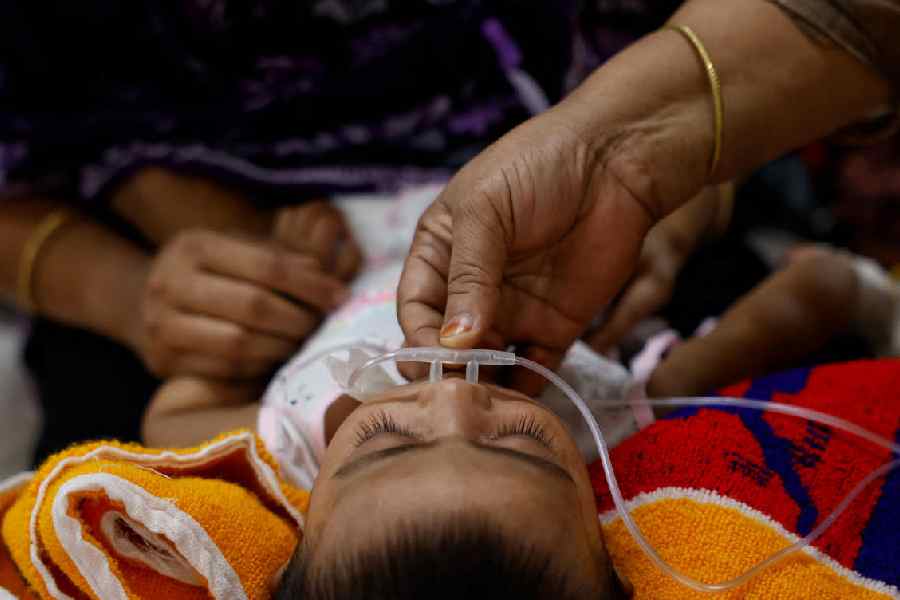
• Three days ago, a teacher of a reputable ICSE school had to arrange blood through replacement donation - a practice banned under Indian laws - for her father-in-law who underwent open-heart surgery at Medanta in Irba. This despite she having a voluntary donor card, which entitles her to one free unit of blood
• In February, Santevita Hospital had asked 70-year-old patient Herbert Toppo's family members to fetch blood "only from Apollo or Seva Sadan banks". When the family pleaded expenses, the hospital pressured his daughter Rishi to give a written undertaking that if anything happened to the patient, the hospital would not be responsible

These are not stray stories of harassment. Unscrupulous healthcare institutions are collectively drawing blood of the helpless in Ranchi. They are refusing affordable units from the model blood bank at RIMS and compelling vulnerable relatives of critically ill patients to either pay three times more for a drop of life or replace it.
In a 1996 directive, the Supreme Court had banned replacement donation for a patient in need of blood to stem malpractices such as improper screening and rise in the number of professional donors. Hence, blood stocked at licensed banks need to be collected only through voluntary donations. The National Blood Policy, 2002, which debuted after the apex court order, also banned commercialisation of the lifeline.
"All that is on pen and paper. The real world works differently," said the schoolteacher who has accused Medanta Abdur Razzaq Ansari Memorial Hospital (formerly Apollo) of refusing her a requisition slip so that she could get blood from the model bank at RIMS.
"I am a regular donor; but what is the use of volunteering when I don't get blood in my times of need? When I asked the hospital (Medanta) to give me a requisition letter for RIMS, it turned me down, saying I must buy blood from the bank they recommended or arrange for a donor. Luckily, we found a donor," she said, unwilling to be named.
At RIMS, a person with a donor card can get a free unit of blood while others can buy it for Rs 300. At blood banks patronised by private hospitals, the minimum rate per unit is Rs 1,000.
Atul Gera, a founder member of Live Savers that conducts blood donation camps for RIMS, said replacement donation was illegal in India. "Donating blood for money or being compelled to replace a unit of blood for a critically ill patient are banned under the country's laws. Blood is not a commodity, it can't be commercialised. Blood banks are no-profit, no-loss entities," he said.
Gera maintained that the national policy gave the nod to only voluntary camps held by Trusts and NGOs.
On July 4, Life Savers will host one such camp at Jharkhand High Court, which will be inaugurated by chief justice Virender Singh.
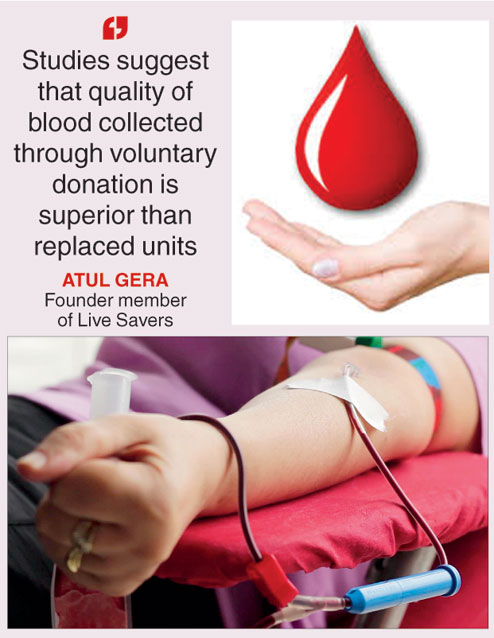
"When donation is voluntary, chances are higher that donors won't hide facts like alcoholism, medication and multiple relationships. Studies have suggested that the quality of blood collected through voluntary donation is superior and hence, less risky than replacement donation," he said, adding that almost all private hospitals in Ranchi had nexus with private blood banks to mint money.
Medical superintendent of Medanta Dr P.D. Sinha denied knowledge of the "unfortunate thing that happened" three days ago at his hospital.
"We allow blood from RIMS and Red Cross Society but not from any private bank. I will immediately issue an in-house circular on blood acceptance norms. We will also take action against those who forced the patient's kin to get replacement. It is illegal," he said.
Dr H.D. Sharan, medical director of Santevita, was candid. "We are not saying blood from RIMS is unsafe, but we have our own arrangements with Seva Sadan and Apollo. Besides, patients come here because they can afford quality healthcare," he said.
Taking cognisance of donation malpractices, former state drug controller B.L. Das had shot a letter to all health establishments last year asking them to mend ways.
S.K. Mondal, blood safety officer at Jharkhand State Aids Control Society (JSACS), said, three months ago, another similar communiqué was sent to hospitals, but in vain. "The government should review licences now. Replacement or forceful donation is becoming a menace," he said.
Have you been harassed by any hospital over blood? Tell ttkhand@abpmail.com