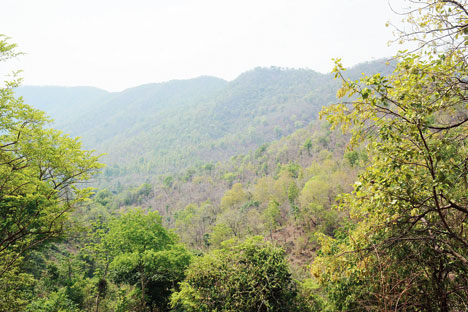

Jamshedpur: Conscious of Jharkhand's marginal 29sqkm growth in forest area between 2015 and 2017, as reported by the India State of Forest Report (ISFR) 2017 last week, state forest department is working on a two-pronged damage control measure.
On the one hand, the department will start custom plantation of species suited to a specific local forest area and on the other hand, involve nearby villagers through micro plans to set up contours and check dams to improve groundwater level and increase awareness on controlling forest fires so that saplings that were planted could survive and thrive.
"Plantation initiatives have to ensure the saplings flourish in the area. It calls for choosing species based on suitability and collaborations with local people," Jharkhand's principal chief conservator of forests (PCCF), Jharkhand, Sanjay Kumar said, adding the results of their efforts would be visible in the ISFR 2019. The report is released by the Union ministry of environment and forests every two years.
In the ISFR 2017, the state posted a marginal 29sqkm growth in forest areas between 2015 and 2017, merely 0.04 per cent of its total 79,716sqkm geographical area. Forest cover increased from 23,524sqkm (2015) to 23,553sqkm (2017), which is 29.55 per cent of the state's geographical area, significantly lower than the national forest policy mandate of 33 per cent.
Asked, PCCF Kumar, however, said Jharkhand's tree cover (in small patches) was 3.67 per cent as per ISFR 2017, and so the state's total forest and tree cover was 32.2 per cent of its total geographical area.
Sources said the forest department earlier used to undertake plantation exercises without putting much effort into whether the trees lived or not.
But, critics said juggling nu-mbers did not alter the reality of forests depleting due to mining and industrial activities.
Latehar-based Father George Monipalli, co-convener of Jharkhand Vanadhikar Manch, an NGO espousing forest conservation, said, "Plantation drives won't matter till the government stops giving forestland for mining and for industries."
According to the 2017 report, of the 23,553sqkm forest area, only 2,598sqkm is very dense forest (70 per cent and above density), 9,686sqkm is moderately dense (between 40 and 70 per cent) and 11,268 sqkm is open forest (10 to 40 per cent dense). Latehar, Lohardaga, Chatra, West Singhbhum and Gumla have dense forests, Deoghar, Jamtara and Dhanbad have the sparsest.
Among districts, Ranchi gained 10sqkm forest cover while Chatra lost 8sqkm.