 |
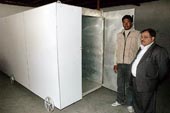
| The solar refrigerator at Kokar in Ranchi. Picture by Manik Bose |
Ranchi, Dec. 27: Here’s a product that could change the face of rural Jharkhand. A solar powered cold storage unit that’s come out of intellectual inputs of BIT, Mesra and the hands-on practical know-how of a successful entrepreneur.
Claiming that it’s a first, professor Arvind Kumar of BIT, Mesra ’s mechanical engineering department said the “invention” had the capacity to store five to seven tonnes of green and seasonal vegetables, fruits and other perishables, including life-saving drugs.
Designed and fabricated by Kokar industrial area-based P. L. & Grandsons, well known manufacturers of traditional electricity-run refrigerating units, the unit would be of special use in the hinterlands of the state since it does not need electricity to run.
“The photo-voltaic unit comprises solar plates of 3,000Watt power, batteries and a chilling machine,” explained professor Arvind Kumar of BIT, Mesra’s mechanical engineering department. “The minimum temperature attained during demonstrations is 2 degrees Celsius while the average temperature of the system revolves between 2 to 4 degrees Celsius, sufficient for safe storage of vegetables and fruits.”
Sudhir Agarwal, proud CEO of P. L. & Grandsons, had no qualms in suggesting it was a “big invention” as far as the general welfare of vegetable growers and medium and small entrepreneurs was concerned.
Jharkhand, which is self-sufficient in vegetable production, exported green and seasonal items to Calcutta, Orissa and Delhi. “But its farmers are always a deprived lot,” added Agarwal. For, seasonal items are sold at abysmally low rates in areas like the Mandar-Kanke-Pithoria belt (near Ranchi), Patamda (in East Singhbhum), Bhuiyandih (Near Tamar in Ranchi district) and the entire green belt of Hazaribagh and Ramgarh.
Kumar, who has been associated with various projects of JREDA (Jharkhand Renewable Energy Development Agency), made a strong pitch for his product. Speaking to The Telegraph, he said, “We have priced each unit at approximately Rs 19.5 lakh. Vegetable growers’ co-operatives with financial support from banks and NGO’s can easily buy it,” he said.
The life of the solar refrigerator, he claimed, was approximately 12 to 15 years with virtually no maintenance costs. As a stand-by option, double set-up batteries and a provision for attaching a bio-diesel generator was also being provided.
BIT, Mesra vice-chancellor S. K. Mukherjee praised the mechanical engineering department’s efforts. “They have made themselves proud through this rare achievement. Now, I wish the technology gets transferred for the real benefit of farmers,” he said.