|
 |
 |
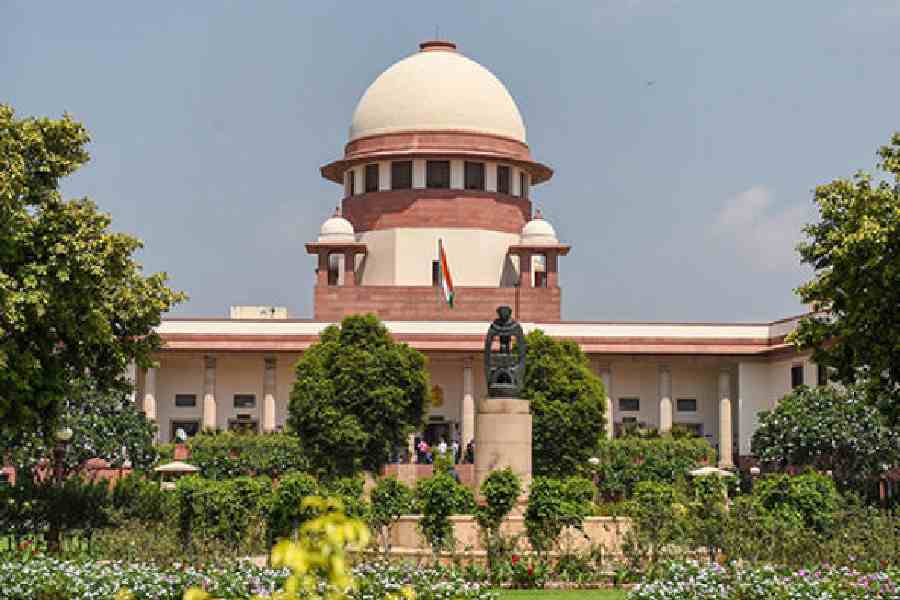
| (From top) Renovation work underway at Laxmi Niwas on Kanke Road in Ranchi on Thursday. Pictures by Hardeep Singh |
If everything goes according to plan, the historical Laxmi Niwas on Kanke Road in Ranchi will be ready in its new avatar by December.
The more than a century old red brick edifice had hit the renovation road in May last year at an estimated cost of around Rs 2.5 crore, which is being borne by the agriculture department that owns the facility. Once ready, the double-storeyed heritage building — sprawling over 10,000sqft — will host an agriculture resource centre-cum-museum, conceptualised to draw heavy researcher and tourist footfall.
Situated inside the agriculture department’s office premises, Laxmi Niwas was once owned by a zamindar of Bengal before it was taken over by the Bihar government in 1970. It became an integral part of Jharkhand after the state was born in 2000.
“The bungalow will be the cynosure for tourists from both the capital city and outside,” said S.D. Singh, the former convener of Intach, who is currently overseeing renovation work in partnership with Indo-German agency Knospe & Co. and Polish conservation experts Miriam M. Owsinski and Renata Bronka.
Elaborating on what all was left to be done at the bungalow, Singh said internal plastering, fixing of new windows and floor finishing would be completed by the end of the year. “We could have done all this much earlier, but work was affected for sometime owing to delay in funds release. However, things have been sorted now,” he said.
He added that cleaning the premises, including removing weeds, was a tricky task. “The building was in a shambles. The biggest challenge was to carefully clear deep-rooted undergrowth without damaging the structure itself. Also, our focus was not to change the original brick façade, which is rare in today’s time. Once ready, Laxmi Niwas will be a visual treat for old-timers and history scholars.”
Singh confirmed that they were eyeing December completion of the flagship project, the success of which might further set the tone for renovation of other structures of historical importance in and around Ranchi that are, currently, rotting in neglect.
For instance, two prominent heritage sites — Pithoria Mosque and Tagore Garden — have long been crying for attention, but in vain. The 20ft by 20ft mosque on the outskirts of Ranchi dates back to the 16th Century, during the reign of Sher Shah Suri who defeated Humayun to take over the Mughal empire for a brief period.
Situated in the heart of the capital, Tagore Hill was named after Jyotindranath Tagore, a playwright, musician and painter, and elder brother of Nobel laureate Rabindranath Tagore.
Jyotindranath had settled at this pristine spot for his literary pursuits. He is said to have translated Bal Gangadhar Tilak’s Srimad Bhagawad Gita Rahasya in Bengali at this very place. However, Tagore Hill today is the favourite haunt of hoodlums, courtesy government lethargy in conservation.
Intach convener Singh, who is also working on restoration of another heritage building in Patna, Bihar, where Gandhiji camped for 66 days just before Partition, admitted Jharkhand’s notoriety in neglecting places of historical significance. But, he hopes, Laxmi Niwas will open the door for more conservation projects.
Do you think Laxmi Niwas will be completed on time? Tell ttkhand@abpmail.com