
Manika (Latehar), Dec. 3: Having grown up amid sounds of gunfire and landmine blasts, Pratima Kumari, a 15-year-old village girl of rebel-hit Latehar district, giggles a lot to mask her ingrained fear of strangers.
Coming home from school with friends Sheela, Pravina, Patika, Sangeeta, all clad in regulation salwar-kameez uniforms, Pratima mumbles inaudible replies when asked by The Telegraph team about herself, her school, village and her family members.
The only time the student of the state-run high school in Manika, a block 30km from district headquarters, answers firmly is when asked what her future plans are.
" Padhna hai, matric pass karna hai, college padhna hai, graduate banna hai aur naukri karna hai (I have to study, pass matriculation, go to college and graduate to get a job)," the girl says, one line coming out like an arrow.
But, asked what job, the girl again bows her head and fidgets, looks at her friends for help.
Clearly, the first-generation learners from some of Latehar's remotest villages, such as Katia, Nawadih, Humamara, Yamuna and Hosi, which have neither roads nor electricity, don't know about their possible careers. Nor do their parents and elders, who voted in the second phase of panchayat polls on November 28.
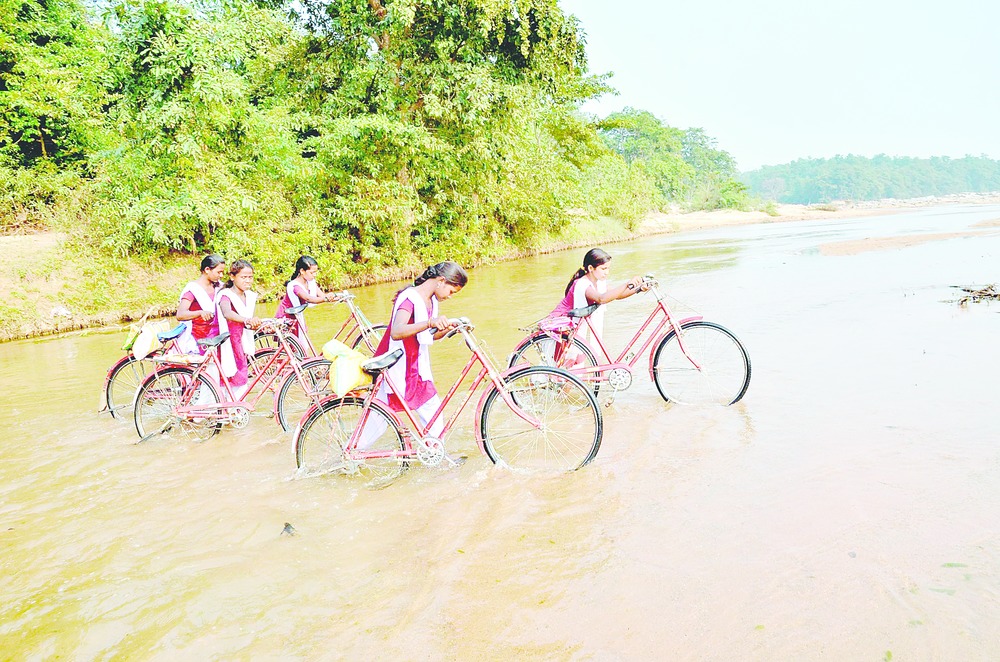
But, the teenaged girls know they must go to school, even if it means pedalling 15-20km a day and hitching up salwars to their knees and lugging cycles, which, incidentally, they got from the state government as Class VIII students, to cross Auranga river and reach school.
The river has no bridge or culvert. Don't they fear slipping and hurting themselves or getting swept away? A further ground of giggles ensues. When it's a choice between crossing a river to go to school and sitting at home, it's no choice.
Near Auranga, a man lugging a gunny bag of ration on his bike stops and interrupts the conversation. Identifying himself as Rajendra Ram, a teacher at an upgraded middle school in Humamara village and resident of Nawadih, he said: "These girls from Latehar's remotest villages are incarnations of Durga and Kali. It is for them that education for girls is flourishing in rural Latehar."
He explained why. "In the monsoon, when the river swells up and can't be crossed on foot, these girls walk to the nearest Kumandih station, take a train to Latehar and then a bus to Manika. It takes Rs 80 to Rs 100 per day for this commute, not to speak of the six or more hours spent in travel."
And, then the schoolteacher added: "These are all poor girls. So, for this extra expense during monsoon in Classes IX and X, they tell their parents not to buy them new clothes and shoes. They save money round the year so that they can commute to school by train and bus during monsoon."
Some girls, not all, with the means and permission of parents, form groups and rent rooms in Latehar to stay the monsoon. Most travel back and forth everyday.
Ram said that boys in this traditional Maoist hotbed, where rebels target policemen, CRPF jawans and train tracks, were not as focused about studies as the girls. "Boys have a more laidback approach, they go their own ways. These girls help their mothers in household chores, look after their younger siblings and yet find time to go to school daily."
But, it is not just the girls, the district has also changed for the better at least in a few ways. "Our girls feel safer now," said a married woman in Katia who declined to name herself. "Back in our day, we also wanted to study but party wallahs (Maoist rebels) virtually had their permanent base camp in this area till two-three years back. After a police picket came up in Kumandih (near railway tracks), things started changing gradually and more and more girls started feeling safer to pursue high school," she said.
Latehar DC Balmukund Jha praised the students. He also asked people to look forward to better infrastructure. "The state has sanctioned 24 roads for Latehar. The district will also get around 400 schoolteachers in a couple of months for which recruitment is on," he said.
There doesn't seem to be any plans for a bridge over Auranga for the time being though. But, it doesn't faze the girls.