

with wife, Rosa
The cardboard box ar-rived at the desk of Geraldine Forbes almost by happenstance 40 years ago. It was from John Fuller, professor of photography at the State University of New York at Oswego, United States, where Forbes is professor emeritus in the department of History. Fuller had received the box from an antique dealer as partial payment for some photographs.
Forbes, who is visiting Calcutta, tells us, "The box contained a bewildering mix of glass plate negatives, lanternslides, negatives taped to glass, and ordinary negatives."
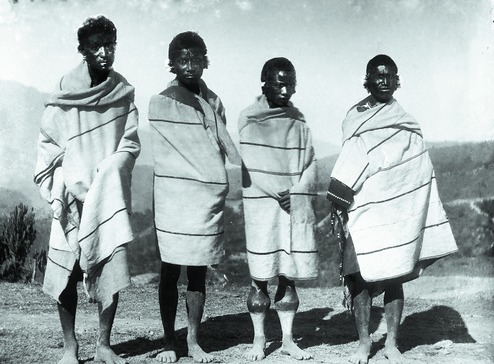
Once developed, they turned out to be photographs of India. Of the Himalayas, elephants, missionaries and their children, and natives before and after missionary intervention.
They belonged to one Samuel Alden Perrine, who arrived in Nagaland in northeastern India in 1892 as a Baptist missionary. Perrine stayed there, travelled the length and breadth of the Northeast and returned to the United States in 1906.
Last month, Forbes showed a few of these photographs at a talk, "God and a Camera: An American Baptist Missionary in the Naga Hills", hosted by the United States-India Educational Foundation in Calcutta.
After years of searching for material on Perrine - this included a study of genealogies in the Library of Congress, US - Forbes discovered in 2009 that Perrine's grandson, Robert, lived only five miles from her home in central New York.
Perrine had been an amateur photographer who clicked several pictures to document his work and travels in the Northeast. Forbes says, "His photographs were some of the first on northeastern India to appear in the Baptist Missionary Magazine and were used in his own book, Under the Roof of the World, and in books by other missionaries."
Forbes has been using photographs as documents to write about the history of colonial India for decades. In an earlier study, she recreated the socio-political context of women here in the 1920s and 1930s based on old family photographs.
She tells us how after he retired from his job as a missionary in India, and later as a pastor in New Jersey, Perrine pursued a career as a public speaker. "Perrine used visual imagery as a tool of persuasion in his two careers - missionary and public lecturer." Each of the Perrine Lectures - that's what his talks were called - was illustrated with "projected coloured plates". One flyer read: "Ten years Among the Wild Head-Hunters". Other lectures were more or less variations of this theme. Forbes tells us that Perrine's audience would be entertained and leave the lecture enlightened by an India expert who had experienced the country and survived "bloodthirsty savages" [Perrine's words] of the far east.
American Baptist missionaries first made contact with the Naga hill tribes in 1837. Working in the Northeast in those days involved extreme hardships. The terrain was inhospitable and the warrior tribes, with their distinct cultures, resisted the attempts of missionaries to convert them to an alien faith.
The low rate of conversion did not impress the Home Board of Baptist Missions in the US that funded missionary activities in India. Things got worse when there was a split between the northern and southern Baptists in 1845, and the subsequent outbreak of the American Civil War in 1861. The economic dislocation meant there was less interest and funds for overseas missionary activity.
A decade later, the Board's views changed when missionaries had some success in the conversion of the tribes in the Garo Hills and erstwhile Burma, areas not very far from the Naga hills. The renewed interest of the Board coincided with the extension of British control over the tribes. In order to protect the tea plantations and gain access to the natural resources of the hills of the Northeast, the British quelled the Naga resistance and annexed large tracts of the Naga territory.
By 1872, Reverend Dr E.W. Clark, a missionary from Boston, arrived in Nagaland along with his wife, Mary Mead. By 1885, it was said of them that they were living like natives. The Clark couple had picked up local languages (Ao, Naga and Assamese), put up in a Naga-style house and established a rapport with the locals. They set up schools and churches in many villages and were able to convert a number of tribals to Christianity.
Perrine arrived on the scene - in Molung, a village and the centre of Baptist missions in Nagaland - with his wife, Rosa, in 1892. He writes about how he was "shocked by wickedness, wretchedness and heathenism" among the tribes, but was convinced that he had made the right choice. The Perrines were not happy with their accommodations and the hardships that life in Molung entailed. Perrine himself was also not happy about Clark's converts who continued with "their old customs such as opium-eating, smoking, drinking of rice beer and other non-Christian habits". Soon Perrine found a supporter in fellow missionary Fred Haggard.
Perrine and Haggard pitted themselves against Clark. The duo disbanded the Molung church and expelled all its members. They called for the imposition of strict temperance and tribals were told to obey the rules laid down for Christians. Also, Haggard and Perrine moved to an uninhabited site called Impur further north, and built bungalows. Perrine set up an English Language training school to educate the tribal children.
Perrine realised the importance of projecting his achievements to the Board to garner support and funds. To promote this work, he wrote reports and articles and also took photographs to be published in the Baptist Missionary Magazine and other publications on missionary activity.
Perrine pronounced the region "the most manly and virile missionary ground in the [British] Empire". He also proclaimed the Nagas of the hinterland, manly men who were "equal, if not superior to the average American Christian". Says Forbes, "Perrine's writings about the Nagas presented them to his American audience as "more manly" than other subjects of missionary attention. Naga warriors, he argued, were like the Anglo-Saxons of Europe - strong, brave, and destined for greatness."
All this created a positive image of missionary work to American youth who viewed the field as an attractive career option, not only to prove their dedication to Christ but also for some adventure.
Forbes has made one trip to Nagaland to trace the footsteps of Perrine and Clark, but has not been able to visit the place where they worked. She tells The Telegraph, "The school Perrine established in Impur (now called Clark Memorial Higher Secondary School), still exists. Reverend Clark, whom Perrine and Haggard criticised for his failure to impose strict temperance, is the missionary most remembered by the Ao Nagas. Perrine (and Haggard who spent even less time) is seldom mentioned in the histories of the region. I think this has a lot to do with the fact that he left in 1905 and other people took over the school."
According to the last Census, Christians comprise 90 per cent of Nagaland's population. Says Forbes, "Nagas converted Nagas. Clark, Perrine, Haggard were American Baptists and at this point, it is estimated 80 per cent of Nagas are Baptists. So, the Baptists definitely left their mark, but Nagas have also made Christianity their religion."
As a missionary, Perrine wrote and presented his side of the story of a people undergoing change. However, after retirement from missionary work, he constructed a narrative that abandoned history to focus on the heroic white man navigating a chaotic world. He portrayed the Naga hills as the new frontier to be conquered and to prove one's masculinity.
Says Forbes, "I am most concerned here with photographs as documents of history. As is evident from this example, photographs can generate different stories about the same events. In this case, the same photographs were used in the service of a missionary project and to entertain. Both are renditions of historical facts differently considered and interpreted."
Simply put, photographs don't tell the whole story. Not then, not now.