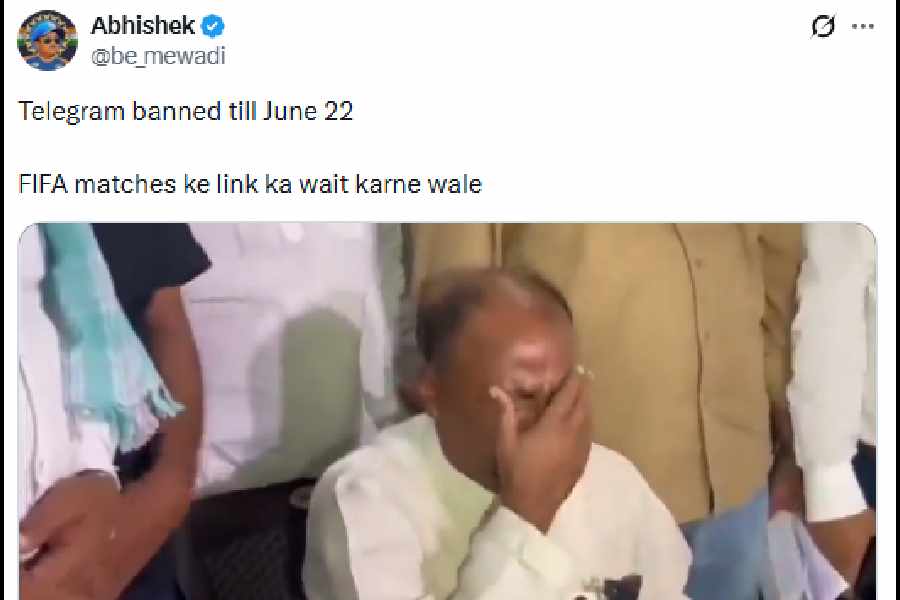
The Centre on Tuesday blocked messaging app Telegram in India till June 22 amid rumours of paper leaks in the run-up to the June 21 NEET-UG medical entrance retest.
The May 3 NEET, which 22 lakh students had taken, was cancelled following a paper leak, with some question setters in custody.
Google has removed Telegram from Play Store in compliance with the government order. Apple is likely to follow suit, sources said.
Welcoming the blocking of Telegram, the National Testing Agency (NTA), which conducts the NEET, said the action was “in response to the organised use of the platform by cheating rackets to defraud candidates appearing for the National Eligibility cum Entrance Test 2026 re-examination scheduled on 21 June 2026”.
Two persons were arrested in Ahmedabad on Monday on the charge of operating an interstate gang that collected money from students and parents by falsely claiming to share on Telegram question papers before the July 21 retest.
Critics slammed the government’s decision on Telegram, saying it had merely offered a “band-aid solution” rather than cracking down on the sources of possible leaks and addressing the larger issue of exam fraud. Opposition parties led by Rahul Gandhi, and also the satirical platform Cockroach Janata Party, have demanded education minister Dharmendra Pradhan’s resignation over the large-scale irregularities in the
exam process.
According to an NTA statement, the ministry of electronics and information technology had acted on recommendations from the agency to direct the temporary bar on access to Telegram in India until June 22. The government has also instructed the platform to disable its message-editing feature in India until June 30.
The NTA said Telegram’s message-editing feature had allegedly been used to create misleading “paper leak” evidence after exams.
According to the NTA, channel administrators can edit older posts and replace attachments with question papers after an exam has concluded while retaining the original timestamp. Such altered posts had earlier been circulated as “proof” of question paper leaks. Sources said disabling the feature temporarily would help prevent the creation and spread of such fabricated evidence during the post-exam period.
Telegram is owned by Russian-born tech billionaire Pavel Durov and claims to have more than 1 billion monthly active users globally. Sources said Telegram focuses more on anonymity, unlike WhatsApp. When a person creates a profile on Telegram, they can hide their phone number from other users and use the app just through a username. It is easy to create a Telegram channel that can have unlimited subscribers, while keeping the user identity anonymous.
Durov posted on X: “India’s IT ministry banned Telegram for one week because some users shared leaked exam questions. This punishes 150M+ ordinary Telegram users in India — not the insiders who leaked the exam materials. And the ban hasn’t stopped anything. The leaks just moved to other apps.”
The Telegram action adheres to a provision of the IT law that allows the government to block access toonline sites in the “interest of the sovereignty and integrity of India.”
The NTA said the restriction was “a measure of last resort, taken only after intermediate remedies, including the take-down action coordinated by I4C (Indian Cybercrime Coordination Centre), had been pursued and had not produced, at the platform level, the response required to protect candidates in the run-up to the examination”.
Channels on Telegram have been operating under names like- “PAPER LEAKED NEET”, “Re-NEET 2026”, “Private Mafia”, “REE NEET MAFIAA”. These channels have “demanded sums ranging from a few thousand to several lakhs of rupees from candidates and their families, in exchange for purported access to the re-examination paper”, the NTA statement said, adding that such promises were “in every instance, a fraud”.
The NTA categorically stated that no question paper exists outside the secured examination chain, and that every such promise is, without exception, a fraud designed to extort money from anxious aspirants.
Congress president Mallikarjun Kharge accused the government of having completely failed the test of accountability by not asking education minister Pradhan to step down following repeated irregularities related to exams.
He also criticised the government for putting curbs on Telegram. “The Modi government has temporarily blocked Telegram for the NEET exam re-test. Modi ji should first demand the resignation of his education minister Dharmendra Pradhan, who has blocked the futures of millions of youth,” Kharge posted on X.
An activist group said the restrictions were an infringement of free speech that would not solve the problem.
“Shutting down Telegram is a band-aid solution and is a disproportionate answer to exam fraud,” the Internet Freedom Foundation said. The measure, it said, would “punish ordinary users instead of addressing the systemic source of exam leaks”.
“If a paper has to be leaked, there are countless ways for it to happen. Banning Telegram is not a solution. Question papers can be shared in person, through private groups, phone calls, screenshots, or any number of other channels. The real issue isn’t the platform, it’s the failure to secure the examination process,” said Ratna Singh, a social media user.
The problem, she said, lies with those running the scams and the loopholes that enable them, not merely the medium being used. “If fraudsters are determined, they will simply move to another platform or another method. The solution is stronger safeguards, better enforcement, and accountability, not scapegoating one app.”