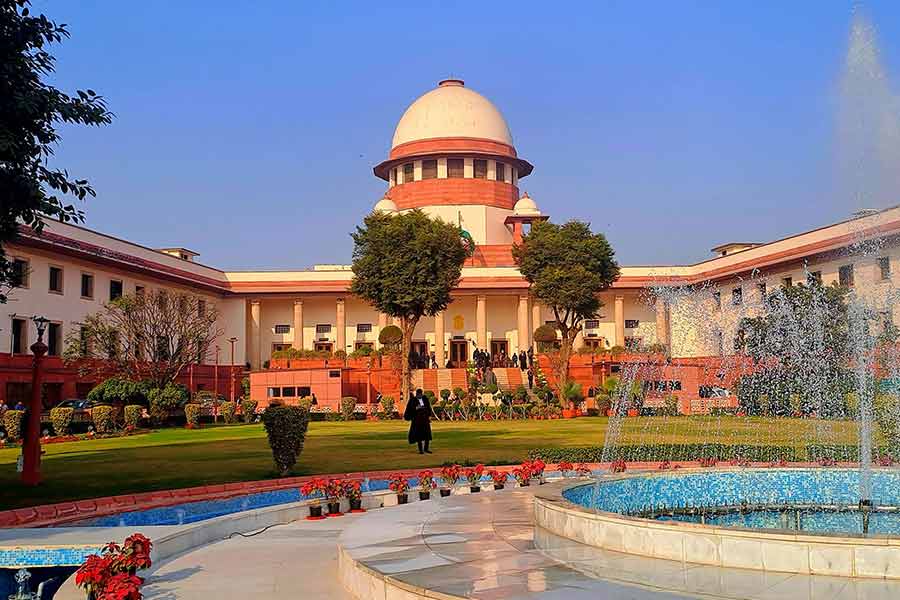
The Supreme Court has held that passport renewals cannot be denied to people facing criminal cases because any restriction on foreign travel can be imposed only by courts.
“Liberty, in our constitutional scheme, is not a gift of the State but its first obligation. The freedom of a citizen to move, to travel, to pursue livelihood and opportunity, subject to law, is an essential part of the guarantee under Article 21 of the Constitution,” the apex court observed.
A bench of Justices Vikram Nath and Augustine George Masih passed the judgment while allowing the appeal filed by Mahesh Kumar Agarwal challenging the concurrent findings of a single judge and a division bench of Calcutta High Court. The high court had refused to direct the renewal of his passport on the ground that he was facing a criminal case before an NIA court for offences under the Unlawful Activities (Prevention) Act, the IPC and other provisions.
Agarwal had contended that the high court’s order came despite the NIA court in Ranchi and Delhi High Court permitting him to travel abroad, subject to certain conditions to secure his presence during the trial.
Aggrieved, he had filed the current appeal in the top court.
“It is important to keep distinct the possession of a valid passport and the act of travelling abroad. A passport is a civil document that enables its holder to seek a visa and, subject to other laws and orders, to cross international borders. Whether a person who is on bail or facing trial may actually leave the country is a matter for the criminal court, which can grant or withhold permission, impose conditions, insist on undertakings, or refuse leave altogether. In the present case, both criminal courts have done exactly that,” Justice Nath, who authored the judgment, said.
“To refuse renewal on the speculative apprehension that the appellant might misuse the passport is, in effect, to second-guess the criminal courts’ assessment of risk and to assume for the passport authority a supervisory role which the statute does not envisage,” he added.
The apex court said Section 6(2)(f) of the Passports Act empowered the authorities to withhold permission for the issue or renewal of a passport to a person facing a criminal case in any court. However, if a jurisdictional court permits such a person to travel, the passport must be issued, and the embargo on the renewal under Section 6(2)(f) will not apply.