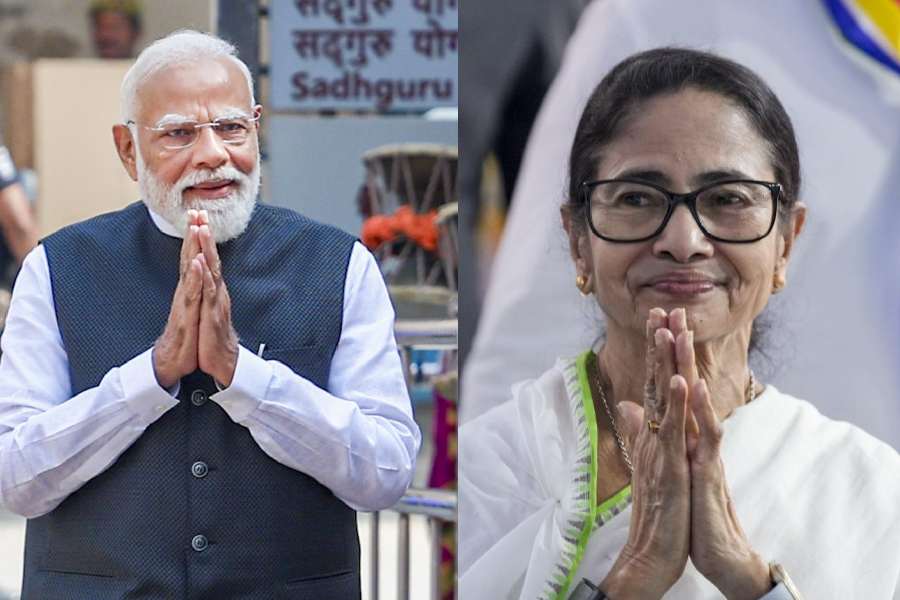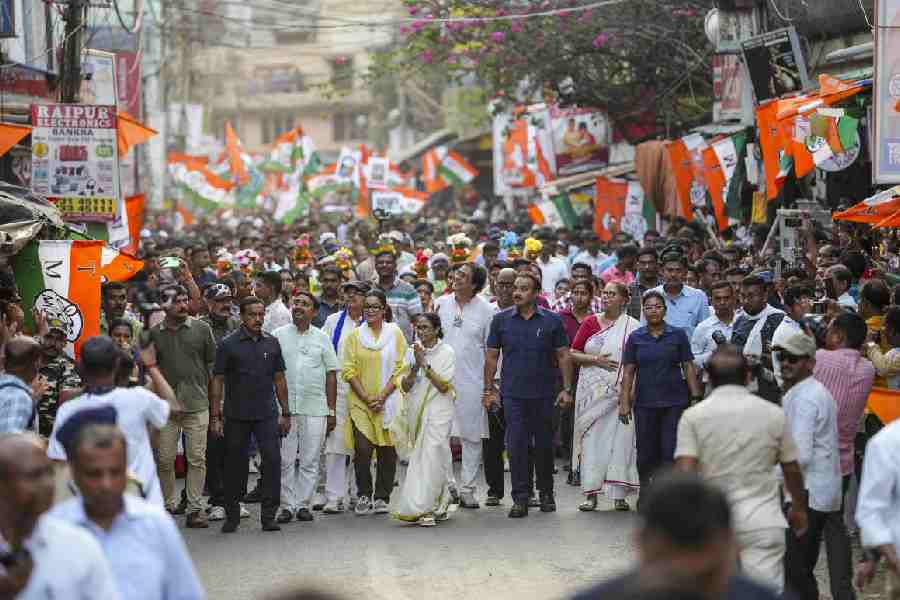
The Supreme Court, hearing the ED’s appeal against Mamata Banerjee and police bureaucrats for interrupting raids on I-PAC premises on January 8, said on Wednesday that a chief minister cannot “obstruct” an inquiry and “put democracy in peril”.
The court also referred to the hostage situation in Malda involving judicial officers on SIR duty earlier this month, noting that such incidents of lawlessness were not uncommon in the state.
Referring to the I-PAC incident, a bench of Justice Prashant Kumar Mishra and Justice N.V. Anjaria said in response to arguments advanced by senior advocate Menaka Guruswamy, appearing for some police officers from Bengal: “We don’t agree with you. This is not a dispute between the state and the central government. You cannot walk in like that and obstruct the inquiry.
“A chief minister of any state cannot walk in in the midst of an investigation, put democracy in peril and then say, convert this into a dispute between the state and the Union. This is per se an act committed by an individual who happens to be the chief minister, putting the whole democratic process in jeopardy.”
The bench was dealing with a petition filed by the ED seeking a CBI probe and the registration of criminal cases for theft, dacoity and other offences against Mamata and several police officers who the central agency accused of forcibly entering the I-PAC premises during the raids relating to alleged money-laundering offences linked to a “coal scam”.
The Bengal government has challenged the maintainability of the ED petition under Article 32 of the Constitution, which gives every citizen the fundamental right to move the Supreme Court for the enforcement of their rights that may have been violated by the State.
The Bengal government had contended that the ED’s petition was not maintainable on technical grounds as the probe agency was not a “citizen” and the only remedy for it was to move an appeal under Article 131, which empowers the top court to deal with disputes between the Centre and the states or between states.
Justice Mishra, heading the bench, said: “…The chief minister of a state walks in in the midst of an inquiry or an investigation and you say that it is a dispute essentially between the state and the central government? You are saying if at all this can be maintainable; this cannot be maintained under Article 32 but only under Article 131.”
“You have taken us through Kesavananda Bharati, Seervai and other judgments…. But none of them would have ever conceived of this situation at that time that in this country a day will come when a sitting chief minister will walk into the office of some other agency,” Justice Mishra told Guruswamy, adding that the framers of the Constitution too would not have envisaged such a situation.
The bench also refused to buy the argument of senior advocate Sidharth Luthra, appearing for the Bengal government, that the ED should have filed a complaint before a magistrate, as envisaged under BNSS Section 223, instead of approaching the Supreme Court
“Here we are dealing with an extraordinary situation. Before the other bench where the SIR is under question, we have seen the situation that several judicial officers had been kept hostage and still you want the petitioner to have gone to a magistrate? We cannot shut our eyes to the reality of what’s happening. We cannot lose sight of the practical situation which is present in the state. Don’t compel us to make observations,” the court said.
It remarked that the dispute was not a petty suit between some “Ram vs Shyam”.
Senior advocate Abhishek Manu Singhvi, appearing for the Bengal director-general of police, also argued that the ED cannot move a petition under Article 32 and cited several earlier Supreme Court judgments, including those delivered by constitution benches, wherein it was held that corporations and government departments were not citizens and therefore could not claim the enforcement of the fundamental rights available to the people.
The arguments will continue on Thursday.