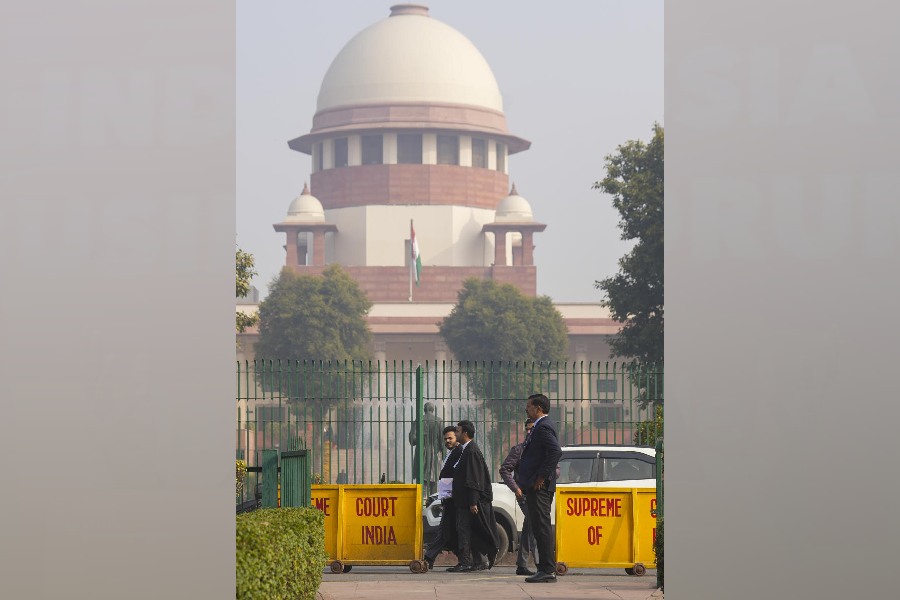
The Supreme Court on Monday put a stark number to India’s growing cybercrime problem: more than Rs 54,000 crore siphoned off through digital frauds.
Calling it absolute “robbery or dacoity”, the court said the scale of the crime now exceeds the budgets of several small states and needs an urgent, coordinated response from the Centre, regulators and enforcement agencies.
A bench comprising Chief Justice of India Surya Kant and Justices Joymalya Bagchi and N. V. Anjaria asked the Centre to draft a standard operating procedure in consultation with the Reserve Bank of India (RBI), banks and the Department of Telecommunications (DoT) to deal with digital fraud cases.

The court said the existing response has been fragmented and slow, allowing cyber criminals to move money across accounts before any effective action is taken.
The bench noted that such offences may be caused either by collusion or negligence on the part of bank officials and stressed the need for timely intervention by banks and the RBI.
It pointed out that delays in freezing accounts often make recovery impossible, leaving victims with little recourse.
Issuing a series of fresh directions, the court asked the Ministry of Home Affairs to examine the RBI’s existing SOP and similar SOPs or decisions of the DoT, and prepare a draft memorandum of understanding within four weeks to deal with these offences in a coordinated manner.
The bench also recorded that the RBI has already crafted an SOP prescribing action by banks, including temporarily holding debit cards, to prevent cyber-enabled fraud.
It, however, indicated that the measures on paper must translate into quick action on the ground.
In a significant push to ongoing investigations, the court directed the Central Bureau of Investigation to identify digital arrest cases and asked the Gujarat and Delhi governments to grant sanction to the agency to proceed with probes in the cases identified.
The Supreme Court further asked the RBI, the DoT and other stakeholders to hold a joint meeting to work out a framework for compensation in digital arrest cases.
It said a pragmatic and liberal approach is required while awarding compensation to victims and listed the matter for further hearing after four weeks. Authorities have been asked to file fresh status reports before the next date.
The court’s concern over digital arrest frauds is not new.
On December 16, it asked the Centre to examine suggestions made by the amicus curiae on ensuring compensation for victims, while flagging the enormous sums being siphoned out of the country by cyber criminals.
Earlier, on December 1, the top court ordered a unified pan-India probe by the CBI into digital arrest cases and questioned the RBI on why artificial intelligence was not being used to trace and freeze bank accounts linked to cyber fraud networks.