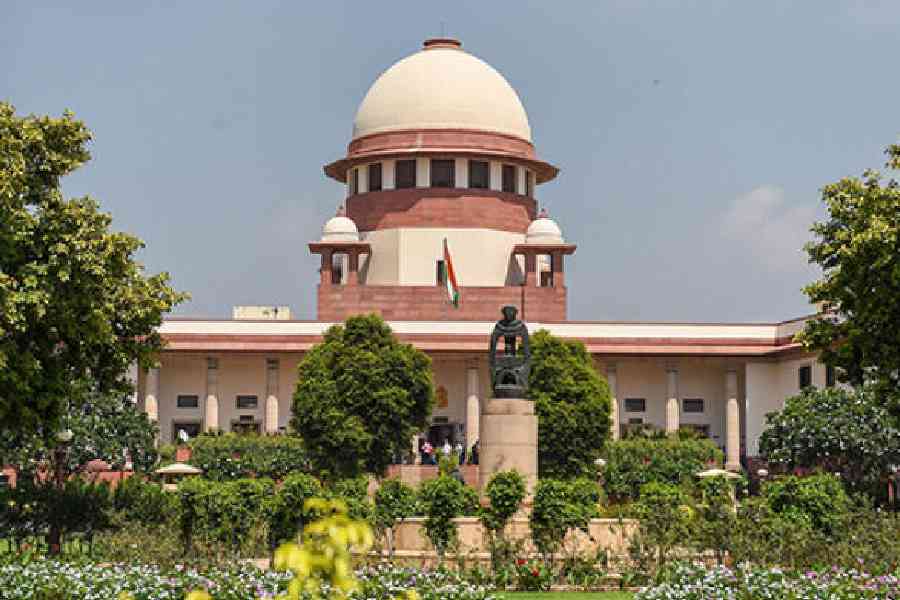
The Supreme Court on Thursday refused to entertain a petition seeking minimum wages for domestic workers, saying an order mandating such payment could lead to every household in the country being dragged into litigation.
The court also felt that such a directive could end up dissuading people from hiring domestic help, leading to more unemployment.
The bench of Chief Justice Surya Kant and Justice Joymalya Bagchi observed that many industrial units in the country had had to be closed down over the years because of trade unionism.
It said an employment agency that used to supply workers to the Supreme Court exploited them by taking away a chunk of their payment as commission.
“Every household in the country will be dragged into litigation once minimum wages are fixed. People will refuse to hire,” CJI Surya Kant said.
“Tell me, how many industries have been able to hire successfully with the help of these trade unions?” he asked senior advocate Raju Ramachandran, appearing for petitioner Penn Thozhilalargal Sangam, an organisation espousing the cause of unorganised workers.
“When minimum wages are enforced, unions will ensure that every household is dragged into litigation.”
Justice Kant narrated an instance of an employment agency exploiting the workers it sent to the Supreme Court.
“The Supreme Court was paying an agency for skilled workers and we were paying ₹40,000 per worker, but the poor girls got only ₹19,000 each,” he said. “This is how trust is broken.”
The bench observed: “Millions engage domestic workers. If they are engaged through these agencies, imagine what will happen.”
The court, however, acknowledged that unorganised workers faced exploitation and said they should be made aware of their rights. It said it was for the legislature to take a policy decision to mitigate the hardships of such
workers.
Courts cannot issue directions, orders or decrees that are unenforceable and such decisions must be taken by the states, the bench said, suggesting that the petitioner approach the authorities concerned.
“You know how many industrial units have been closed down in the country thanks to the trade unions? Let us accept reality,” Justice Kant said.
“All traditional industries in the country have been closed down because of these jhanda trade unions. They don’t want to work. These trade unions are largely responsible for stopping industrial growth in the country.”
Justice Bagchi underlined that the Unorganised Workers Social Security Act addresses the grievances of such workers.