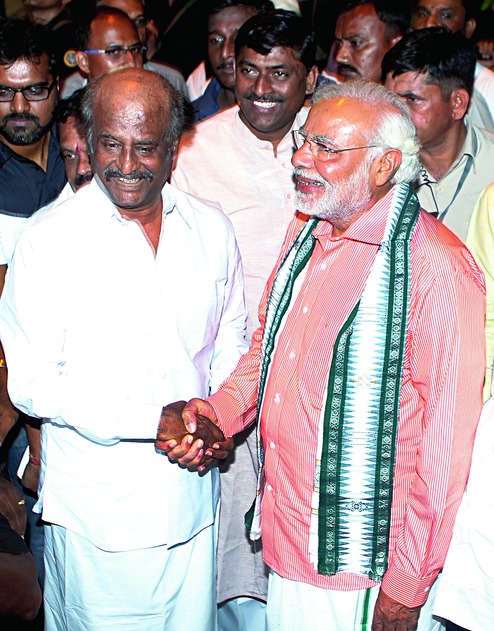


The master campaigner was in his elements. Addressing a rally in Visakhapatnam in coastal Andhra during the last leg of the Lok Sabha and simultaneous state Assembly polls in 2014, the National Democratic Alliance's (NDA) prime ministerial candidate, Narendra Modi, exhorted the crowds to choose between "Swarn Andhra" and "scam Andhra".
As the crowds cheered him on, he came down heavily on the " Ma-Beta sarkar", referring to Sonia and Rahul Gandhi, and accused them of choosing June 2 as the date of bifurcation of Andhra Pradesh as it was also Italy's Republic Day.
Modi also made the customary slew of promises, if voted to power - fast implementation of the Polavaram irrigation project, special package for the state after bifurcation, funding for the building of the new capital, Amravati, and turning Visakhapatnam into a gateway for India on the eastern coast.
The people of present-day Andhra embraced both Modi and the message. The Congress was punished for dividing the state. The BJP-Telugu Desam bagged 19 of the 25 seats, the Jagan Reddy-led YSR Congress bagged the rest. Many started to predict that Andhra could be the second south Indian state after Karnataka where the BJP could make serious inroads.
A year or so ago, when Pew - a US-based research centre - conducted a survey, it found that 95 per cent of people polled in the southern states of Andhra, Telangana, Karnataka and Tamil Nadu had a favourable view of Modi. In fact, he was more popular in these states than other parts of the country by as many as 10 percentage points.
"The people of Andhra had high hopes from Modi ji," says the Telugu Desam Party (TDP) leader, Y.V.B. Rajendra Prasad. He adds though, "Now they are angry and will teach him and the BJP a lesson if their attitude towards our state doesn't change."
While Andhra, left without a substantial financial allocation in the Union budget, is seething, Congress-ruled Karnataka is far from a done deal for the BJP when Assembly elections are held soon. And despite Modi's and the Sangh's best efforts to create a meaningful base, Tamil Nadu and Kerala remain far from grasp.
Says Chennai-based political analyst Sumanth Raman, "Even now Modi remains popular among a section of the electorate, but the wave that was there in 2014 is receding very fast. Unless something dramatic happens over the next few months, there is unlikely to be a Modi wave in the southern states in 2019."
But first, was there really a Modi wave in 2014? In Tamil Nadu, the BJP secured 5.56 per cent of the vote and won only one out of 39 Lok Sabha seats. And this despite alliances with six different regional parties. In pre-partition Andhra Pradesh, the party in alliance with TDP won three seats with a total vote percentage of 8.52. Its alliance partner won 16 seats. In Kerala, it drew a blank in terms of seats, although its vote percentage moved into double digits with 10.45 per cent votes. It was only in Karnataka that the "wave" was virulent, with the party securing 43.37 per cent votes and 17 Lok Sabha seats.
Overall, 130 seats are on offer in the South and the BJP, on its own, has 21 seats in the current Lok Sabha. If the alliance partners are included, the tally approaches 40. But some of those alliances can no longer be taken for granted.
Improving its strike rate in the South is important for Modi in the context of the 2019 general elections, as he may not be able to repeat the success of 2014 in the north. For instance, in states like Rajasthan and Gujarat, the BJP won all the seats on offer and in others like Uttar Pradesh, Madhya Pradesh, Haryana and Bihar, its performance was close to maximum draw of seats.
"They will be fighting with their backs to the wall in the South. Modi will be lucky if he retains the seats of 2014," says J. Prabash, Kerala-based psephologist and political analyst. But Modi and BJP president Amit Shah cannot be accused of not trying hard enough.
The elevation of Venkaiah Naidu as vice-president was considered an attempt to reach out to Andhra voters. But according to G.V. Purnachand, a Vijayawada-based political analyst, this was not perceived as some "great favour" by Telugu speakers. "Politically, Naidu's elevation has made no difference. He was a long-time BJP man and he was rewarded. That is all," says Purnachand.

K.J. Alphons too was made minister of state for tourism in the Modi government in an attempt to woo the Christians of Kerala. It has made no difference in Kerala, insists Prabash. In fact, he goes a step forward and says Modi could have chosen better candidates than Alphons. "He is regularly lampooned on social media for his statements. He is a liability with no clout in the state. It is a mystery why Modi chose Alphons."
BJP leaders in Andhra and Kerala reject these assertions. Andhra BJP vice-president K. Kapileswaraiah insists that the current trouble with the TDP is temporary, that the latter is "merely shadow boxing" and Chandrababu Naidu will need Modi during the next elections more than anyone else. "I concede that we may not be in a position to win many seats on our own, but Modi ji is the most popular national leader in Andhra," he says.
In other words, Modi may be a popular leader, but the thing that matters is that convincing the person entering the booth to vote for the lotus will be tough.
Analysts point to a combination of factors that has limited the growth of the BJP in south India under Modi. They point to a lack of delivery on " vikas", as promised in the run-up to the 2014 Lok Sabha polls; over-emphasis on Hindutva and Hindi leading to fear among both minorities and people at large who prize their respective languages and fear the imposition of Hindi; lack of charismatic leadership in Tamil Nadu, Andhra and Telangana; and failure of the strategy of taking the ruling Left Front government head on in Kerala.
Prabash points to Amit Shah's much-hyped Janaraksha Yatra - that was held in October last year - to highlight the alleged violence of the CPM against the BJP and RSS workers in the state. He says, "Amit Shah had to cut short his visit. Most probably he saw the writing on the wall."
He also believes the BJP has given up on Kerala already. "You cannot apply a one-size-fits-all template in Kerala," he says and insists that voters in Kerala reject political parties that emphasise religious identities. "Even radical Muslim parties have been ignored by the electorate in the state." There could be some truth to this, as local body elections and by-elections since 2014 show that the BJP hasn't been able to build upon its Lok Sabha win.
Giving a free hand to Hindutva forces in the North could be seen as Modi's biggest failure by the voters in the South. "Take Andhra, Telangana and Tamil Nadu for example. These states simply don't have the BJP-RSS mindset, which is based on religious identity. Modi spoke of how development and alliance with the TDP worked in Andhra. But it is different now. You cannot arouse passions in these states unless they [issues] are related to language and water," says Bangalore-based political analyst Chandrasekar Patil.
It is only in Karnataka that the BJP is a major force on its own. So, as opposed to the bulldozing election machine of Modi and Shah in the North, it could be back to coalition talk in the South - an alliance with the sulking TDP in Andhra, and Rajinikanth or the AIADMK in Tamil Nadu. "Come 2019, it will be the same old story for the BJP," says Patil. "Modi or no Modi, the BJP remains a struggling party in the South."
Former minister and Karnataka Congress leader B.K. Chandrashekar says, "The politics of the South has strong secular foundations. Social, language and political movements have seen local minorities participating in a big way. So the communal parties have an uphill task. I still believe that had Modi delivered on his promise of development, many may have thought of giving him the benefit of doubt. It is too late now."
Political analyst Sumanth Raman agrees. He says, "Minorities constitute a sizeable chunk of the population in the southern states and the people have lived by and large in communal harmony making it difficult to leverage any divide."
BJP leaders, however, have no choice but to vociferously deny all this. "The wave is very much intact. Modi ji is by far the most popular leader in the country. We will not only defeat the Congress in the Karnataka Assembly polls, but also in the Lok Sabha elections," says Ashwathnarayan, Karnataka BJP spokesperson.
"The proof of the pudding is in the eating," says Chandrashekar.
And going by the note of satisfaction in his voice, he is confident of a bitter southern aftertaste for Modi and the BJP.