
Zaatari (Jordan), March 13: Hassan Shap smiled at his rosy-cheeked, one-year-old son Qais as he rocked him in his arms - then looked away quickly, his eyes tearing up.
Shap, 38, had earned three Jordanian Dinar - about Rs 300 - since the morning, more than many of his fellow 80,000 Syrian refugees at this sprawling camp 18km from the Jordan-Syria border.
But his savings would never be enough to migrate to Europe with his wife, parents and six children - not even by a hired, dodgy dinghy across the choppy Mediterranean.
His hometown Deraa, across the border, is a new hub of clashes between the forces of Syrian President Bashar al-Assad that Shap's family had fled from, and the Islamic State militant group they equally fear.
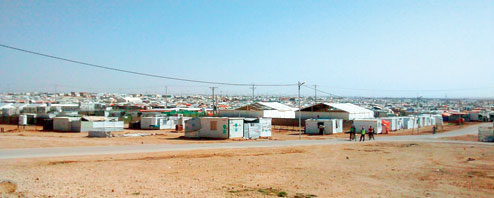
For Qais, who was born in the camp, home is a prefabricated tin shed provided by the office of the UN high commissioner for refugees, and the world a dusty shantytown of fellow refugees where daily entrepreneurship thrives but hopes for the future are fast dissipating.
"That's how it's going to be - this is our fate," Shap said, blinking back tears. "We can't go back to Deraa and we can't emigrate. You tell me, what is the future for the children?"
Zaatari grew out of a giant patch of desert east of the city of Mafraq in northern Jordan, 70km from capital Amman, in June 2012 as the country prepared to house an exodus of refugees initially largely from Deraa.
The city of Deraa had merged as the cradle of the revolt against the Assad government and locals were facing what many refugees described as a brutal crackdown.
By far the single-largest Syrian refugee camp in the world, Zaatari by 2014 housed over 120,000 inmates - effectively making it Jordan's fifth-largest city.
Worried about the challenges of managing such a large camp - Zaatari was planned for 10,000 refugees - the Jordanian government created a second camp east of Amman called Azraq where about 40,000 refugees were moved.
The camp residents represent only a fraction of the total number of Syrian refugees in Jordan - 620,000 officially registered with the UNHCR but an estimated 1.3 million in all, including many who entered but did not register with the government or the UN.
But the choice of the Zaatari refugee camp by its residents marks out their relative vulnerability even among fellow Syrians who have fled the civil war that has claimed more than 200,000 lives.
The giant camp has 24 schools, each running two shifts a day to accommodate 21,000 registered students, Colonel Mohammed Hamdi Al-Kohafi, the commander of Zaatari, told The Telegraph in his office surrounded by a walled compound protected by concertina wire.
Till last year, most residents lived in tents. Now, 26,000 prefabricated tin sheds house the refugees. "No one is in a tent now," Al-Kohafi said. "We are trying our best to give them a life of dignity."
Refugees in the camp have also opened dozens of temporary shops selling everything from shampoo to shawarma - a meat roll - while some have started English language classes. A giant football field serves as the southern border of the camp that also boasts a basketball court.
But for many residents, the deepening roots of the camp represented by the more stable accommodation they now enjoy and the shops they can visit also serve as a reminder of the absence of any clear future beyond Zaatari.
Some, like 29-year-old Waffaa, a mother of three children, are victims of both the Syrian government forces and of Daesh, as the Islamic State is known in Arabic.
Her family belongs to Raqqa, the town the IS has made its de-facto capital, while her husband is from Deraa, Waffaa explained as her eldest son played on a makeshift swing in their doorway.
Zaatari is a peaceful refuge by contrast, with food, water and electricity ensured by the Jordanian government, and the schools sponsored by the UNHCR and other countries including the US, Norway, Saudi Arabia and Australia.
But economic options - even for shop owners - beyond their dole are limited because their market is the same set of refugees short of money.
Ahmed Omar, a 31-year-old running a tiny hair-cutting salon at the western edge of the camp, said he considers himself lucky if four customers come by in a day.
Camp authorities allow refugees to leave Zaatari if they obtain a pass, but they must declare where they are visiting and when they will return. These trips outside help Shap, who works at a shop that sells toys and utensils, to stock up. But any violation of the commitments by the refugees in obtaining the pass means blacklisting for the future.
Turkey - which bears the largest burden of Syrian refugees along with Jordan - has for long tacitly encouraged refugees to migrate to Europe, in part as a bargaining tool for membership to the European Union.
Jordan, on the other hand, is a political ally of key European states, and has tried to check illegal immigration of Syrian refugees.
But many refugees aren't thinking of migrating - and those without jobs don't even step outside their tin shelters.
Tamir Ali Mansoori sits all day in his family's shed, decorated with wall sketches of cats - pets the family had in Deraa and needed to leave behind. His mother, wife and sister wait with him as Mansoori's two sons return from their afternoon school 200m away.
"There's nothing to do," the 24-year-old Mansoori said last Monday. "Nothing except to wait and see when our fortune turns."