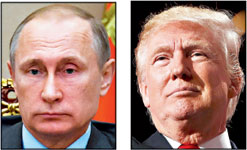
Washington, July 25: An unusual question is capturing the attention of cyber specialists, Russia experts and Democratic Party leaders in Philadelphia: is Vladimir V. Putin trying to meddle in the American presidential election?
Until Friday, that charge, with its eerie suggestion of a Kremlin conspiracy to aid Donald J. Trump, had only been whispered.
But the release of some 20,000 stolen emails from the Democratic National Committee's computer servers, many of them embarrassing to Democratic leaders, has intensified discussion of the role of Russian intelligence agencies in disrupting the 2016 campaign.

The emails, released first by a supposed hacker and later by WikiLeaks, exposed the degree to which the Democratic apparatus favoured Hillary Clinton over her primary rival, Senator Bernie Sanders of Vermont, and triggered the resignation of Debbie Wasserman Schultz, the party chairwoman, on the eve of the convention's first day.
On Sunday morning, the issue erupted as Clinton's campaign manager, Robby Mook, contended that the emails were leaked "by the Russians for the purpose of helping Donald Trump", citing "experts" but offering no other evidence.
It was a remarkable moment: even at the height of the Cold War, it was hard to find a presidential campaign willing to charge that its rival was essentially secretly doing the bidding of a key US adversary.
But the accusation is emerging as a theme of Clinton's campaign, as part of an attempt to portray Trump not only as an isolationist but also as one who would go soft on confronting Russia as it threatens nations that have shown too much independence from Moscow or, in the case of Lithuania, Latvia and Estonia, joined Nato.
Proving the source of a cyber attack is notoriously difficult. But researchers have concluded that the national committee was breached by two Russian intelligence agencies, which were the same attackers behind previous Russian cyber operations at the White House, the state department and the joint chiefs of staff last year.
Metadata from the released emails suggests the documents passed through Russian computers. Although a hacker claimed responsibility for giving the emails to WikiLeaks, the same agencies are the prime suspects.
Whether the thefts were ordered by Putin or just carried out by apparatchiki who thought they might please him is anyone's guess.
Mook, Clinton's campaign manager, suggested the Russians might have good reason to support Trump: the Republican nominee had indicated in an interview with The New York Times last week that he might not back Nato nations if they came under attack from Russia - unless he was first convinced that the countries had made sufficient contributions to the Atlantic alliance.
Trump has also said he would like to "get along with Russia" if he is elected, and complimented Putin saying he is more of a leader than President Barack Obama. Putin has in turn praised Trump. But Trump campaign officials yesterday strongly rejected any connections between their candidate and efforts to undermine the Democrats.
Asked by a journalist whether there were "any ties between Trump, you or your campaign and Putin and his regime", Paul Manafort, Trump's campaign chairman, replied: "No, there are not. That's absurd. And, you know, there's no basis to it."
One of Trump's sons, Donald Trump Jr, was more definitive, charging the Clinton camp with a smear campaign. "I can't think of bigger lies," he said on CNN. The younger Trump mockingly suggested that Mook's "house cat at home once said this is what happened with the Russians''.
It may take months, or years, to figure out the motives of those who stole the emails and, more important, whether they were being commanded by Russian authorities, and specifically by Putin.
But the theft from the national committee would be among the most important state-sponsored hacks yet of an American organisation, rivalled only by the attacks on the Office of Personnel Management by state-sponsored Chinese hackers, and the attack on Sony Pictures Entertainment, which Obama blamed on North Korea.
There, too, embarrassing emails were released but they had no political significance. The WikiLeaks release, however, has more of a tinge of Russian-style information war, in which the intent of the revelations is to alter political events.
Exactly how, though, is a bit of a mystery, apart from embarrassing Democrats and further alienating Sanders's supporters from Clinton.
Evidence so far suggests that the attack was the work of at least two separate agencies, each apparently working without the knowledge that the other was inside the Democrats' computers.
It is unclear how WikiLeaks obtained the email trove.
But the presumption is that the intelligence agencies turned it over, either directly or through an intermediary. Moreover, the timing of the release, between the end of the Republican convention and the beginning of the Democratic one, seems too well planned to be coincidental.
NEW YORK TIMES NEWS SERVICE