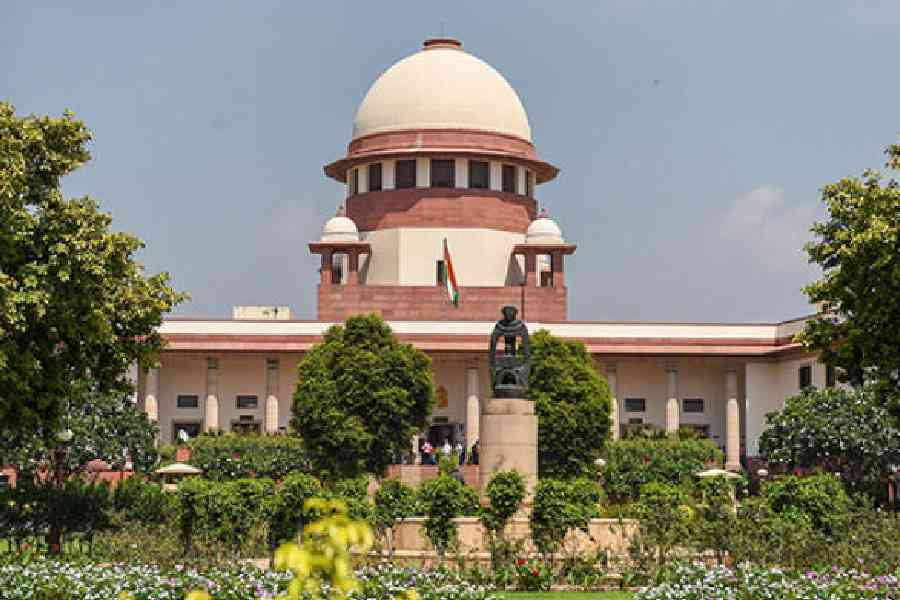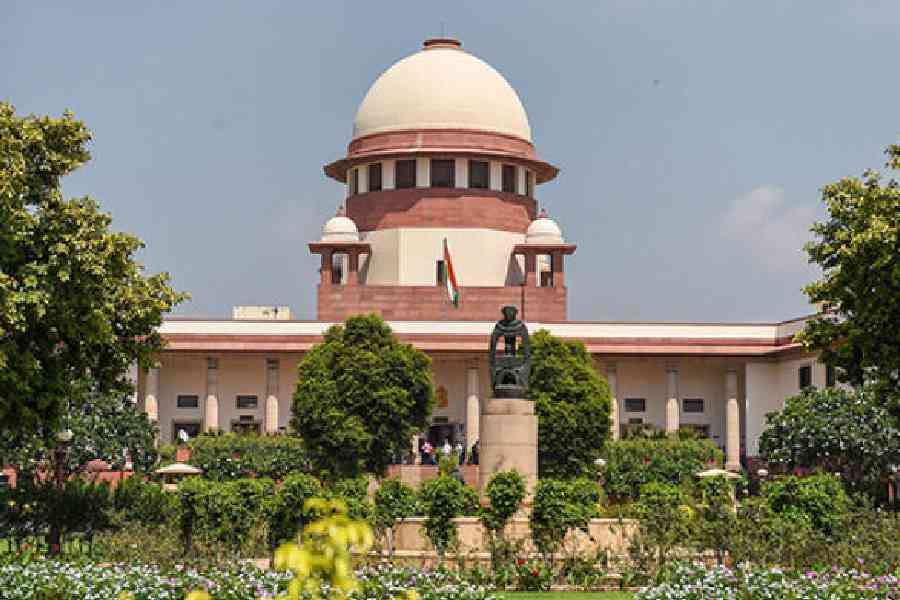
The Supreme Court on Thursday observed that traditional practices cannot be expected to divide the Hindu religion, pointing to the need for inclusivity while hearing the Centre’s arguments in favour of appeals seeking the continuation of the ban on women of childbearing age from entering the Sabarimala temple in Kerala.
The Centre told the nine-judge constitution bench that courts should not interfere with traditional practices such as those followed by the temple.
“Everybody must have access to every temple and mutt. But if you say it is a practice and it is a matter of belief, that I will exclude others and only my sects, my denominations will be allowed in the temple and nobody else, that is not good for Hinduism. It will be counter-productive for the denomination,” the bench observed.
Solicitor-general Tushar Mehta, appearing for the Centre, submitted that several temples have their own unique practices which cannot be challenged in courts as it involves the beliefs and faith of people. He referred to the Kottankulangara Sree Devi Temple in Kerala where men dress up as women during certain celebrations. In these celebrations, men are helped by women to get ready, Mehta said, adding that people’s
faith and beliefs must be left to them.
Additional solicitor-general K.M. Natraj argued that in certain temples, only vegetarian food is permitted and none can demand non-veg items there. In some other temples, liquor is given as “prasadam” and a teetotaller cannot object to this, Natraj said.
Senior advocate C.S. Vaidyanathan, appearing for the Nair Society Kerala and two other organisations, submitted that judges are expected to respect people’s beliefs and not sit in judgment of such beliefs and religious practices.
The arguments will continue on April 15.
The nine-judge bench of Chief Justice Surya Kant and Justices B.V. Nagarathna, M.M. Sundresh, Ahsanuddin Amanullah, Aravind Kumar, Augustine George Masih, Prasanna B. Varale, R. Mahadevan and Joymalya Bagchi is dealing with a batch of petitions/cross-petitions seeking the recall of or defending the September 2018 judgment of a five-judge bench that had ruled as unconstitutional the centuries-old ban on the entry of women of childbearing age to the Sabarimala temple.