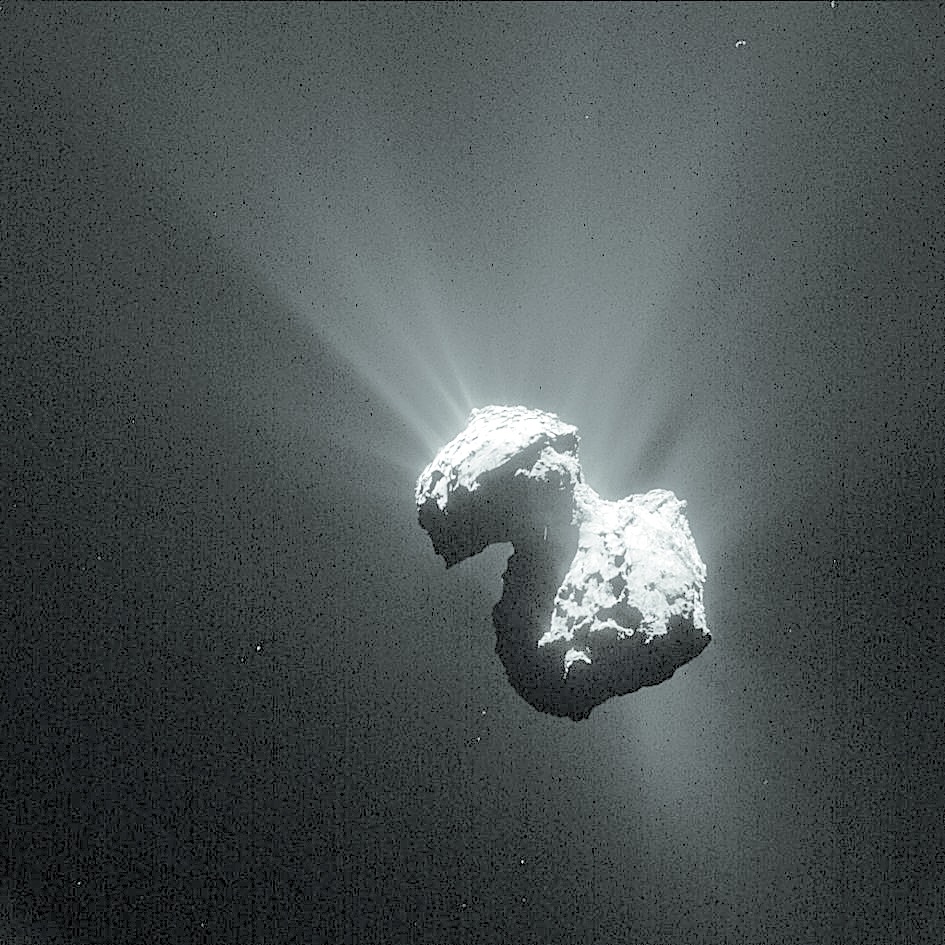

New Delhi, Oct. 28: Astronomers have discovered an abundance of oxygen molecules in a comet's atmosphere, an unexpected finding that some of them say may test current theoretical ideas about the formation of the solar system.
An international team of astronomers today announced the detection of molecular oxygen in the cloud of gas that surrounds the nucleus of the comet 67P Churyumov-Gerasimenko.
Oxygen is the fourth commonest gas in the comet's atmosphere after water, carbon monoxide and carbon dioxide, according to observations from the European Space Agency's spacecraft, Rosetta.
While molecular oxygen has been spotted on the moons of Jupiter and Saturn, until now it has remained unobserved on comets. The new finding is surprising because oxygen is highly reactive and current ideas assume that any oxygen would have long back combined with hydrogen to form water. This would mean comets shouldn't have too much of molecular oxygen.
"It was astonishing that the ratio of water to oxygen didn't change in different locations on the comet or over time," said Kathrin Altwegg, a scientist at the University of Bern, Switzerland, who led the team that used the spacecraft instrument that detected the oxygen.
The oxygen measurements show that at least a significant part of the comet's material is older than the solar system and has a composition typical of the clouds of gas and dust called nebulae from which star systems originate.
"This evidence of oxygen as an ancient substance will likely discredit some theoretical models of the formation of the solar system," Altwegg said in a media release issued by the University of Bern. The findings will appear in the journal Nature tomorrow.
The oxygen on the moons of Jupiter and Saturn can be explained by them being struck by high-energy particles from their mother planets. But the comet has been bombarded by high-energy particles from cosmic radiation for over 4.6 billion years.
These particles can split water, but as the comet goes around the Sun, it loses between one and ten metres of its circumference and should have lost much of its oxygen.
The researchers say the oxygen is likely to have originated before the formation of the solar system. Cosmic radiation particles that strike grains of ice in the cold and dense birthplace of stars can generate oxygen and hydrogen.