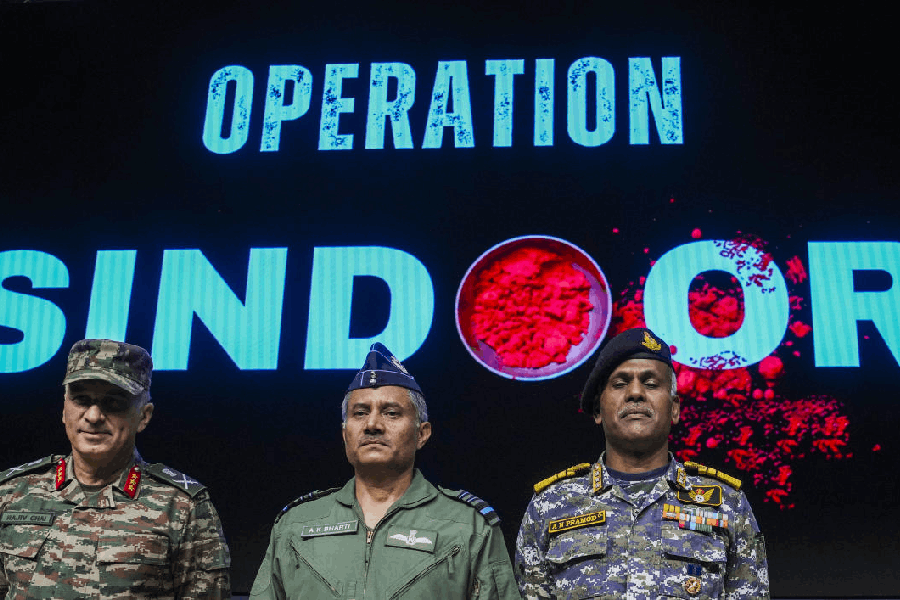
Operation Sindoor stands as a “resounding testament” to India’s unwavering resolve against terrorism, the defence ministry said on Wednesday, describing the military action as a calibrated and decisive blow delivered with precision and professionalism deep inside Pakistan’s terror infrastructure.
In a year-end review statement, the ministry said the operation sent an “unambiguous message” to the world that “India will not tolerate terror, and those who sponsor it will face the full force of retribution”.
“This operation would be remembered as a defining moment in India’s military history and as a symbol of military precision and national resolve,” the ministry added.
Operation Sindoor was carried out in the early hours of 7 May in response to the Pahalgam terror attack that killed 26 innocent civilians.
At least 100 terrorists were eliminated when Indian armed forces launched a series of precision missile strikes on nine terror camps in Pakistan and Pakistan-Occupied Kashmir. The strikes triggered a four-day military conflict between India and Pakistan.
According to the ministry, the operation demonstrated decisive leadership, joint operational synergy and the nation’s intent to safeguard its sovereignty against brutal killings by Pakistan-based terrorists.
It showcased “unmatched multi-domain capability” and was executed simultaneously across land, maritime and air domains, as well as the emerging domains of cyber, space and information warfare.
“With strategic foresight and restraint of the forces, Operation Sindoor highlighted India’s sustained focus on capability development, i.e., from intelligence dominance to cutting-edge technology and joint operational readiness,” the statement said.
It termed the operation a “classic demonstration of execution of will of the nation” through seamless integration of all organs of the government.
The ministry said the success of home-grown technologies and weapon systems in combat validated the vision of ‘Aatmanirbharta’.
While the Indian Air Force carried out strikes from the air, Army soldiers remained firmly deployed along the Line of Control and “delivered a befitting reply to every Pakistani action”.
The Indian Navy maintained a strong posture in the north Arabian Sea, “sending a clear message to Pakistan that India is capable and prepared to strike at every vital Pakistani base, from sea to land”, the ministry said, quoting an earlier statement by Defence Minister Rajnath Singh.
Singh told Parliament that Operation Sindoor had only been halted and not ended. “If Pakistan again tries to carry out any nefarious act, we are fully prepared for an even more intense and decisive action,” he had said.
The ministry said the operation was powered by the country’s “transitional shift in its policy against terrorism”.
Under the leadership of Prime Minister Narendra Modi and the guidance of the defence minister, India sent a clear message to its adversaries that the sovereignty, unity and integrity of Bharat will never be compromised, the statement said.
Singh had also asserted that the action was completely in self-defence and was “neither provocative nor expansionist”.
On 10 May, at approximately 1:30 am, Pakistan launched a “massive attack” on Indian Air Force bases, army ammunition depots, airports and military cantonments using missiles, drones, rockets and other long-range weapons, along with electronic warfare technologies.
The Indian air defence system, counter-drone system and electronic equipment “completely thwarted the attack”, the ministry said, adding that the adversary failed to hit any targets and no vital assets were damaged.
“Major airbases like Chaklala, Sargodha, Rafiqui, Rahimyar Khan, Jacobabad, Sukkur, and Bholari were struck, and the mission was successfully accomplished,” the statement said.
On 10 May, Pakistan’s Director General of Military Operations contacted India’s DGMO and appealed for a halt to military operations.
Formal talks were held on 12 May, after which both sides decided to cease military operations.
The ministry said the effective use of state-of-the-art ‘Made-in-India’ weapons during the operation testified to India’s progress towards self-reliance, which is “fundamental to ensuring strategic autonomy” in the current geopolitical landscape.
From Operation Sindoor to the Mission Sudarshan Chakra vision, record defence production and exports, equipping soldiers with the latest weapons and technologies and finalising future deals, “2025 gave a glimpse of a secure, self-reliant and prosperous India”.
The year-end review also highlighted the growing drone threat along the western front.
A total of 791 drone intrusions were reported during 2025, with nine incidents along the International Border in Jammu and Kashmir and 782 along the IB in Punjab and Rajasthan.
“Effective employment of own spoofers and jammers along the western front significantly countered the drone threat,” the ministry said.
During the year, Indian forces brought down 237 drones along the IB sector, including five drones carrying war-like stores, 72 carrying narcotics and 161 without any payload.
The security situation in Jammu and Kashmir, the ministry said, remains “firmly under control” due to the relentless efforts of the Indian Army.
The ‘whole-of-nation’ approach has resulted in a reduction in violence levels, scaled-down protests and zero incidents of stone pelting, the statement said.
Following the DGMO talks on 10 May and 12 May, the situation remains stable though unpredictable, the ministry noted, adding that there has been an increase in Pakistan’s attempts to surreptitiously infiltrate terrorists through the Line of Control and the IB sector.
Pakistan attempted to activate the Poonch-Rajouri region as a “hotbed for proxy war during the year 2023-24”, it said.
The ministry said Pakistan continues to demonstrate a persistent intent to prosecute a proxy war strategy, as evidenced by the functionality of training camps, the presence of terrorists in launch pads and continuing infiltration attempts.
Significant efforts are being made by Pakistan to exploit the IB sector to smuggle weapons and narcotics using drones and to infiltrate large numbers of terrorists.
In view of ongoing operational concerns, sanction was accorded for emergency procurement in niche technology domains, including drones and counter-drone systems, weapon systems, precision ammunition, electronic warfare and surveillance systems.
The ministry said 29 capability development schemes have already been contracted, while another 16 were likely to be contracted in December 2025.
On drone manufacturing and achieving ‘Aatmanirbharta’ in ammunition production, the ministry said 515 Army Base Workshop and select Corps Z Workshops and EME Battalions have established credible drone manufacturing capability using in-house expertise and collaboration with subject matter experts.
These facilities are state-of-the-art and meet quality requirements. A total of 819 drones have been manufactured so far, including 193 surveillance drones, 337 kamikaze, armed or weaponised drones and 289 first pilot view drones.
The ministry also assessed the situation along the northern borders, saying it remains stable yet sensitive.
It asserted that the deployment of the Indian Army along the Line of Actual Control is “robust, well poised” and prepared to deal with any emerging contingency.
Bilateral interaction between India and China at political, diplomatic and military levels facilitated positive developments and stabilisation along the northern borders, it said.
After the disengagement agreement in Depsang and Demchok in 2024, 2025 witnessed reduced deployment levels of the People’s Liberation Army opposite the northern borders and in traditional training areas.
The PLA maintained 10 Combined Arms Brigade-size forces each in tactical and operational depth opposite the northern borders and in training areas, while the overall BMP pattern remained unchanged from 2024.
The ministry said India’s defence preparedness has been enhanced with the induction of new-generation equipment and deployment of newly created force multipliers such as Rudra Brigades, Divyastra Batteries and Bhairav Battalions along the northern borders.
Significant improvement in infrastructure, connectivity and billeting was also recorded across all sectors along the northern front.
The ministry said India’s military actions are calibrated, with the approach aimed at achieving peace and tranquillity while adhering to the principle of “Mutual and Equal” security.
During 2025, various channels of communication were effectively used to address mutual concerns along the LAC.
The year saw renewed engagement through the 33rd and 34th rounds of the Working Mechanism for Consultation and Coordination meetings in March and July, followed by the 24th round of Special Representatives talks on 19 August in New Delhi.
The positive developments in bilateral ties were further reinforced during Prime Minister Modi’s visit to China for the SCO Summit in Tianjin in August 2025.
Constructive engagement was also reflected during the 23rd Corps Commander Level meeting held in the western sector of Eastern Ladakh on 25 and 26 October.
At the ground level, Border Personnel Meetings continued in a cordial and friendly environment to resolve issues of concern.
Reiterating its assessment of Jammu and Kashmir, the ministry said the security situation in the Union Territory remains firmly under control, with consistent improvement in the hinterland since 2019, underpinned by sustained counter-infiltration measures, relentless operations in higher reaches and efforts to reduce local recruitment by fostering development.