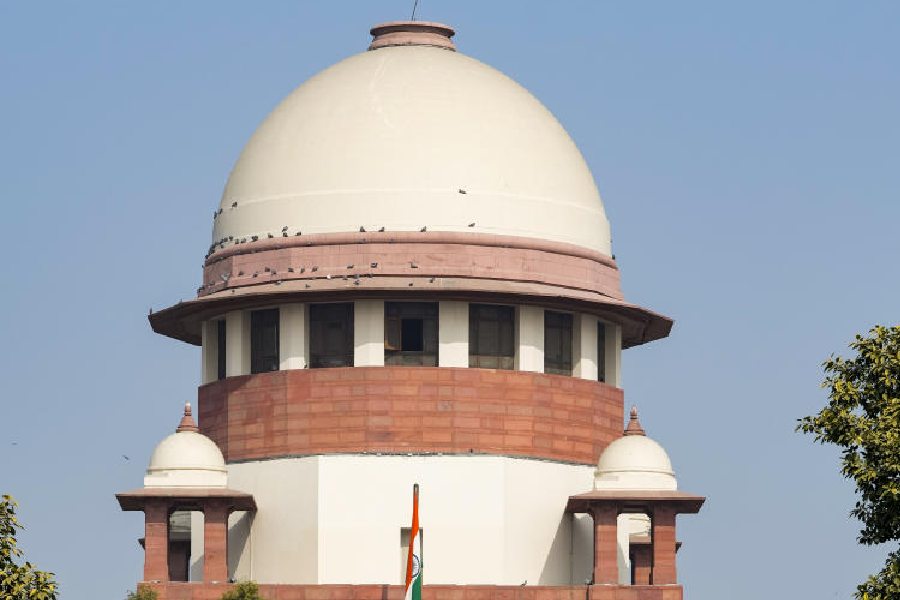
The Supreme Court on Wednesday expressed concern over the rising number of dog bite incidents in India, criticising municipal authorities and other local bodies for failing to implement the Animal Birth Control (ABC) rules.
The bench, comprising Justices Vikram Nath, Sandeep Mehta, and NV Anjaria, noted that children and adults are being bitten, and people are even dying due to stray dog attacks.
"We are conscious that these things are happening. Children, adults are getting bit, people are dying," the top court said, as quoted by Bar and Bench.
The bench further highlighted that in the last 20 days, there have been two animal-related road accidents involving judges, with one judge suffering serious spinal injuries. "One of the judges is still suffering through spinal injuries. It’s a very serious issue," it added.
The matter gained national attention last year when a bench, led by Justices J.B. Pardiwala and R. Mahadevan directed Delhi municipal authorities to round up and shelter stray dogs, drawing protests from animal rights groups.
The order was later modified by the current bench to mandate vaccination and release of sterilised dogs instead of permanent sheltering.
In November 2025, the apex court directed state governments and the National Highways Authority of India (NHAI) to remove stray animals from highways across the country. It also ordered fencing of government and private educational and health institutions within eight weeks to prevent dog bites.
Stray dogs picked up were not to be released back to the same location, the Court added.
Amicus curiae Gaurav Agarwal informed the Court that the NHAI has prepared a standard operating procedure (SOP) to implement the court order. "There’s 1,400 odd km of vulnerable stretch. After detecting, the NHAI says that the State government has to take care," he said.
The bench remarked that the NHAI can also take steps to cordon off or fence the roads.
Agarwal added that infrastructural development and manpower are needed at ABC centres to implement sterilisation and vaccination programs.
He noted that major states like Madhya Pradesh, Uttar Pradesh, Tamil Nadu, Karnataka, and Punjab have yet to file compliance affidavits, despite the Court’s directions.
Senior Advocate Kapil Sibal, representing petitioners advocating animal rights, emphasised the need for a responsible societal response.
"We are here as dog lovers. If one tiger is a man-eater we don’t kill all tigers. We must make sure that sterilisation takes place, the population must come down. There is a process for that. It’s called CSVR model accepted throughout the world. It’s called Capture, Sterilise, Vaccinate, Release. It has brought down dog population in states like UP to almost zero. If we have dogs who have rabies and who don’t have rabies in the same shelter, all of them will get rabies," he said.
The top court observed that stray animals on roads also lead to accidents. "While they are running on the road it is a problem. Roads where there are moving vehicles. It’s just not biting," it said.
During Sibal's submissions, the apex court remarked that the "only thing missing is providing counseling to the dogs as well. So that he doesn’t bite when released back".
Sibal countered, "But dogs are not on roads; they are on compounds." The bench replied, "Your information seems to be outdated. Prevention is always better than a cure. The roads have to be clear and cleaned of dogs. They might not bite, but they still cause accidents."
Sibal also stressed that removal of dogs from institutional areas without proper planning would be counterproductive. "Dogs are highly territorial. Territorial vacuum will soon be filled again. This is not what I say. This is a plan based on experience. Fundamentally our children and people have to be protected. But that doesn’t mean it increases the risk," he said.
Sibal noted, "Removal of dogs from institutional areas won’t solve the problem. Other dogs will come. There will be lack of food in shelters, there will be dog fights, rabies will increase…."
Senior Advocate K.K. Venugopal, representing NALSAR Hyderabad, said, "15,46,941 are total educational institutions including schools. Taking an average of 10 dogs per institution will be 1.54 crore. Total shelters required will be 77,347."
He also noted that ABC rules require stray dogs to be returned to their original locations, calling for the formation of a committee to examine implementation issues.
Senior Advocate Colin Gonsalves warned against mass removal of dogs, citing potential health risks. "If you have 70 per cent vaccinated, and 30 per cent not vaccinated then those 30 per cent dogs also get the rabies shield. So it’s important to release back vaccinated dogs," he said.
Solicitor General Tushar Mehta added that Residents Welfare Associations (RWA) in gated communities should vote on whether to allow stray animals inside their premises. "While we're all animal lovers, we're also human lovers. One day, someone might want to bring in a buffalo to drink its milk. Should that be allowed? Others would be inconvenienced," he said.