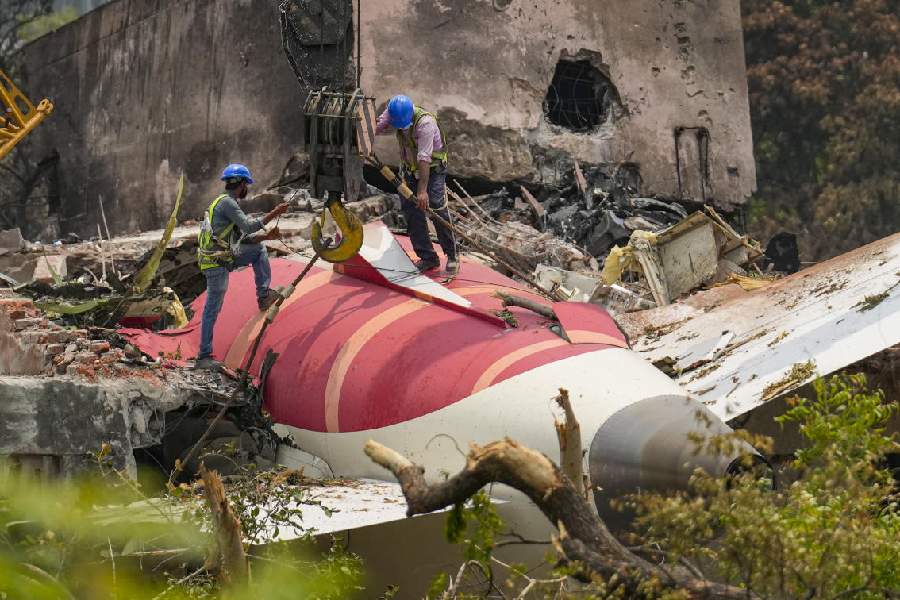
A year after Air India Flight 171 crashed shortly after take-off from Ahmedabad, killing 260 people, grief remains raw for families, trauma continues to haunt survivors and a final explanation for India's deadliest aviation disaster in recent history has yet to emerge.
“We saw the live footage on TV,” said Kunal Agarwal, a relative of Vahora Yasmin Yasinbhai, his voice carrying the weight of grief. “We still cannot visit that area.”
Among the wreckage were Parvez Vahora and his four-year-old daughter, Zuveriya.
The duo had traveled to India to visit family. They were returning home to their lives in London when the flight went down, transforming an ordinary departure into an enduring catastrophe.
"Everyone is bound to suffer, right?" Faruk Bhai, Parvez’s relative, reflected. "It’s been a year, but a young man is gone, a little girl is gone. The pain will always remain."
The devastation radiates deepest toward Parvez’s wife, Mobbashera Vahora.
Pregnant and waiting in London when the tragedy unfolded, she lost her entire world in a single afternoon. "There was no way she could have stayed there alone," Faruk Bhai recalled. "She lost everything. The family decided that she should move back."
Mobbashera returned to her family's native roots in Tarapur to be surrounded by loved ones, later giving birth to a baby boy.
Yet, for a mother mourning a husband and a daughter, the void remains absolute.
"A year has passed, but how can the pain go away for someone who has no husband and no daughter left?" Faruk Bhai asked. When asked if the family home now feels quiet and empty, he brushed the word aside as a severe understatement. "Empty? Life itself has completely changed."
The trauma has even altered how surviving family members perceive travel. "The fear will always be there. Whenever we see an airport, we will remember Parvez."
On the ground, the disaster tore through ordinary lives.
"He is standing right in front of my eyes even now," recalled Suresh Patani, a local driver. His teenage son, Akash, was engulfed in the flames from the post-crash explosion while working at the family’s tea stall near the impact zone.
Whenever Ajay Parmar sees a plane overhead, fear grips him. At 28, he has no steady job, his marriage is over, and sometimes he wakes up in the middle of the night.
Parmar was riding home on his two-wheeler when the Air India flight AI-171 crashed into the Meghaninagar hostel complex and he found himself amid burning debris.
A resident of Meghaninagar, he worked as a gardner at the medical college hostel complex, and had got married only a month before.
"I suddenly heard a loud crash. Before I could understand anything, my hands and legs were on fire," he said.
Parmar abandoned his vehicle and ran.
"The last thing I saw was my vehicle engulfed in flames. After that I rememeber nothing. I fell down unconscious. Someone took me to Civil Hospital," he said.
He spent two months under treatment for severe burns. Doctors said he should not work under direct sunlight, so he had to quit his job.
Then his wife left him. "She left because I could not work, and my physical appearance had changed because of the burns," said Parmar.
He tried to find an office job. But people would sit away from him during lunch time because of his appearance.
"They didn't want to see my scars."
His mother works as a domestic help, and she helps him with his financial needs.
One year later, the definitive cause of the disaster remains trapped in regulatory review.
Moments after departing Ahmedabad, Flight 171—a Boeing 787 widebody aircraft—lost altitude and crashed into the ground, triggering an explosion. In the aftermath, India’s directorate general of civil aviation (DGCA) launched a technical probe, demanding detailed inspections of Air India’s entire Boeing 787-8 and 787-9 fleet.
Investigators focused closely on the aircraft’s fuel control switch mechanisms, though initial fleet-wide checks yielded no immediate mechanical findings or structural anomalies.
A final report from aviation safety authorities is still pending; the status of the investigation remains a painful waiting game for families seeking answers.
While the families navigate this reality, the corporate and financial machinery of the aftermath has ground forward.
In the immediate hours following the accident, Air India and its parent company, Tata Sons, deployed over 500 volunteers and assigned dedicated caregivers to guide shattered families through the DNA identification and funeral processes.
To date, Air India has disbursed an interim compensation of Rs 25 lakh (21,000 GBP) each to 96 per cent of the families of the deceased. Tata Sons chairman N. Chandrasekaran announced ex gratia financial assistance of Rs 1 crore per family through the newly established AI171 Memorial and Welfare Trust—a philanthropic gesture extending beyond legal mandates, which has already reached 91 percent of the affected households.
For some relatives, like Agarwal and Geetha Krishna—who were in Rajkot when the crash occurred—the initial financial settlements came but carried strict codes of confidentiality, with instructions not to disclose the final amounts.
“We were initially contacted by Air India and given fast compensation,” Agarwal noted, though family members add that systematic communication from the airline has since grown quiet as the final, non-pressured compensation phase begins.
The airline has also engaged in the meticulous task of returning personal items. Out of more than 22,000 personal belongings recovered and cataloged by external specialists. For digital devices, Indian authorities mandated strict screening before 16 of the 25 recovered items were restored to the next of kin.
The tragedy forced a structural reckoning. Air India enacted a voluntary "safety pause" in June 2025, scaling back schedules to run exhaustive checks on its widebody fleet and expanding its operational reliability programs. The company also deployed a network of 265 psychologists under its Wellness.AI initiative, providing mental health interventions to over 900 cabin crew members and affected families.
Yet, no amount of institutional reform, meticulous cataloging of personal effects or structural audit overhauls can bridge the chasm left behind.
As the first anniversary passes, the true legacy of Flight 171 rests not in corporate statistics or financial disbursements, but in quiet households where families stare at empty chairs, and a mother holds a newborn boy, wondering how to explain the flight that changed everything.
(With inputs from PTI)