The Narendra Modi government is pushing the Great Nicobar infrastructure project despite serious environmental concerns and is attempting to open the door to private participation while hiding key details from the public, Congress leader Jairam Ramesh alleged on Friday.
“The Great Nicobar project is being bulldozed through by the Modi Govt even though there is mounting evidence that it will have disastrous ecological impacts,” the Congress general secretary wrote in a post on X (formerly Twitter).
“The project has evoked widespread concern, and petitions against the manner in which environmental and other laws have been flouted to push it along are pending in the Calcutta High Court and the National Green Tribunal,” he added.
The former Union environment minister has repeatedly raised objections to the project in a series of letters addressed to the minister for environment, forests and climate change.
In his post on Friday, the Congress leader argued that the government’s persistence with the project has revealed a deeper motive.
He shared a newspaper report that said that the Union Ministry of Ports, Shipping and Waterways has proposed that the Galathea Bay international container transshipment terminal — a central component of the Great Nicobar project — be developed under the public-private partnership (PPP) model.
“One of the key reasons for the insistence and persistence of the Modi Govt has now become evident,” Ramesh said in his post. “There is absolutely no mystery of which private conglomerate the Ministry has in mind while making this recommendation.”
Ramesh seemed to hint at the Adani Group.
“This conglomerate already owns and operates 13 ports and terminals in the country apart from being the biggest mover and shaker in the corporate world. All with the PM’s blessings,” the Congress leader wrote.
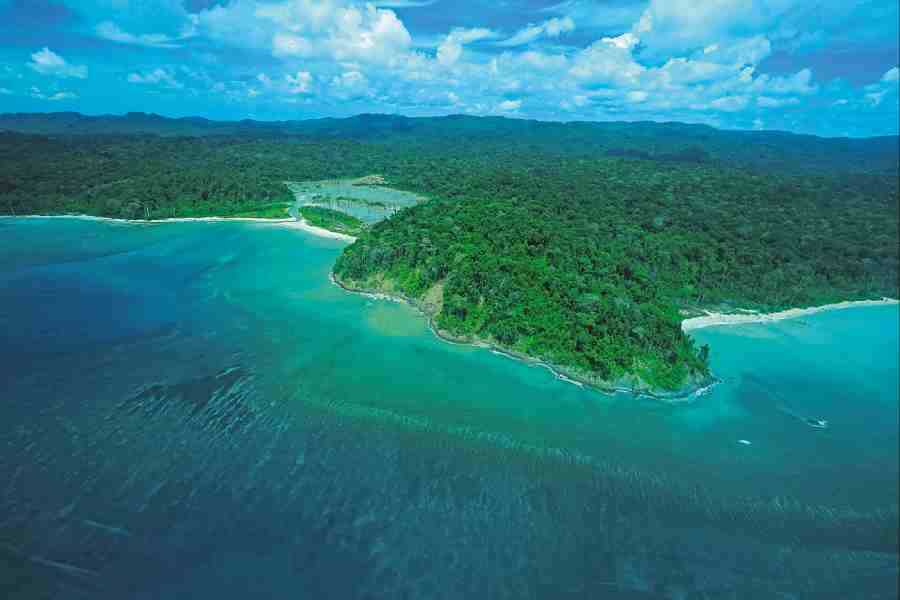
The Galathea Bay terminal is among the most ambitious elements of the Great Nicobar plan, which includes a transshipment port, an international airport, power plants and urban infrastructure.
The overall project has faced criticism from environmental experts, civil society groups and scientists, who warn that large-scale construction could irreversibly damage the island’s fragile ecosystem and threaten indigenous communities.
Ramesh also questioned the government’s approach to transparency, pointing out what he described as a contradiction between secrecy and privatisation.
“It is also notable that the Modi Government is attempting to bring in private players into the project at a time when it has refused to disclose key project details to the general public on the grounds of national security,” he said. “It goes to show that the lack of public transparency is a matter of political convenience for the Modi Government.”
Ramesh referred to developments around the proposed port project.
The newspaper report stated: “The Centre is moving on its ambitious plan to develop the Rs 40,000-crore Galathea Bay International container transshipment terminal (ICTT) project, in the Andaman and Nicobar islands, in a public-private partnership (PPP) framework.”
According to the same report, “This month, the Ministry of Ports, Shipping and Waterways moved a proposal with the PPP Appraisal Committee (PPPAC) under the finance ministry. It calls for building the port in Design Build Finance Operate Transfer (DBFOT) mode, according to at least two senior officials.”
Under the DBFOT model, private companies take on financial and operational risks from the early stages of construction. Several state governments have previously adopted this approach for greenfield ports.
The report noted that the recently operationalised Vizhinjam Port in Kerala also follows a similar framework, though the central government has more commonly used PPP models for expanding already constructed ports.
The ICTT at Galathea Bay is planned to serve transshipment traffic from ports along India’s east coast as well as Bangladesh and Myanmar. Its location is projected to make it closer than major regional hubs such as Singapore and Port Klang.
At present, nearly 75 per cent of India’s transshipped cargo is handled at ports outside the country.
Government assessments estimate that shifting this cargo to Indian ports could save between $200 million and $220 million annually.
The project has also drawn political criticism from other senior Congress leaders.
Sonia Gandhi had earlier described the Great Nicobar initiative as a “planned misadventure,” warning that it poses an existential threat to the island’s indigenous tribal communities and accusing the government of making “a mockery of all legal and deliberative processes.”
The BJP-led government has rejected these charges. Environment minister Bhupendra Yadav has maintained that all statutory clearances were obtained and has defended the project as essential for national development and strategic interests.