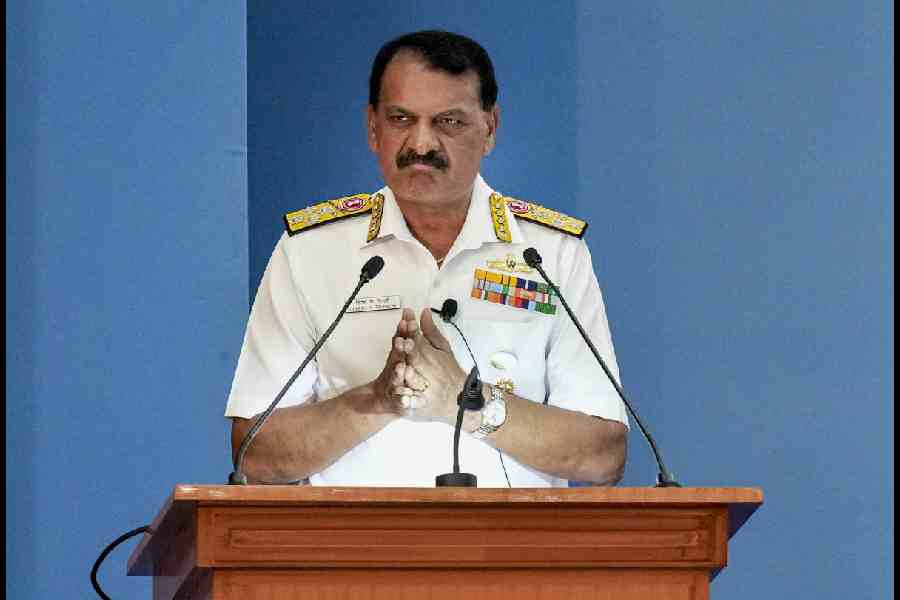
The navy’s top brass, led by Admiral Dinesh K. Tripathi, will hold a three-day conference on the implications of the West Asia crisis in the context of safeguarding India’s energy security as well as discuss the navy’s operational preparedness to protect national maritime interests.
The apex-level conference beginning Tuesday will also review the navy’s deployment in the Indian Ocean, where it is tasked with protecting oil tankers that are travelling towards India after passing through the Strait of Hormuz, in light of the ongoing conflict in West Asia.
Last week, the navy chief had flagged the wider implications of the disruptions in the Strait of Hormuz, warning of serious economic and strategic consequences.
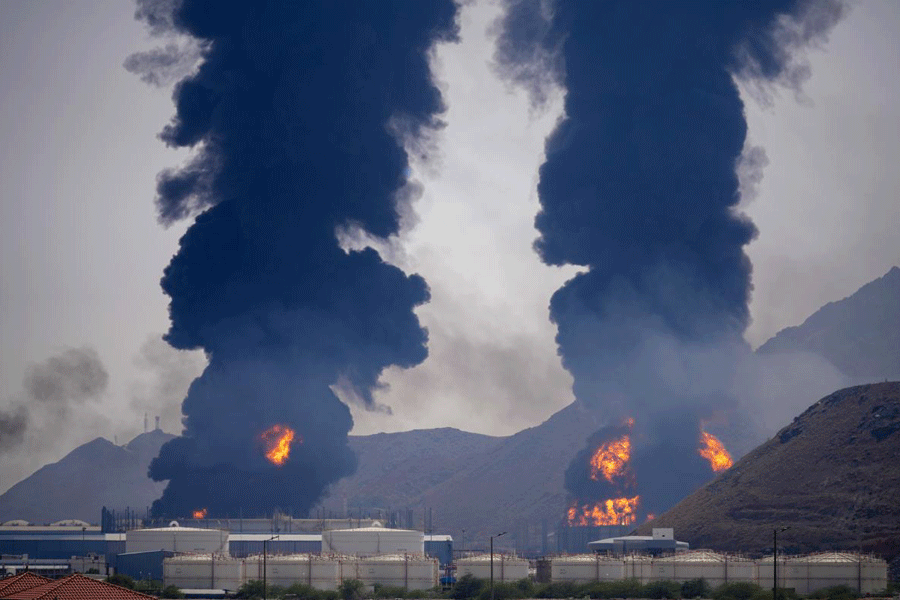
The blockade of the Strait of Hormuz — a vital waterway that connects oil and gas producers in the Persian Gulf with the wider world — by Iran has led to an over 40 per cent surge in crude prices.
India imports about 88 per cent of its crude oil, 50 per cent of natural gas and 60 per cent of LPG. Before the war broke out, more than half of the oil that India imported came from countries like Saudi Arabia, Iraq and the UAE, which use the strait for shipping.
“The conference holds significant importance in the light of swift naval deployments to safeguard India’s energy security, amidst the ongoing conflict in West Asia with convergence of multi-national forces (MNFs) in the Indian Ocean Region,” the navy said on Sunday.
It also bears prominent significance in reaffirming the navy’s operational doctrine, inter-services coordination and technology-driven response mechanisms post-Operation Sindoor, it said.
The navy, however, did not elaborate on the role it has in safeguarding India’s energy security given disruptions in the transit of ships through the Strait of Hormuz. Over the past several years, it has been escorting Indian-flagged merchant vessels, specifically those carrying crude oil and natural gas, to ensure their safe passage through the Gulf of Oman.
The blockade of the Strait of Hormuz has led to more than 23 merchant vessels being attacked; nearly 1,900 vessels remain stranded; and daily traffic has fallen sharply to just 6-7 transits, compared to the pre-conflict average of about 130.
Admiral Tripathi, along with the operational commanders and senior naval leadership, will review and assess plans to address multi-dimensional challenges in the current geo-strategic environment, the navy said.
“Alongside security imperatives, the deliberations will focus on achieving decisive operational success, enhancing blue-water capabilities, training, human resource management, sustainable maintenance practices, effective employment of uncrewed systems, operational logistics, and other key enablers for combat readiness of platforms,” it said.
The deliberations at the conference would aim at promoting the navy as the "preferred security partner" in the Indian Ocean Region and the Indo-Pacific.
Chief of Defence Staff Gen. Anil Chauhan and Union home secretary Govind Mohan will be among those to address the commanders.