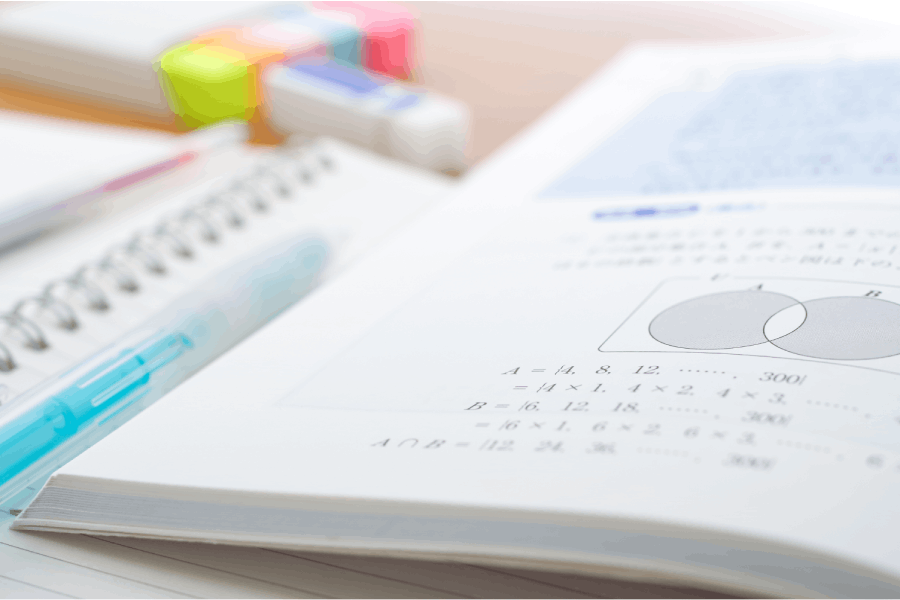
The newly-introduced NCERT Class 9 mathematics textbook 'Ganita Manjari' features references to ancient Indian mathematical systems and embeds historical context within core concepts, marking a shift from earlier editions.
The 196-page Part 1 textbook, comprising eight chapters and to be implemented from the 2026-27 academic session, places greater emphasis on indigenous contributions, unlike the previous book which contained limited references to ancient Indian mathematics and largely focused on procedural learning.
While the earlier textbook presented topics such as number systems, integers and irrational numbers in a largely definition-based format, the new book integrates these concepts with historical narratives, linking them to ancient texts and scholars.
For instance, the revised textbook credits the Sindhu-Sarasvati civilisation with early "grid-based thinking" and describes it as an example of systematic spatial planning.
It says "grid-based thinking" and geometry, which require defining specific points in space, "indeed has deep roots in Bharat" with first systematic use of grids occurring thousands of years ago "on a massive urban scale in the Sindhu-Sarasvati Civilisation, where city streets were constructed with striking precision in North-South and East-West directions at uniform distances of 10 metres apart. This was a coordinate system in practice." The textbook also states that ancient Indian mathematician Baudhayana later used East-West and North-South lines for his "deep geometric constructions, developing the Baudhayana-Pythagoras Theorem and thus laying the foundation of coordinate geometry." In the same chapter, titled "Orienting Yourself: The Use of Coordinates", the textbook states the 'Ujjayina' was described in the early "Siddhantas" of ancient Indian polymath Bhaskara as "the point marking the central longitude meridian from which all other locations were measured" -- as early as 4th century BCE.
The book credits Brahmagupta with formalising key concepts, stating he "formalised the notion and use of zero and negative numbers as algebraic entities" in modern coordinate systems, with the 'origin' at zero and the 'negative axes' representing values less than zero.
It also states that the Rigveda "set the stage for the number system based on powers of 10", linking it to the evolution of the decimal place value system. The earlier textbook treated zero as a mathematical concept without elaborating on its historical origins.
The earlier textbook briefly mentioned Aryabhata mainly for his approximation of 'pi' value and his work as an astronomer-mathematician, with limited context.
The new textbook places his contribution in a broader framework, highlighting his description of pi as "Asanna" (approximate) as an early insight into mathematical approximation.
The new textbook also refers to Madhava, crediting him with the formulation of infinite series. It says the concept of irrational numbers was inaugurated in the 14th century by Madhava of Sangamagrama, who launched the Kerala School of Mathematics. Madhava realised that to express an irrational number, one cannot use a single fraction; but must use an infinite sum, the book highlights.
Aligned with the National Education Policy (NEP) 2020 and the National Curriculum Framework for School Education 2023, the revised textbook reflects a broader push to integrate Indian knowledge systems into school education. The textbook was developed by a 26-member Textbook Development Team (TDT).
In the foreword, NCERT director Dinesh Prasad Saklani wrote, "This textbook aims to develop students' ability in formulating well-defined problems that can be addressed through mathematical reasoning -- an essential aspect of learning Mathematics." "This textbook highlights the rich history of Mathematics in India, spanning thousands of years. By learning about mathematical developments in India and across the world, students can develop a deeper sense of cultural rootedness," he added.
The NCERT Class 9 mathematics textbook was first published in February 2006, with the revised 2022-23 edition presently part of the curriculum.
Except for the headline, this story has not been edited by The Telegraph Online staff and has been published from a syndicated feed.