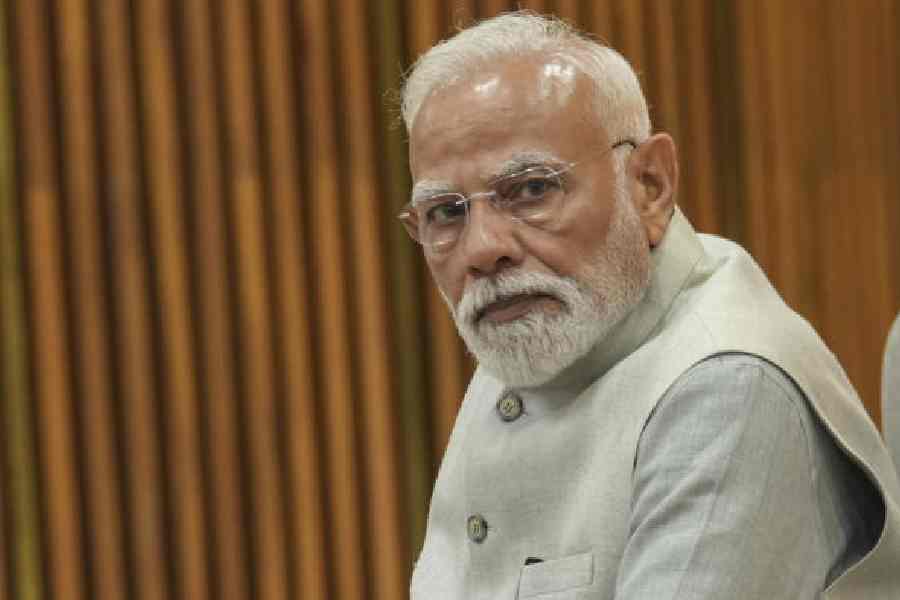
Prime Minister Narendra Modi on Monday reaffirmed solidarity with the Gulf nations facing Iran’s retaliatory attacks, citing "sovereignty and territorial integrity" to seemingly tilt towards the US-Israel combine the delicate balance India has been maintaining in the conflict.
He remained silent on the US-Israel strikes on Iran, which too claims violation of its sovereignty and territorial integrity.
After condemning the attacks on the United Arab Emirates on Sunday, Modi on Monday dialled the Saudi crown prince and Prime Minister, Prince Mohammad bin Salman, and Bahrain’s King Hamad Bin Isa Al Khalifa.
“Discussed the evolving situation in West Asia with Crown Prince and PM of Saudi Arabia, HRH Prince Mohammed bin Salman. India condemns the recent attacks on Saudi Arabia in violation of its sovereignty and territorial integrity,” Modi posted on X.
“We agreed that earliest restoration of regional peace and stability is of utmost importance. I thanked him for looking after the well-being of the Indian community in these difficult times.”
In another post, the Prime Minister detailed his discussions with the King of Bahrain but did not mention sovereignty or territorial integrity.
“Had a productive telephone conversation with the King of Bahrain, His Majesty King Hamad Bin Isa Al Khalifa,” he wrote.
“India condemns the attacks on Bahrain and stands in solidarity with its people in this difficult hour. I thank him for the steadfast support extended to the Indian community in Bahrain.”
Both posts were mum on Iran, as was Sunday's when Modi had informed the world about his phone conversation with the UAE President, Sheikh Mohamed bin Zayed Al Nahyan.
“Strongly condemned the attacks on the UAE and condoled the loss of lives in these attacks. India stands in solidarity with the UAE in these difficult times,” Modi had posted.
“Thanked him for taking care of the Indian community living in the UAE. We support de-escalation, regional peace, security and stability.”
The US-Israel joint strikes on Iran began on Saturday, and Tehran responded with retaliatory attacks across the Gulf targeting American military bases and allies.
New Delhi has, however, not expressed the same kind of solidarity with Iran that the Prime Minister has conveyed to the rulers of UAE, Saudi Arabia and Bahrain.
The external affairs ministry’s lone comment on the West Asia situation since the conflict began contains a call for respecting sovereignty and territorial integrity — an apparent acknowledgment of the Iranian position.
But India has not commented on the assassination of Iran’s Supreme Leader, Ayatollah Ali Khamenei, though it had in the past mostly frowned on such foreign-backed exercises to topple governments.
India had a troubled relationship with Khamenei, particularly given his criticism of New Delhi’s Kashmir policy and the condition of minorities in India.
External affairs minister S. Jaishankar did reach out to Iran after the bombing began. However, all he said about his conversation with his Iranian counterpart on Saturday was: “Had a telecon with Iranian FM Seyed Abbas Araghchi this evening. Shared India’s deep concern at the recent developments in Iran and the region.”
Modi reiterated this concern on Monday in his statement to the media after a bilateral engagement with Canadian Prime Minister Mark Carney.
India supports all efforts to resolve outstanding issues through dialogue and diplomacy, he said.
He added that the government was working with the Gulf countries to ensure the safety of all Indians living in the region.