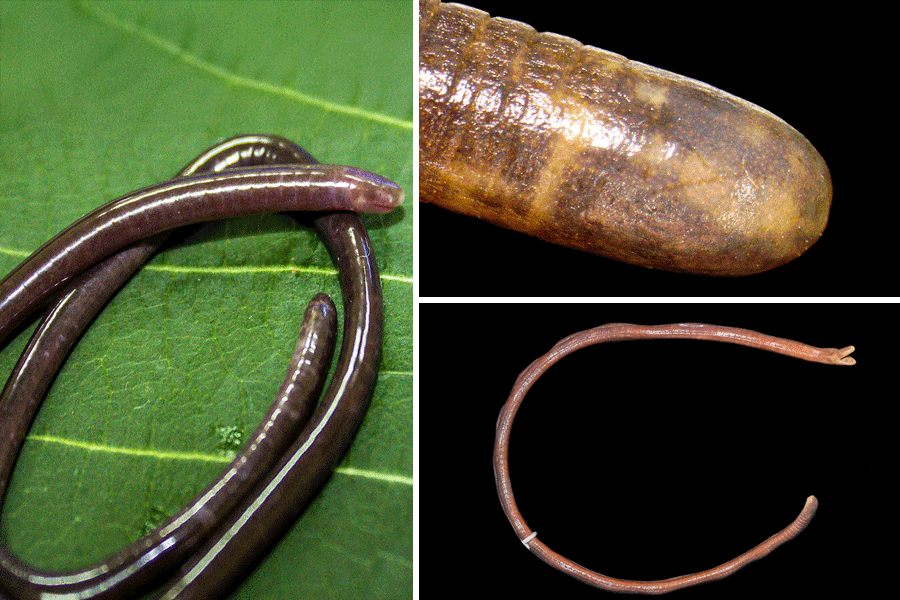
A team of Indian scientists has uncovered a rare, subterranean amphibian species in Maharashtra’s northern Western Ghats, throwing light on one of the least understood groups of animals on the planet.
The newly identified species, Gegeneophis valmiki, is the first addition to its genus in more than a decade, underscoring how much of India’s biodiversity still lives unseen, beneath the soil.
The species was first collected in 2017 from the Valmiki Plateau in Satara district by Dr. K.P. Dinesh, Senior Scientist at the Zoological Survey of India (ZSI). It has now been formally described following years of detailed study.
The name Gegeneophis valmiki honours the Maharshi Valmiki Mandir located close to the site of discovery, rooting the scientific finding firmly in its local landscape.
The research, published in the international journal Phyllomedusa, is the outcome of a collaborative effort involving the ZSI, Savitribai Phule Pune University, Balasaheb Desai College and the Mhadei Research Centre.
Together, the teams pieced together morphological and genetic evidence to confirm that the specimen represented a species previously unknown to science.
Caecilians, often called “hidden amphibians”, are limbless, worm-like creatures that spend most of their lives underground. They do not croak or call like frogs, and their eyes are buried beneath layers of skin and bone, making field identification exceptionally difficult.
“Identifying members of the genus Gegeneophis in the field is incredibly difficult,” said Dr. Dinesh. “Commonly known as blind caecilians, their eyes are concealed beneath their bony skull. They look and move so much like earthworms that confirming their status as a new species required years of rigorous morphological and genetic analysis.”
Globally, caecilians account for just 231 of the world’s 8,983 known amphibian species. India records 42 caecilian species among its 457 amphibians.
The Western Ghats alone are home to 26 endemic caecilians, with 11 belonging to the Gegeneophis group.
While amphibian diversity is usually higher in the southern Western Ghats, the northern region shows an unusual concentration of Gegeneophis species, making this discovery particularly significant.
Beyond rarity, caecilians play an important ecological role. Their burrowing improves soil aeration and structure, their feeding helps regulate soil invertebrates, and they form part of the food web for birds, reptiles and small mammals.
They also represent a key evolutionary link between aquatic and terrestrial vertebrates.
“With 41% of the world’s amphibians threatened with extinction, documenting these species is a race against time,” said Dr. Dhriti Banerjee, Director, ZSI. “We must identify them to prevent ‘silent extinctions’—where a species vanishes before we even know it exists.”
Conservationist Nirmal U. Kulkarni noted that phylogenetic studies indicate several more such species may still be hidden in the northern Western Ghats. Formal scientific validation, he said, is the first step towards bringing these underground dwellers into the conservation mainstream and safeguarding their fragile habitats.