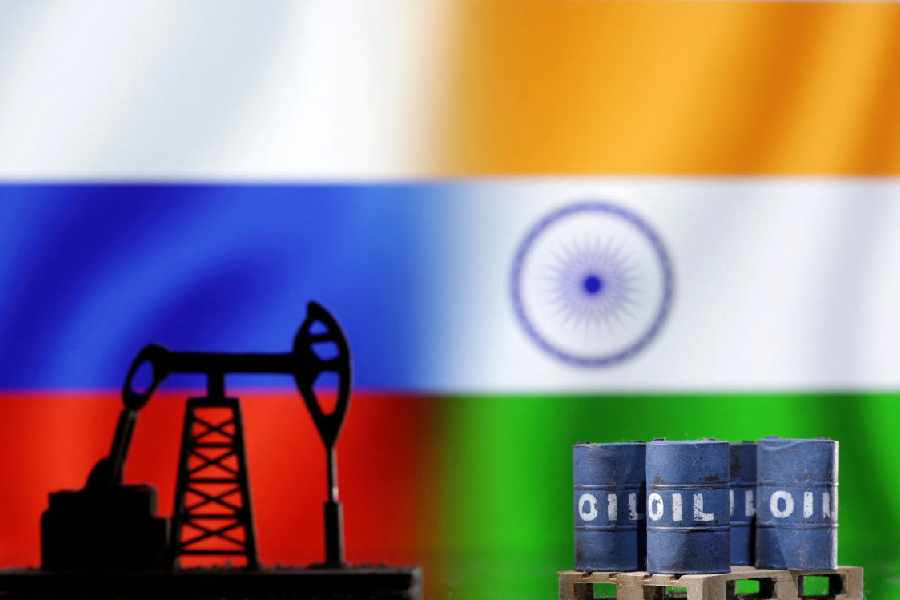
A “30-day waiver” from the US to India to buy Russian oil prompted Indian refiners to rush to secure millions of barrels of Russian crude floating on sea on Friday, but experts said the concession offered only partial relief amid the West Asia crisis.
The Office of Foreign Asset Control under the US treasury department issued a general licence on Friday morning (India time) allowing Russian crude oil to be delivered at Indian ports till April 4. The waiver applies only to “oil already stranded at sea”.
Indian refiners had snapped up some 20 million barrels of Russian oil, PTI reported.
In a tweet, US treasury secretary Scott Bessent said the measure was meant to “alleviate pressure caused by Iran’s attempt to take global energy hostage”.
India imports close to 85 per cent of its crude oil requirement. About 50 per cent of the import is shipped through the narrow Strait of Hormuz — sandwiched between Oman and Iran — where the Iran war has brought ship and oil tanker movement to a
standstill.
“To enable oil to keep flowing into the global market, the Treasury Department is issuing a temporary 30-day waiver to allow Indian refiners to purchase Russian oil,” Bessent wrote on X.
“This deliberately short-term measure will not provide significant financial benefit to the Russian government as it only authorises transactions involving oil already stranded at sea.”
Ajay Srivastava, founder of trade intelligence firm GTRI, said the waiver offered “little relief”, given the limited quantity of sea-borne crude that can be effectively redirected to India with Hormuz now shut.
Sumit Ritolia, analyst at data intelligence firm Kpler, agreed that the US concession would not fully make up for the 2.6 million barrel per day (MBD) of oil exposure India had to West Asian crude.
Indian refiners had been importing around 1 MBD of Russian crude in recent months, which can now go up to 1.6 to 2 MBD following the US decision, a note from Ritolia said.
According to Kpler, 130 million barrels of Russian crude remain in water, including significant volumes across the Indian Ocean, the Red Sea-Suez routes and around Singapore, which could potentially be redirected toward Indian ports if commercial deals are finalised.
Won’t disclose: Russia
The Kremlin said on Friday that Russia would not disclose data on crude oil export to India and keep it secret from “too many ill-wishers”.
Kremlin spokesman Dmitry Peskov said: “No, of course, we’re not going to provide any quantitative data for obvious reasons. That’s the first thing. There are too many ill-wishers.”
15 million barrels
Indian companies have so far been procuring non-sanctioned Russian oil and waiting for more clarity on the payment terms for the sanctioned oil.
With the Strait of Hormuz virtually closed, not many other places are left for India to turn for oil right now, The New York Times said. India’s main suppliers used to be Iraq and Saudi Arabia, with Kuwait and Oman expected to make up much of the balance, it added.
Russian oil, however, sails to India by several routes, the NYT said. From Russia’s western ports, oil can be shipped through the Mediterranean, the Suez Canal and the Red Sea to India’s west coast.
Some oil has been shipped from the Russian Far East, too, though that may be diverted to buyers in East Asia who, too, are seeking alternatives to Gulf supplies.
A PTI report said that about 15 million barrels of Russian crude were currently floating on tankers in the Arabian Sea and the Bay of Bengal, while vessels carrying another 7 million barrels were idling near Singapore. These cargoes can reach Indian refiners within days.
Additional tankers loaded with Russian oil are in the Mediterranean Sea and near the Suez Canal, and could arrive at Indian ports within a month, it added.
Russia had emerged as India’s biggest source of crude oil with the onset of the Ukraine war in 2022, as the product was available at a discount to the market.
However, Russian crude is now likely to be sold at a premium to India because of the shortage created by the Iran war. Benchmark Brent crude futures leapt to $90 a barrel on Friday, the highest in recent months.
India’s Russia oil trade had come under strain in August when US President Donald Trump imposed a 50 per cent tariff, accusing New Delhi of funding Kremlin’s war machine in Ukraine.
In February, Trump announced an interim trade deal with India, halving reciprocal tariff on Indian goods to 25 per cent and claiming New Delhi had agreed to stop buying Russian oil.
The Narendra Modi government never explicitly denied the claim. However, Indian refiners did not fully stop buying non-sanctioned Ural crude, as the Russian blend is known.
Srivastava argued that India’s oil security cannot depend on a temporary US waiver.
“Efforts by the US to authorise or restrict such commerce effectively extend unilateral control over trade between independent countries, raising serious questions about the principles of sovereign equality and freedom of international commerce,” Srivastava said in a note.
“With supply risks rising and stocks thin, India must consider regular import of Russian oil rather than relying on narrow waivers covering cargoes already at sea.”