
New Delhi, July 31: The status of an Olympic lightweight has only a few advantages. India has just discovered one of them.
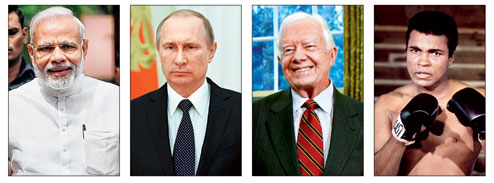
The Narendra Modi government has decided not to prod the country's sport associations to aid Moscow's lobbying efforts against serial Olympic bans on Russian sportspersons, citing India's limited influence among its reasons for not publicly backing its steadiest all-weather friend.
Russian President Vladimir Putin's government has over the past week through its embassies in several countries across the world - including in India - tried to convince nations about the legitimacy of Moscow's concerns against the Olympic bans.
India's decision is unlikely to hurt bilateral relations because Russia recognises the constraints even its friends face as it battles its biggest diplomatic challenge in sports since the US-led boycott of the 1980 Moscow Olympics, officials from both countries have told this newspaper.
The seriousness of the charges against Moscow, accused of a state-sponsored doping project for athletes, and the Olympic charter ban on the interference of governments in the work of their national Olympic associations are other factors that influenced India, officials here said.
But the decision highlights a rare occasion when a traditional weakness in one field - Olympic sports - can turn into a handy accomplice in another - diplomacy - saving India from a difficult choice between turning away a friend and sullying its own reputation with others.
There is no Indian on the executive board of the International Olympic Committee (IOC) that eventually decided last weekend to allow individual global sports bodies to decide whether Russian sportspersons could compete in their disciplines at the Olympics.
India is represented on the executive councils or boards of only seven of the 28 discipline-specific international sports associations that are now deciding which Russian men and women can participate in the Rio de Janeiro Olympics that start on August 5.
"There has been no communication from the government of India on Russia," Birendra Kumar Baishya, former Rajya Sabha MP and the Indian representative on the International Weightlifting Federation (IWF) executive board, told The Telegraph on Friday. "But the charges of doping are extremely serious."
Hours later, the IWF executive board decided to ban all eight Russian weightlifters who had qualified for the Olympics, accusing the country's wrestling federation of bringing "the sport into disrepute".
For Russia, the ongoing process of lobbying the international governing body for each sport is leaving a trail of shattered dreams for many champion athletes. Over 100 of the country's original planned delegation of about 370 sportspersons have already been banned, including two-time Olympic pole vault champion Yelena Isinbayeva.
Russia has also long viewed its sporting prowess as a geopolitical statement. The Soviet Union, with Russia at its heart, topped the medals tally in seven of the nine Olympics it participated in. The former Soviet states competed together in the 1992 Barcelona Olympics as a "Unified Team" - months after the break-up of the communist country - and also topped the medals tally. And Russia has remained among the top three nations in the Olympics medals tally ever since.
And though the Olympic charter bars governments from influencing national Olympic associations - a charge former Soviet bloc countries once frequently faced - it did not stop Moscow, or Washington, from using sports as a political tool, especially in the 1980s.
After the Soviet Union invaded Afghanistan in 1979, the US under Jimmy Carter decided to lead a boycott by western nations of the then upcoming Moscow Olympics. Then, unlike now, India had found itself - unwittingly - at the centre of the diplomatic battle that unfolded.
Carter picked boxing legend Muhammad Ali as his envoy to convince African nations to join the boycott. But Ali was at the time in India, on a 12-day charity tour. By the time US diplomat Frances Cook, assigned to accompany Ali on a tour to Africa, landed in New Delhi to meet Ali, the Soviet ambassador to India Yuri Vorontsov had also sought a meeting with the boxing legend.
The US mission here allowed Vorontsov to meet Ali the day before he was to depart from New Delhi, according to a paper published by Canadian researchers Stephen Wenn and Jeffrey Wenn in the journal Olympika in 1993. Vorontsov failed to convince Ali to abandon the tour, but planted enough doubt in his mind, according to the researchers, that he was not convincing during the visits to Tanzania, Kenya, Nigeria, Liberia and Senegal.
Cook, the US diplomat, in later interviews, also conceded that Ali had almost decided not to go to Africa after his meeting with Vorontsov. The mission to Africa is today widely considered among the Carter administration's many diplomatic failures. India, as a non-aligned nation, participated in both the 1980 Olympics, and in the 1984 games in Los Angeles, which were boycotted by the Soviet Union and many of its communist allies.
But Russia's diplomatic clout today stands far reduced compared to the Soviet Union's in the 1980s.
India, which insists it stood by the Olympic charter by participating in both the 1980 and 1984 Olympics without political influence, also can't afford to deviate in a case involving serious doping allegations, diplomats and sporting officials argued.
"On the issue of doping, there is complete global unanimity," Adille Sumariwala, head of the Athletics Federation of India and India's only representative on the executive council of the International Association of Athletics Federations (IAAF), told this paper. "And the IOC has taken a very thoughtful decision."
The IAAF, the governing body of athletics, has taken a unanimous decision to ban all Russian athletes, except one who is allowed to compete under the Olympic flag.
Had India served as a critical player on the Olympic stage, turning down Russia's request would have proven difficult, officials here conceded. Russia had stood by India when much of the West imposed sanctions on New Delhi following the 1998 nuclear tests, and its airplanes, ships and missiles remain the backbone of India's military defence. Moscow is also already suspicious of India's growing proximity to the US.
Apart from Sumariwala and Baishya, only five other Indians represent the country on the governing bodies of Olympic sporting associations. One of those five, Narendra Batra, is on the international hockey federation - Russia didn't qualify in the team sport in any case.
Olympic gold medallist Abhinav Bindra in shooting, former MP Akhilesh Das Gupta in badminton, Dilip Thomas in golf and Anil Khanna in tennis are the remaining four Indians on the executive councils of their global sports bodies.