The air in Puvarti village carries a different weight these days — lighter, almost forgiving. Gone is the miasma of gunpowder that once clung to the breeze. In its place drifts the sweet, heady aroma of mahua flowers — pale yellow blossoms lie strewn on the forest floor like scattered promises of renewal.
This is the native soil of Mandvi Hidma, the fallen poster boy of Left-wing Extremism, a man whose name once evoked terror across Bastar and beyond. The slain Maoist leader masterminded ambushes that claimed the lives of 260 troopers and 76 civilians. Here, where he once drilled his 300-strong battalion in the grim art of arms and ambush, now stands a security forces camp, its presence no longer a provocation but a quiet sentinel.
With the Centre declaring the end of Maoism within the March 31 deadline set by home minister Amit Shah, green fatigues and rifles have yielded ground to the laughter of children playing near the newly built Anganwadi Kendra, a modest rural centre for mothers and infants. The air hums not with commands but with the patter of small feet.
A little distance away, Mangli, barely out of her teens, basket balanced on her hip and a baby slung across her back, picks mahua flowers. She no longer needs to cast furtive glances over her shoulder, gone is the dread of being caught in a crossfire. Nor does she need to give away to the Maoists a portion of her income from the sale of mahua flowers.
The armed security personnel don’t strike fear in the hearts of Bastar residents any more. Jawans are seen handing out pens, cricket bats and packets of biscuits to kids, while the elders receive free grocery items and utensils.
The stirrings of hope appear to be tiptoeing up the pathway being laid by the Border Roads Organisation, a lifeline snaking through Chhattisgarh’s densely forested districts towards the distant coastal metropolis of Visakhapatnam in Andhra Pradesh. Electricity poles and mobile towers — once banished from this “red den” — now stand tall along the flanks. A fair-price shop has opened. Children from the village walk unafraid to school — a CRPF Gurukul — within the perimeter of the security camp.
The “ghost of Bastar” has vanished. Barse Deva, Hidma’s deputy, surrendered in January, his once-feared battalion in tatters — some felled in encounters, most choosing to lay down arms.
Some 35km away lies Gogunda, another Maoist bastion for four decades, perched defiantly on a 660-metre-high cliff covered by dense forests. For the first time, its villagers are receiving electricity. Where once lives were governed by the sun’s arc — rising with it, sleeping with its setting — people now linger into the night, working, studying, or gathering over shared bottles of mahua liquor and endless chatter that no longer carries the undertone of dread.
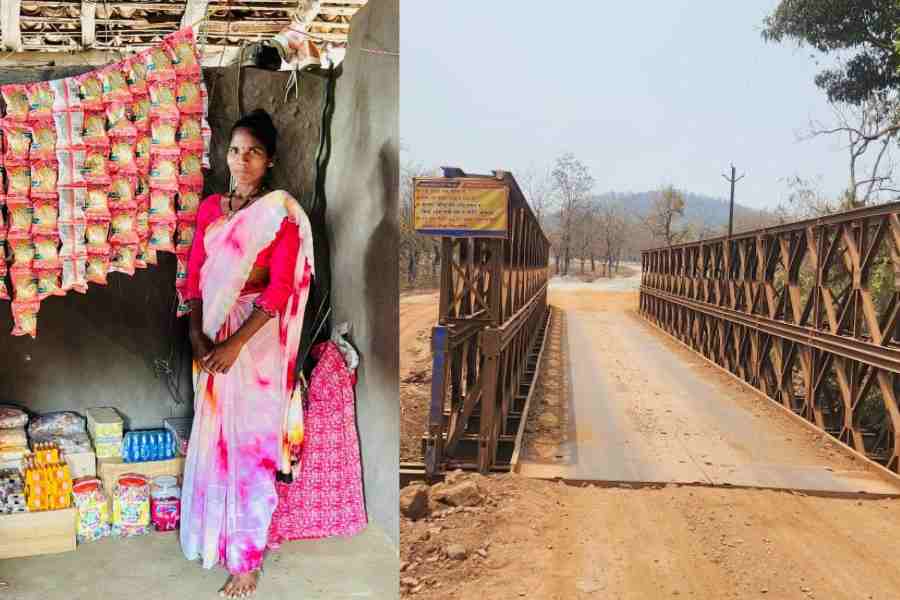
Gangi Muchaki beams like the single LED bulb dangling inside her modest kiosk — the first grocery shop in Gogunda, opened with government assistance. “This feels surreal,” she says. “I still cannot believe we have electricity, a motorable road and a kirana shop in our village. The night of red terror is over. This is a new dawn.” She adds that she no longer pays any “protection fee” to anyone. A security camp now guards them.
As fresh roads push deeper into the interiors of Gogunda, the ebbing fear of red terror has allowed the reopening of several arterial routes sealed for 15 to 30 years by Maoists. The Barsur Marg, linking Narayanpur to Dantewada via the forbidden Abujhmarh and shut since the 1990s, has been largely restored. In December 2025, another vital stretch — the Bijapur-Avapalli-Basaguda-Jagargunda Highway — was thrown open to traffic.
A 250km drive from the old Maoist war zones of Sukma, Bijapur and Dantewada, threading through these newly liberated stretches, now brings one to Abujhmarh — the mist-shrouded hills that until three months ago remained a no-go zone for security forces, government officials and civilians.
For decades, these remote forests and rugged heights — devoid of roads, electricity, potable water, schools, hospitals, or even mobile phone connectivity — served as the ultimate sanctuary for top Maoist leaders. The Maoists’ self-proclaimed capital has fallen. Roads are now inching into the deepest recesses of this 4,000sqkm wilderness, a terrain larger than Goa.
In Baleveda village, about 80km from district headquarters Narayanpur, the setting up of a BSF camp has triggered an extraordinary homecoming. Families who fled Maoist atrocities and lived as refugees in distant towns are returning to resettle on their ancestral land.
Not long ago, there were only two families in Baleveda. The others had escaped the anarchy of the so-called Jantana Sarkar — the “people’s government” of Left-wing extremists. Ramulal Wadde, the new sarpanch of Baleveda who spent 20 years in exile in a Narayanpur slum, has returned with some 20 other families. They are rebuilding homes that had crumbled into disrepair during their long absence.
Today, a BSF camp stands on the very ground where Maoists once held their kangaroo courts. “This is where they executed so many innocent villagers, including my relatives, simply for defying their diktats like refusing to hand over a child to the Maoists’ Bal Sena or daring to visit a town doctor or send a child to a state-run school,” Wadde says.
In the span of a decade, Wadde’s uncle lost two sons — one killed by police after being coerced into joining the rebels, the other murdered by the insurgents themselves on suspicion of being a police informer. Wadde too had to flee after being similarly branded.
One of his first acts as sarpanch was to demolish the “Shaheed Minar” — the memorial tower raised in honour of slain Maoists. “You see that hand pump over there?” he tells this correspondent. “I used the rubble from their pillar to build its platform. Every single day, we walk over it and trample their legacy underfoot.”
An 8km trek through dense jungle trails, occasionally interrupted by shallow river crossings, leads to Khader, another village witnessing a mass return of its people after decades. The landscape is dotted with small brick-and-mortar houses under construction, many funded under the Prime Minister’s Housing Scheme.
Until three or four months ago, the story was different. As security forces surged forward to establish camps deep inside former Maoist strongholds, the insurgents panicked. They began branding villagers as informers at random and resorted to public executions.
“The Maoists, running their Jantana Sarkar, would summon people from nearby villages and behead the so-called ‘informers’ in full public view as their wives and children begged for mercy,” recalls Ramulal.
Across the decades, some 4,000 civilians — innocent villagers, teachers, engineers, construction workers, health staff — fell to this systematic brutality. The Maoists killed more than 20 teachers in the region since 2020 alone, also bombing or shutting down hundreds of schools.
In recent years, 263 schools have been reopened or newly established in the once Maoist-dominated interiors of Bastar. Over 9,000 children now study in them, with nearly 100 more buildings under construction. The thatched-hut “schools” run by Maoists — little more than indoctrination camps pushing their ideology — are gradually giving way to proper state-run institutions.
In a region where district magistrates were once kidnapped on a whim, today Narayanpur DM Smita Jain hops onto a motorcycle and tours the rugged terrain to take part in Sushasan Shivirs — good governance camps.
She sits with locals, turning these visits into festive occasions where villagers queue up for Aadhaar cards, ration cards and other essential documents long denied to them.
A DSP-rank official who accompanied this reporter deep into the interior put it simply: “We cleared the jungle to lay a mud road so that the tribesmen could connect to civilisation and governance could reach their doorstep.”
Deeper into the jungle, the fresh roads suddenly dissolve into a wilderness of tall trees.
Animesh Paul, a journalist who has covered the Maoist insurgency for nearly two decades, told this correspondent: “Today we drive here in a police car. Just three months ago, that would have been considered suicidal. Entering the rebel den in uniform or a marked vehicle was nothing short of a death wish.”
In Abujhmar alone, 35 security camps have been set up in the once-inaccessible villages. Manish Usendi, a young District Reserve Guard jawan from Nelangur, a part of the Abujhmar hills that spills into Maharashtra’s Gadchiroli, says Maoists killed his brother two years ago merely because he aspired to join the police.
The family, fearing the same fate for the younger son, sent him to Ramakrishna Mission School in Narayanpur. The 22-year-old defied Maoist diktats and joined the DRG — a specialised, locally recruited force formed to fight the insurgency.
On May 21, 2025, Manish got his chance at reckoning. “Nambala Keshava Rao alias Basavaraju, the general secretary of the banned CPI (Maoist), and his gang were neutralised by a joint security team,” the lanky young jawan recounts, proudly showing his weapon. “We had intelligence that they were hopping between five particular hills. We encircled all five and closed in. The encounter lasted over 50 hours before the top leader and his accomplices were eliminated.”
The fall of Basavaraju cracked open the last safe havens and shattered the backbone of the Maoists in Abujhmar, triggering mass surrenders — around 300 rebels laid down arms.
At a rehabilitation camp in Narayanpur, these former insurgents sit like obedient students in white shirts and blue trousers. Mangtu, who was inducted as a “child soldier” at 14, says softly: “I was mesmerised by their uniforms and weapons. I followed them almost in a trance.”
Now aspiring to become a taxi driver, he adds: “I am training to drive taxis; others are learning plumbing. I am done with this endless, goalless revolution. I am tired of running and hiding. I want a normal life — to start a family.” He and his wife must now undergo reversal of the sterilisation forced upon them as Naxal cadres.
Sterilisation was a cruel cornerstone of Maoist discipline — hundreds of young men and women were subjected to vasectomy or tubectomy without anaesthesia in makeshift “factories”. The procedure began by tying the thumbs tightly to numb sensation before the knife was wielded. The aim was to sever family bonds and human emotions, forging ruthless “human weapons” with no desire to return to village life.
The region, once paralysed every March to May by the dread of Tactical Counter Offensive Campaigns (TCOC), is now experiencing an unprecedented calm. After nearly 25 years of cyclical bloodshed, this summer has passed without major Maoist incidents.
Since 2001, TCOC periods in Bastar had recorded 1,031 Maoist actions — 617 attacks on security camps, 373 civilian killings, and 373 IED or explosive blasts. The last significant strike came in 2023 at Aranpur in Dantewada, where Maoists blew up a DRG vehicle, killing 11 jawans.
The government’s strategy of putting relentless pressure on the Maoist leadership and its financial networks, sustained operations, and adaptive tactics have dealt a crushing blow to Maoism.
IG Bastar Range Sundarraj P, who played a pivotal role in dismantling the Maoist structure, told reporters: “The elimination of top leaders and the breaking of their organisational backbone has made them far weaker. Continuous action against their financial lifelines has crippled their resources. In the changed security environment, Maoists are no longer capable of the big strikes they once executed. The long era of Maoist violence in Bastar has ended.”
Learning from past errors, authorities are ensuring that no new leadership raises its head. The Jantana Sarkar and kangaroo courts have been replaced by sustained good governance campaigns.
Yet the local tribal economy remains fragile — dependent on a single rain-fed crop and the collection of minor forest produce. Every morning, women and children descend from the hills with baskets of mahua flowers, tendu leaves and other gifts of the forest, eking out a precarious livelihood.
The proposed Bodhghat project on the Indirawati river, estimated at around ₹49,000 crore, promises to change that calculus. Capable of generating 125MW of power and irrigating nearly seven lakh hectares across Bijapur, Dantewada and Sukma, it could finally bring assured water to these parched fields, enabling multiple crops — paddy, maize, kodon and kosa — and reducing dependence on erratic rain and forest gleanings.
Now that the Maoists have been stripped of their capacity to strike at will, the question is when will the forces drawn from the BSF, ITBP, SSB, and the CRPF begin to withdraw from these corridors freed from Maoists?
Chhattisgarh deputy chief minister Vijay Sharma offers a measured response: “The operation has been successful. But you do not self-discharge yourself immediately after a critical surgery. This is the time for healing the state. The Naxals are gone, but they have left behind landmine-riddled roads, jungles and ponds. The forces are clearing them out to make these landscapes safe for everyone once again.”