
New Delhi, July 3: A panel of oncologists has prescribed regular mammography scans and cervix screening tests for some women as well as oral visual examinations for tobacco users to improve the cure rates for India's top three cancers.
The panel's recommendations for breast, cervical and oral cancers, tailored to cover high-income and low-income households, come amid longstanding concerns that over 70 per cent of cancer patients in India seek treatment in the advanced stages of their disease.
Patients with cancers of the breast, uterine cervix and the lip and oral cavity make up 34 per cent of all cancer patients in India. Doctors say tumours at these sites are easily detectable in their early stages through appropriate diagnostic and screening tests.
"But we're just not detecting enough cancers fast enough," Anil D'Cruz, a cancer surgeon and director of the Tata Memorial Hospital, Mumbai, told The Telegraph . "Each of these cancers offers high survival rates when detected early enough."
Medical studies and anecdotal accounts documented by doctors across India reflect poor cancer survival rates. Only five in 10 women in India with cervical cancer stay alive five years after diagnosis.
Doctors say that the five-year survival rate for cervical cancer is about 73 per cent with early diagnosis and drops to about seven per cent with advanced-stage diagnosis.
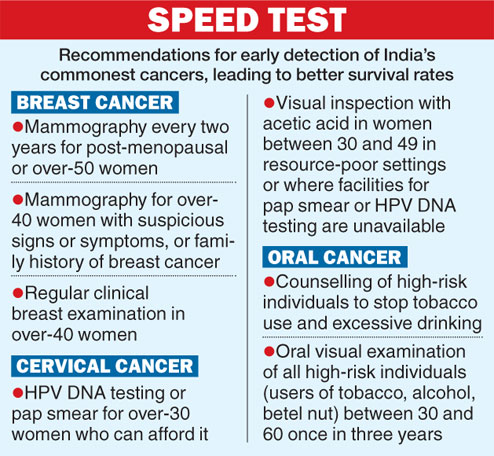
D'Cruz and the other panel members reviewed medical studies on diagnostic or screening tests to generate what they say are "evidence-based recommendations" to serve as an early detection guide for doctors, public health experts and the public. (See chart)
While India's health ministry is developing uniform guidelines for the early detection of breast and cervical cancer, these guidelines are not widely available, do not cover oral cancer and have not been implemented nationwide, the panel said.
"We see a significant preventable loss of life in India due to late detection of its three most common cancers," said Preetha Rajaraman, an epidemiologist at the US National Cancer Institute, a panel member, and lead author of the recommendations just published in the medical journal Lancet Oncology.
"For the public, the importance of early detection cannot be overstated," she told this newspaper.
The panel has recommended mammography every two years for post-menopausal women and women above 50 years, and mammography in women above 40 years if they have suspicious signs or a family history of breast cancer.
Women above 30 should be screened for the human papilloma virus (HPV), which has long been known as the primary cause of cervical cancer, the panel said. But it acknowledged that it might not be immediately feasible economically to offer this expensive test to all women.
Those who can afford the HPV DNA test should take it, D'Cruz said. But the panel has recommended an alternative screening procedure that uses acetic acid and visual examination of the cervix for women between 30 and 49 in resource-poor settings or where facilities for a pap smear or HPC DNA testing are unavailable.
In the private sector, the HPV DNA test typically costs about Rs 2,000. "Unfortunately, there's not enough awareness about the test yet," said Navin Dang, a senior microbiologist and head of a private pathology laboratory in New Delhi.
For early detection of oral cancer, the panel has recommended that people between 30 and 60 years who consume tobacco products or excessive alcohol should have their mouths visually examined by trained healthcare workers at least once in three years.
While calling for early detection of cancers, the panel has cautioned against strategies that could lead to false positive results, unnecessary biopsies or needless surgeries.
"At times, non-malignant tissues or dense fibrous tissue in the breast may create false impressions through mammography scans," Chinmay Basu, an oncologist at the Netaji Subhas Chandra Bose Cancer Research Institute, Calcutta, told this newspaper.
"Policymakers and doctors need to guard against over-prescription of diagnostic tools to reduce the risk of false positive results."
Some doctors say early detection would require India to simultaneously expand cancer treatment services.
"It is not enough to detect cancer early enough - patients need to be provided appropriate treatment," said Raju Titus Chacko, a medical oncologist at the Christian Medical College, Vellore.
"But the wherewithal for cancer treatment has in recent years grown in private and government hospitals."