|
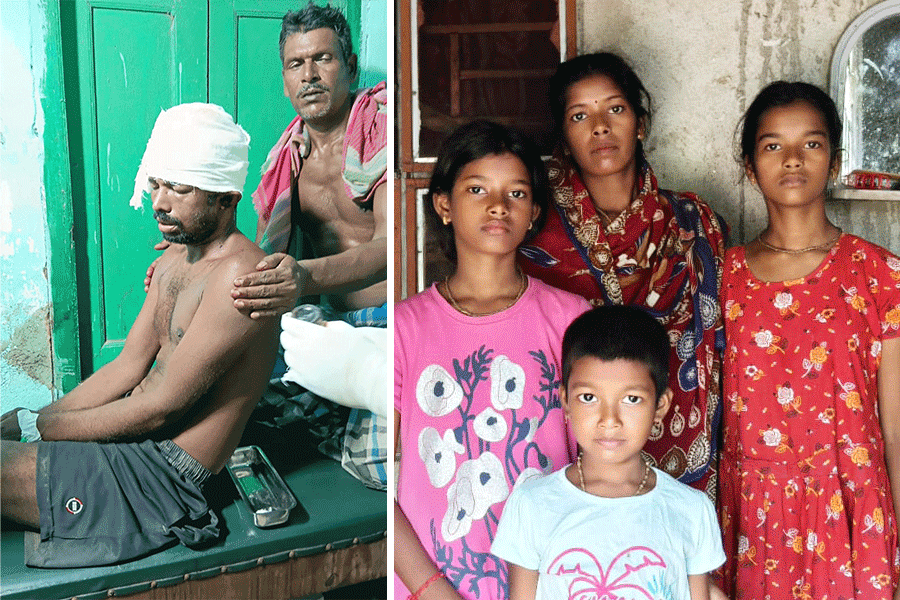
| Abdul Hamid breaks his Ramazan fast in a small eatery in Bilasipara. Telegraph picturePranab Bora in Kokrajhar |
July 28: If there is a piece of statistic that Prime Minister Manmohan Singh may not have been provided with when he visited Assam’s strife-torn Kokrajhar this afternoon, it could have well been this: that two days after chief minister Tarun Gogoi proclaimed “peace and normalcy within two or three days”, and six days after the main clashes began last Sunday, the number of relief camps in Bilasipara subdivision has only gone up from 71 to 88. Each camp, say police sources, houses at least 1,000 displaced people. The increase has come in just three days, since Thursday.
In other words, while the open violence may have no longer been visible in Kokrajhar, the surgical cleansing had continued — in however different a manner it may have been, it still was having the desired effect.
In a small eatery in Bilasipara’s main market, Abdul Hamid, 42, breaks his Ramazan fast with some people he knows. The CRPF head constable had rushed from Jharkhand to be with his family but wasn’t in a relief camp, thanks to a relative in Bilasipara. With no home to go to, the eatery had to do. “My village in Dotma (in Kokrajhar) has been destroyed,” he says. “This is much worse than Maoist-hit Jharkhand where I work.” Agreeing to a photograph, they offer their take on the ongoing strife: “Hagrama Mohilary (Bodo Territorial Council chief and former leader of the militant Bodo Liberation Tigers) is responsible for what has happened to us. This ethnic cleansing is meant to ensure the 50 per cent population that the Bodos require in the BTAD area to press for a division of Assam for a Bodoland. Last count, they were a meagre 27 per cent.” Hamid adds: “Burning our homes and all we have also ensures that we have no documents to prove our domicile after this.”
Given his central government job, Hamid would be far better off than most of his community. And he can afford an iftaar. In “minority” relief camps in Bilasipara, there is darkness, disease and people counting their dead by the dozen.
Many villages along the 20km road from Kokrajhar to Bilasipara, a subdivision in Assam’s Dhubri district, have mainland names, but are home to “minority” populations.
Theirs is often the story of the Gaurang river, that comes in through Bhutan to flow finally to the Brahmaputra. As the name suggests, Barua Para was an Assamese village decades ago, abandoned by its original inhabitants who moved further inland as the “minority” moved in. It is now home to a 2,000 strong predominantly Muslim population that moved there in 1985 after the Gaurang washed away their homes up ahead. A feature of a number of Barua Para homes is the graves that lie within the compound, or just adjacent. “We have a public graveyard,” a shopkeeper lets us in on Barua Para’s predicament. “But it’s not registered yet with the government though we have applied. So people are scared that if the government takes over that spot, they lose their graves.”
For a community on the move with the river, Barua Para has adapted to its times, even if it has to mean living with its dead. Moving inland and then digging in often means coming face to face with an ethnic community in the region.
Up ahead, Lakhiganj, once a Rajbongshi village, is also “minority-dominated” as the term goes in these parts. Inmates of the relief camp set up in the village shouted at and heckled state border areas development minister Siddique Ahmed when he visited them yesterday. “They hacked my kids,” shouted one woman. “You are hand-in-glove with Hagrama,” the crowd shouted, “which is why you left us to die”. Ahmed, a minister of the Congress party, left in a noticeable hurry.
In Kokrajhar, squatting on the floor of the Gambaribil relief camp, some 40km from the main town, Rajat Kumar Narzary, 79, refuses to accommodate migrants anymore. He has seven bighas of paddy land and 2.5 bighas as part of his home in Kachukata village, a few kilometres from the camp. His village and others like Aminakata have been burnt down by migrant attackers. They, too, have been methodical — houses that are strong have been burnt from the inside; fuel tanks of power tillers have been broken before setting them on fire.
“Bangladeshis take to water like fish. We have heard the migrants want to make us a part of Bangladesh. How can we let that happen?” asks Narzary. “When I was young they weren’t there. Now they are everywhere. How can this happen?” Yet another person, a retired central government officer, also a Bodo, says: “There is no forgiving now, they have set our houses on fire. Each community has to now stand up and do what it has to do.” Kokrajhar welcomes visitors not with an arch but a statue of Jwhwlao Dwimalu, a legendary general. Gambari Sikhla, after whom the Gambaribil School where the relief camp has been set up is named, is a legendary warrior princess.
At least one lakh “minority” people displaced in Kokrajhar are now in Bilasipara alone. There are about 270 relief camps in areas within and outside the Bodoland Territorial Areas District (BTAD).
Bilasipara in Dhubri is now seen as safe for the migrant population as Kokrajhar is for the Bodos. The five Bodo villages under the subdivision have emptied, their residents moving to Kokrajhar. It’s as if a population exchange has taken place and new perimeters set.
Last night, five houses of the migrant community were torched at Basugaon in Chirang, adjacent to Kokrajhar. Trouble has now spread there.
The clash itself, meanwhile, metamorphoses. A Kali temple and little red and saffron flags posted from verandahs mark the Bhauraguri village adjacent to Aminkata in Kokrajhar. A Bharat Mata ki Jai sign marks the border of the village on one side. A predominantly Bengali village of some 2,000 people, Bhauraguri was, despite being adjacent to Aminkata, not attacked by the migrants. “The saffron sentiment does exist among some of them,” say police officials here. While residents of Bhauraguri maintain that the red and saffron flags are part of a Shravan month festival, officials say this is yet another front in Assam’s anti-foreigners conflict. “This is an indication of things to come,” says a district official. “If the conflict takes on a fully communal form, the situation will go completely out of control.”