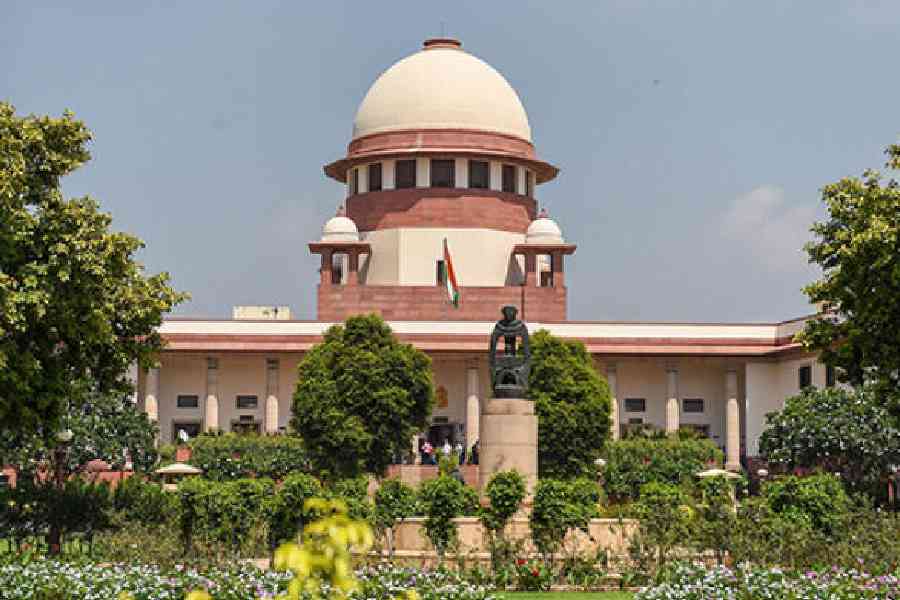
The Centre and the states have a constitutional duty to ensure free and compulsory education to all children from the age of 6 to 14, or till they complete elementary school, the Supreme Court ruled on Tuesday.
The bench of Justice P.S. Narasimha and Justice Atul S. Chandurkar cited Article 21A, which declares free elementary education (up to Class VIII) a “fundamental right” for children and provides the foundation for the Right to Education Act of 2009.
“It is important to recognise that the Constitution declares elementary education as a fundamental right, as against many other liberties, which are in the nature of fundamental freedoms,” the judgment, which re-emphasised the RTE Act, said.
It identified five “duty-bearers”, obliged to help implement the right: “(i) the appropriate government (ii) the local authority (iii) the neighbourhood schools (iv) the parents/ guardians and (v) the primary school teachers”.
“It is important to highlight the obligations and duties of these duty bearers in detail not only for accountability, but also to ensure that they have sufficient support from the government and the society,” the judgment, authored by Justice Narasimha, said.
It said the definition of “school” in this context covered all recognised schools, including governmental schools, government-aided schools, schools from specified categories such as the Kendriya Vidyalayas, and even unaided (private) schools that received no government grants.
It underscored “two foundational constitutional values” articulated by Section 12 of the Act.
“The first… mandates that not less than 25 per cent of the strength of an entry-level class (such as Class I) shall be reserved for and filled by children belonging to ‘weaker sections’ and ‘disadvantaged groups’, who are thereby guaranteed access to free elementary education,” the judgment said.
“The second is that such children are to be admitted to unaided schools in their neighbourhood, thereby embedding within the statutory framework the principle that the constitutional promise of education under Article 21A is to be realised through common local schools rather than segregated or parallel systems.”
The judgment added: “The legislative choice to implement the right to free and compulsory education through neighbourhood schools is not merely administrative; it is a deliberate constitutional strategy to operationalise equality of status, dignity and social integration among children in their formative years.”
The court issued guidelines for the government and impleaded the national and state commissions for the protection of child rights and similar organisations in the task of preparing the rules. Some of the guidelines:
- All the states and Union Territories (UTs) must implement Section 12 and provide online portals for admission.
- Information about the admission process must be made available to parents and guardians.
- All the states and UTs should provide the information in at least three languages – Hindi, English and the local language.
- Schools must be directed to publish the number of seats available for children from disadvantaged groups and weaker sections well in advance of the application stage.
- Helpdesks should be established and proactive assistance provided during the application stage. Designated school staff, the district education officer, the block officer, the block committee office or the Jan Seva Kendras must set up the helpdesks for parents.
- Instead of rejecting a defective application straightaway, a “defect-clearance window” should be established, with an assistant to help rectify the mistakes.
- A redress mechanism should be set up for complaints from parents and guardians, which must be resolved within strict timelines.
- Any denial of admission should be recorded and uploaded with reasons, to be reviewed by the block education officer within 72 hours.
- Training must be imparted to prevent discrimination against children from disadvantaged groups and weaker sections.
The court was dealing with a plea from a citizen, Dinesh Biwaji Astikar, against the denial of admission to his children in Gondia district of Maharashtra.