
New Delhi, Aug. 2: India has quietly withdrawn most of its troops from the disputed Himalayan plateau where a standoff with China has been on since mid-June, suggest statistics cited by Beijing this afternoon and left unchallenged on record by New Delhi till tonight.
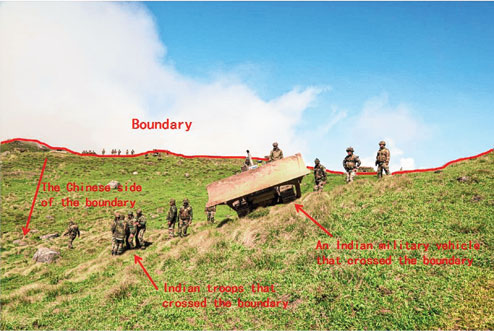
"The trespassing Indian border troops, reaching as many as over 400 people at one point, have put up three tents and advanced over 180 metres into the Chinese territory. As of the end of July, there were still over 40 Indian border troops and one bulldozer illegally staying in the Chinese territory," the Chinese foreign ministry said in its most detailed statement yet on the standoff.
The Indian foreign ministry responded in the evening by calling "peace and tranquillity in the India-China border areas" a "prerequisite" for smooth bilateral relations, but did not challenge any of the assertions in Beijing's statement, not even the alleged troop reduction.
Officials in the Indian defence ministry suggested that India had not reduced its troop strength on the disputed spot, called Doklam by Bhutan and Donglang by China.
But two officials independently told The Telegraph that India had cut its troop presence on the plateau from peak levels, though the exact number of soldiers there or the extent of the pullback remains unclear.
If the Chinese claim about India quietly withdrawing most of its troops is accurate, the pullback contrasts starkly with the shrill rhetoric New Delhi employs with its western neighbour, Pakistan. Already, India has stayed publicly circumspect while responding to the Doklam crisis.
Still, Beijing said, the troop reduction wasn't enough to end the standoff. It said New Delhi must pull back "immediately and unconditionally" the remaining soldiers for a resolution to the spat.
"China has shown utmost goodwill and great restraint and sought to communicate with India through diplomatic channels to resolve the incident," its foreign ministry said in the 16-page statement.
"No country should ever underestimate the resolve of the Chinese government and people to defend China's territorial sovereignty. China will take all necessary measures to safeguard its legitimate and lawful rights and interests. The incident took place on the Chinese side of the delimited boundary. India should immediately and unconditionally withdraw its trespassing border troops back to the Indian side of the boundary. This is a prerequisite and basis for resolving the incident."
The plateau is claimed by both China and Bhutan. After China began construction to extend a road in the plateau on June 16, Indian troops entered the region to stop them.
Bhutan protested China's road construction, which it said violated bilateral agreements to avoid any change to the "status quo" while the two countries resolved their border dispute.
India has not yet confirmed that its troops entered what it claims is Bhutanese territory after seeking Thimphu's permission.
Bhutan, in its only public statement on the crisis, did not mention India - a silence that China today highlighted to accuse India of violating the sovereignty of both the countries that claim the plateau.
"India has no right to interfere in or impede the boundary talks between China and Bhutan, still less the right to make territorial claims on Bhutan's behalf," the Chinese statement said.
"India's intrusion into Chinese territory under the pretext of Bhutan has not only violated China's territorial sovereignty but also challenged Bhutan's sovereignty and independence."
Beijing also said it had informed India "in advance, in full reflection of China's goodwill," of its plans to extend the road on the plateau. This was communicated to India, Chinese officials said, at a border meeting on June 1, as many as 15 days before the construction began.
On June 18, more than 270 armed Indian soldiers crossed into the plateau with two bulldozers, according to China. India has never revealed the number of its soldiers at the disputed spot but the date, June 18, matches New Delhi's account.
The numbers built up to 400 soldiers who reached 180 metres inside the disputed territory and pitched three tents before most of them returned with one of the bulldozers, China said today.
India has contested China's assertion since mid-June that the Sikkim-Tibet part of their border is settled and accepted by both sides under an 1890 Anglo-Chinese treaty. The treaty lays down the watershed principle - a line joining mountain crests - as the basis for the border, and then outlines its starting point as Mount Gipmochi.
India has contended that while it has agreed to the watershed principle as the basis for the border, the delineation remains incomplete.
But today, China quoted from serial diplomatic notes to accuse India of reneging on a six-decade-old consensus on the Sikkim-Tibet border.
It cited a March 22, 1959, letter from India's first Prime Minister Jawaharlal Nehru to then Chinese Premier Zhou Enlai. "The boundary of Sikkim, a protectorate of India, with the Tibet region of China was defined in the Anglo-Chinese convention 1890 and jointly demarcated on the ground in 1895," Nehru wrote.
On September 26 the same year, Nehru wrote to Zhou again, stating that "there is thus no dispute regarding the boundary of Sikkim with the Tibet region".
Five months later, on February 12, 1960, the Indian embassy in Beijing wrote to the Chinese foreign ministry stating that the Sikkim-Tibet border "has long been formally delimited" and that the boundary "has also been demarcated on the ground".
At a meeting of the special representatives on the border dispute on May 10, 2006 - when M.K. Narayanan was India's national security adviser and special representative - India said that "both sides agree on the boundary alignment in the Sikkim sector".
India has also said its intervention was prompted by security concerns. A Chinese takeover of the plateau would bring the People's Liberation Army closer to the narrow strip in north Bengal that connects northeastern India to the rest of the country.
But China today cited a UN General Assembly resolution to argue that security concerns did not justify crossing into a neighbouring country. India, China said, "has invented various excuses to justify its illegal action".
"No such attempt will be tolerated by any sovereign state," China said in the statement. "Still less should it be the normal way of conduct between China and India as two neighbouring states."