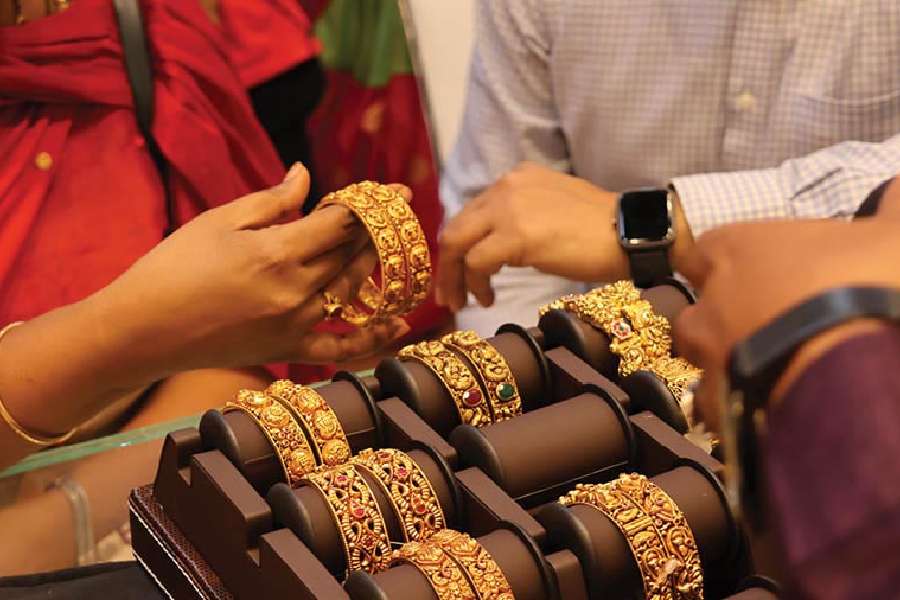
Jewellery shops across Bihar may refuse entry and sales to customers whose faces are covered, citing security concerns amid a spate of robberies and soaring prices of precious metals.
The Bihar unit of the All India Jewellers and Goldsmith Federation(AIJGF) on Wednesday said it has asked its members not to display or sell ornaments to customers who enter shops wearing hijabs, burqas, naqabs, scarves, masks or helmets unless their faces are visible for identification.
Announcing the decision, Ashok Kumar Verma, president of the AIJGF Bihar, said the directive was “purely driven by security considerations” and was not aimed at any particular community or religious group.
“We have decided not to sell items to customers who enter with their faces covered. Unless the customer’s face is visible for identification at the time of purchase, their entry into the shop will be restricted,” Verma told reporters in Patna.
Clarifying the scope of the move, Verma said the rule would apply equally to men and women.
“The federation is not imposing a ban on hijab or burqa. We are only requesting customers to show their faces for identification. This applies to everyone, including men who cover their faces with scarves or helmets,” he said.
Jewellers argue that the measure has become necessary in view of repeated thefts involving masked criminals.
“If customers enter jewellery shops with their faces covered, we cannot identify them. The move will also help police ascertain identities through CCTV footage in case of any theft,” Verma said.
He cited recent incidents to underline the concern, including a robbery in which ornaments worth about Rs 25 crore were looted from a jewellery outlet in Bhojpur district in March last year, and another robbery at a jewellery shop in Siwan district in November.
With gold and silver prices at record levels, jewellers say the risk has increased.
“Today, 10 grams of gold costs around Rs 1.40 lakh, while one kilogram of silver is about Rs 2.5 lakh. The issue arises when people come in groups, wearing full helmets or veils, hiding their faces and committing robberies,” Verma said.
He added that the decision had been discussed with senior police officials in Patna, who raised no objections, and claimed that several shops in the State had already begun following the practice.
“Similar precautionary measures exist in some districts of other States, but Bihar is the first to adhere to this directive across the State,” he said.
The move, however, has drawn sharp political criticism. State spokesperson of the Opposition Rashtriya Janata Da (RJD) Ejaz Ahmed termed the decision unconstitutional and contrary to India’s secular ethos.
“This is an attempt to curtail the fundamental right to religious freedom guaranteed by the Constitution,” Ahmed told The Hindu, alleging that the ruling Bharatiya Janata Party and the Rashtriya Swayamsevak Sangh were “behind such a move”.
He also warned against any coercive enforcement. “No staff member of a shop can remove anyone’s hijab or burqa. At best, a humble request can be made. There should be no confrontation,” Ahmed said, adding that measures taken in the name of security should not weaken the country’s secular fabric.