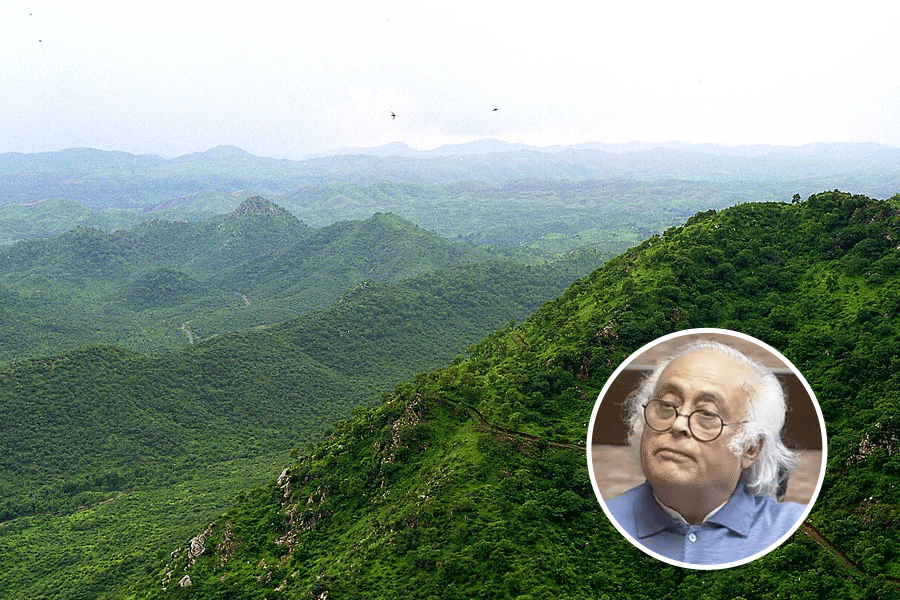
Congress leader Jairam Ramesh on Friday said he has moved the Supreme Court against ex post facto environmental clearances, calling them illegal and harmful to public health, days after the court agreed to review its 29 December ruling on the redefinition of the Aravallis.
In a post on X, Ramesh said, "Excited by the Supreme Court's review of its earlier decision dated 29 December 2025 regarding the redefinition of the Aravallis, I have now filed a petition in the Supreme Court challenging ex post facto (retrospective) environmental clearances."
"Environmental clearances granted with retrospective effect are illegal in the eyes of the law, harmful to public health, and make a mockery of the governance system," the former environment minister said.
Ramesh said they give an easy way out to those who are wilful defaulters. Ignorance of the law cannot be an excuse for violating it, he added.
The Supreme Court on 21 January said that it will constitute an expert committee comprising domain experts to undertake an “exhaustive and holistic” examination of mining and related issues in the Aravallis.
After the outcry over the new definition of Aravallis, the court had kept in abeyance its 20 November directions on 29 December, saying there is a need to resolve "critical ambiguities" including whether the 100-metre elevation and the 500-metre gap between hills criteria will strip significant portion of the range of environment protection.
The top court on 20 November had accepted a uniform definition of the Aravalli hills and ranges and banned grant of fresh mining leases inside its areas spanning Delhi, Haryana, Rajasthan and Gujarat until experts’ reports are out.
The committee recommended that “Aravalli Hill” will be defined as any landform in designated Aravalli districts with an elevation of 100 metres or more above its local relief and an “Aravalli Range” will be a collection of two or more such hills within 500 metres of each other.