
Ranchi, Aug. 5: None of the 19 wholesale hubs in Jharkhand has conducted a single e-transaction, prompting the Union ministry of agriculture to prod the state to return the funds meant for implementing e-NAM, a pan-India electronic trading portal launched in April last year to promote fairness and transparency in business.
To facilitate e-NAM (National Agriculture Market) trading, the ministry had allotted Rs 30 lakh to each of the 19 mandis for infrastructure, Rs 24 lakh for buildings and the rest for the purchase of computers and accessories. Now, according to a central government notice sent last month, the funds must be returned by September-end if e-NAM is not functional. But, implementation of e-NAM looks unlikely.
Even Pandra Krishi Utpad Bazar Samiti in Ranchi, which is the largest of the 19, still does not have the basic infrastructure in place for e-NAM, forget the others in Dumka, Gumla, Chakulia, Daltonganj, Lohardaga, Simdega, Jamshedpur, Dhanbad, Bokaro, Ramgarh, Koderma, Deoghar, Sahebganj, Giridih, Godda, Chaibasa, Hazaribagh and Chaibasa.
The e-NAM system was launched nationally to provide farmers, traders, buyers, exporters and processors a common platform to trade commodities. The portal was intended to help farmers and wholesalers get the best possible deal by eliminating layers of middlemen present in traditional trading.
In Pandra Bazar alone, 204 traders and 68 farmers were enrolled but not a single instance of e-trading has taken place. "The facility was inaugurated with hype the day the Prime Minister inaugurated it nationally. But it was all show," fumed a wholesale trader at Pandra Bazar Samiti.
Doing business worth Rs 10 crore a day in foodgrain, oils, spices, vegetables, among others, Pandra Bazar Samiti is controlled by Jharkhand Agricultural Marketing Board, a unit of the state agriculture department. But apparently, the board, chaired by MLA Ganesh Ganjhu, has shown scant interest in getting e-NAM activated.
A senior board official not wanting to be named said the state government laws for trade of agriculture products need certain amendments to follow e-NAM. "The board needs to approve the amendments, after which it needs to be placed before the cabinet. But, for this board chairman needs to attend meetings," he said, adding that on their July 25 meeting, Ganjhu had not come.
There is a dedicated building for e-NAM at Pandra with seven computers. But, the assessment-cum-testing lab to certify the quality of agriculture products, which would be uploaded on the e-NAM website for prospective buyers, is yet to come up.
Ganjhu could not be contacted. Board managing director Shri Vimal tried to pass the buck on traders. "The trading community is still not convinced about the benefits of e-NAM. We can't force farmers and traders (to trade on e-NAM). We are studying central and state rules and assembling infrastructure," he said.
Sources in the board also claimed that out of the 204 registered traders only few had obtained a licence number from the board for e-trading. But, with almost no infrastructure ready, it is hardly surprising.
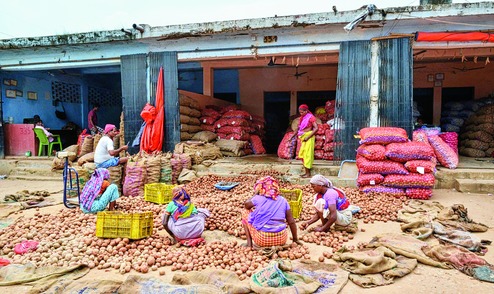
Pandra Bazar Samiti traders have many more problems. Spread over 63 acres, the wholesale market has 704 shops, 30 warehouses and nine trading platforms. But, there are dangerous craters on the road within the premises and seepage in buildings.
During the weeklong heavy rains of last month, a leaking ceiling spoilt goods worth over Rs 5 crore. But, there is no money for its upkeep ever since the state abolished marketing tax in 2015, and more recently, after wholesale traders refused to pay rent to the board after a dispute that is unresolved.