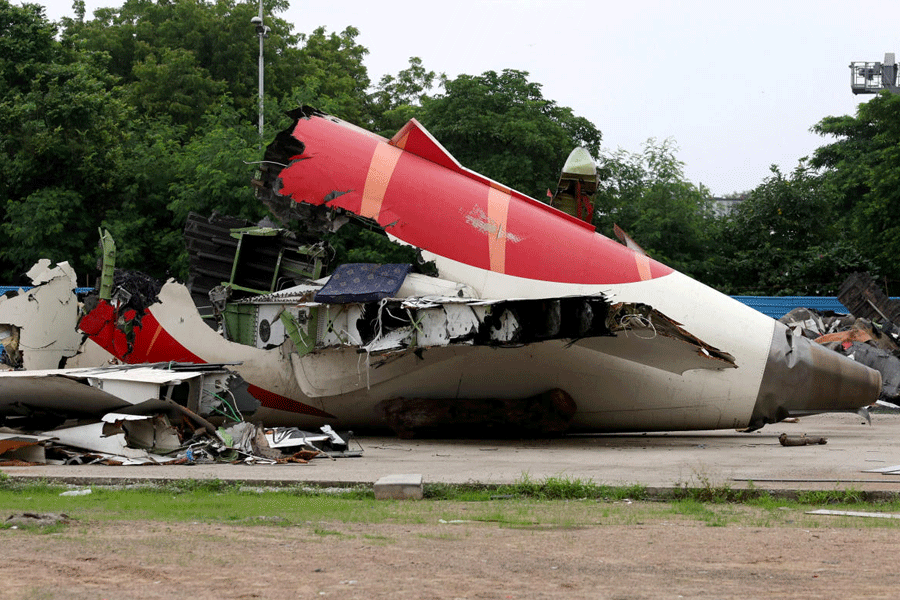
The Air India Boeing 787 that crashed in Ahmedabad shortly after takeoff last year, killing 260 people, had suffered a long history of electrical and systems failures, a US non-government aviation safety watchdog has said in a whistleblower report submitted to the US Senate.
The aircraft, with tail number VT-ANB, had faced avionics, electronics and software faults, repeated tripping of circuit breakers, electrical surges and loss of electrical current, said the report submitted by the Foundation for Aviation Safety on January 12 to the US Senate Permanent Subcommittee on Investigations.
The subcommittee is a bipartisan body that examines government efficiency and compliance with laws, and probes crimes, including fraud, that might impact health, welfare and safety.
The whistleblower report, citing what it described as "non-public information" about VT-ANB, said the problems extended across much of the aircraft's 11-year operational life. Among the issues were burning and overheating of power distribution components and what the report described as a "serious" fire.
The claims come amid unresolved questions about the London-bound Air India flight 171 that crashed on June 12, less than 35 seconds after takeoff. Investigators said the aircraft had lost thrust in both engines almost immediately after leaving the runway. The crash killed 241 passengers and crew members, as well as 19 people on the ground. One passenger survived.
In a preliminary report released a month after the crash, India's Aircraft Accident Investigation Bureau (AAIB) said the fuel control switches to the engines had moved to the "cut-off" position. The agency also released a summary of an exchange between the pilots that suggested one of them had moved the switches.
The report had drawn sharp criticism from members of the Airline Pilots Association of India (ALPA-I), which represents about 1,000 pilots, who said the preliminary report reflected a "presumption of pilot guilt" without sufficient evidence to support such an inference.
The whistleblower report submitted to the Senate subcommittee echoed those concerns, saying the AAIB's preliminary findings "clearly" insinuated that one of the pilots was responsible for cutting the fuel switches.
The Foundation for Aviation Safety and ALPA-I have both accused Indian authorities of obscuring unresolved technical questions by releasing an incomplete report. The Foundation for Aviation Safety had issued a statement in October last year saying the crash of flight 171 illustrated a "consistent and dangerous trend" in which pilots are blamed before all available evidence is examined.
The watchdog group said the AAIB had released an incomplete account of the accident, omitting what it described as critical data — the full cockpit voice recorder transcript, real-time fault messages from the aircraft and its health monitoring systems, and specific alerts and failures visible on cockpit displays.
"Without including the complete factual audio recording, the system fault messages, and flight deck instrument warnings, such omissions confuse the real sequence of electronic and systems failures that led to the tragedy," the Foundation for Aviation Safety said in a media release in October.
The whistleblower submission also said documents reviewed by the foundation suggested the issues were not isolated to a single aircraft. According to the report, other Air India Boeing 787s have shown evidence of electrical system failures, and aircraft of the same type registered in the US, Canada and Australia have experienced similar problems.
Queries sent by this newspaper seeking verification of the whistleblower report circulating online did not receive a response.
Aviation experts and members of ALPA-I said that only a fully transparent investigation would establish why flight 171 crashed, including whether prior or newly developed aircraft faults played a role alongside, or independent of, crew actions.
"The AAIB has not accepted our pleas to allow pilots deeply familiar with the aircraft to be part of the investigation," said Sam Thomas, the president of ALPA-I. "They told us they have 250 subject matter experts — but who are they? They're not telling."