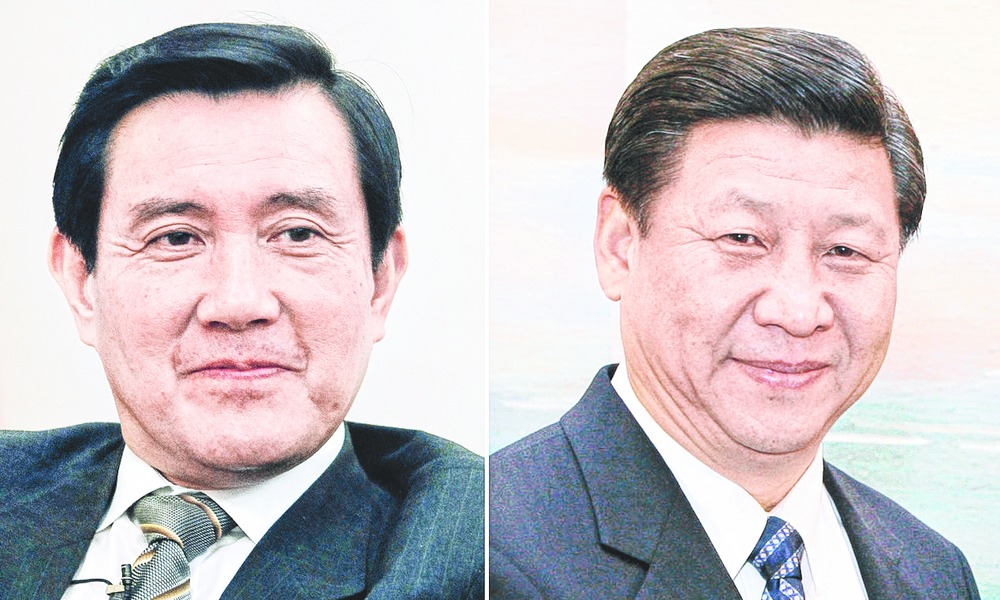

When the general secretary of the Communist Party of China shakes the hand of the successor to Chiang Kai-shek in Singapore on Saturday for the first time since Mao Zedong forced the Kuomintang to flee to Taiwan 66 years ago, it will be a reminder that a year after the US and Cuba ended their long stand-off, there is still room for surprises in diplomacy.
The scheduled meeting between Xi Jinping, who is also China's President, and Ma Ying-jeou, the two-term President of Taiwan, planned in secret, has taken the world by surprise, somewhat like Henry Kissinger's cloak-and-dagger flight to Beijing in 1971 and Richard Nixon's famous handshake with Mao the following year.
The reverberations of Singapore's backroom diplomacy in bringing together Xi and Ma are being felt in New Delhi, where arrangements for Prime Minister Narendra Modi's upcoming travel to the prosperous city state, which is treated as a virtual ally of India in South East Asia, are in full swing.
Adding to the subterranean tremors on Raisina Hill, the seat of government in New Delhi, is a realisation that the Modi government may have misread the signals from South China Sea where India has been embracing the Sangh parivar's view that it should be proactive against Beijing in the maritime dispute between China and South East Asian nations.
The Chinese President arrived in Singapore today after a visit to Hanoi where he addressed the National Assembly and laid the framework for a "truly trustworthy" relationship with Vietnam.
Xi's visit to Hanoi is extremely significant because Vietnam's ruling party will elect a new leadership in January. India has been courting Vietnam with high-level visits and offers of military cooperation.
Xi's latest diplomatic push in Singapore and Vietnam raises questions about the wisdom of the "India-US Joint Strategic Vision for the Asia-Pacific", which Modi and US President Barack Obama unveiled during the latter's visit when he was chief guest at India's Republic Day this year.
Although Obama avoided any mention of this initiative when Modi met him in September, the Prime Minister continued to be enthusiastic about joint diplomacy in the Asia-Pacific.
"I welcome the progress in giving shape to our joint strategic vision on our Asia Pacific and Indian Ocean region, and also our joint engagement with regional partners like Japan. This will also strengthen our maritime security cooperation," Modi said when the two leaders addressed the media at the UN.
Xi and Vietnamese President Truong Tan Sang did not refer to the South China Sea dispute in Hanoi this week, but there was a reference to "tests" both countries had faced in the "winds of history". Xi said their friendship must "not be allowed to stray from the correct path".
A meeting between the leaders of China and Taiwan has been in the making for years. But when it takes place on Saturday, its conceptualisation will be celebrated for a long time as the stuff of diplomatic folklore.
A year after the Kuomintang regained power in Taiwan in 2008 with Ma as the party's presidential candidate, he additionally agreed to don the mantle of the party's presidency -- a post he had held from 2005 to 2007 -- because mainland China's leadership would not meet the President of Taiwan, whom it does not recognise.
Hu Jintao, then the party chief in China, was amenable to having talks with the head of a political party in Taiwan but not with its President. Yet, because of the complexities on both sides of turning their backs on history, the planned meeting did not materialise. Ma relinquished the leadership of the Kuomintang when the meeting did not take place.
Zhang Zhijun, head of the Taiwan work office of the Communist Party of China's central committee, told China Daily this week that Xi and Ma had agreed to address each other with the prefix of "Mr" to their surnames in Singapore.
So there will be no first names like "Barack" when Modi met the US head of state. And certainly no "Mr President" in any conversation on Saturday.
For Xi, whose upbringing was in a communist family -- he was also part of the Great Proletarian Cultural Revolution at the age of 16 -- it will be a perverse throwback to the times when he was addressed as "comrade".
It is not just that China and Taiwan do not recognise each other. They both formally and legally subscribe to the view that there is only one China.
For Ma, the only China he acknowledges is ruled from Taipei, which claims all of mainland China as its own. Of course, for Beijing, the breakaway province is a prodigal that must eventually return home.
Indians and Pakistanis may be tempted to apply their favourite prescription in joint statements and describe the problems between China and Taiwan as an "outstanding issue" but such a view would be wrong. China and Taiwan cannot compromise on the perception that the other side simply does not exist legally.
Therefore, on Saturday, no agreements will be signed and a joint statement has been ruled out. The two men will meet and the plan is that after the photo-op of a handshake, Xi and Ma will hold separate news conferences. Then they will retreat to have dinner together.
The presumption is that Xi agreed to meet Ma to demonstrate that China's belligerence in the South China Sea, which affects Taiwan too, does not mean that Beijing is unreasonable or inflexible. The same goes, in part, for Xi's visit to Vietnam.
Secondly, the meeting will be an acknowledgement of Taiwan's efforts to improve relations with the mainland during Ma's seven-year tenure. In the January 2016 election, the Kuomintang is expected to lose the presidency to the pro-independence Democratic Progressive Party.
Ma, for his part, is hopeful that a historic meeting with China's President can improve the prospects for Eric Chu, the Kuomintang's candidate to be the next President of Taiwan.