Saturday, 06 June 2026
Saturday, 06 June 2026
Saturday, 06 June 2026
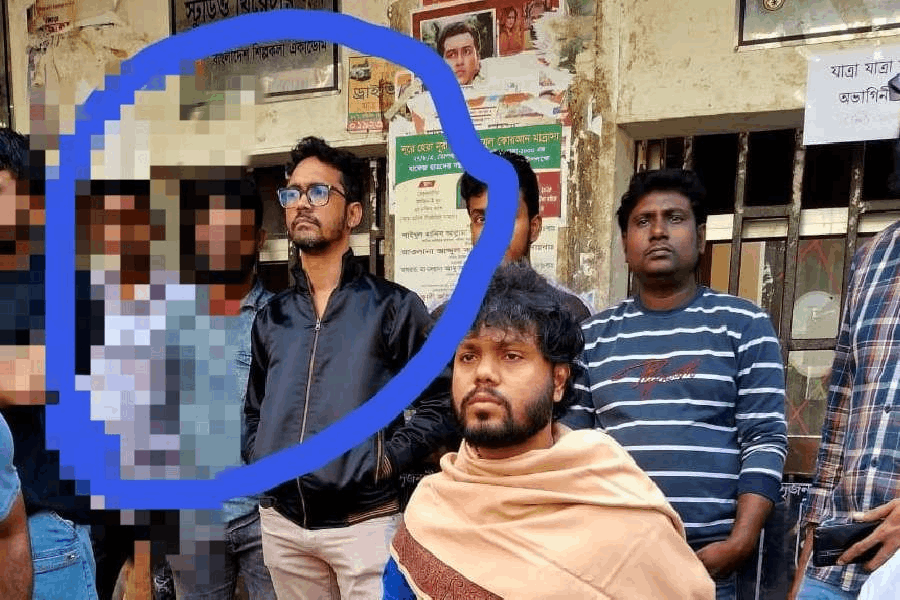
Bangladesh’s latest spiral of violence has a name at its centre: Faisal Karim Masud.
“The prime suspect in Osman Hadi’s killing is Faisal Karim Masud, a former leader of the Chhatra League (currently banned), the student wing of the ousted Awami League,” a local Bangladeshi journalist told The Telegraph Online on Friday. “It appears that Faisal joined Hadi’s campaign with the intention of killing him.”
According to the journalist, Masud participated in Hadi’s election campaign along with another suspect, identified as motorcycle rider Alamgir. “Law enforcement agencies have detained several people, including Faisal’s parents, wife, and girlfriend, but have so far failed to arrest the accused,” he said.
The journalist added that Masud had previously been arrested about a year ago with a foreign-made pistol in connection with an armed robbery at a school.
“There’s a notion that the accused has fled to India,” he said. “Many out here feel India has provided shelter to the accused.”
The Telegraph Online has not verified whether the person shown in the photograph is Masud.
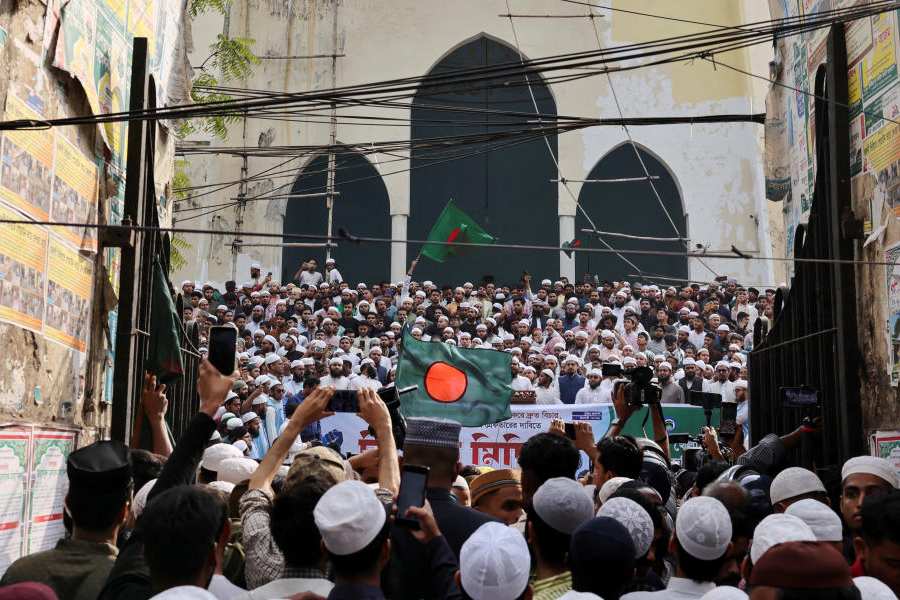
Hadi, a leader of the student group Inqilab Mancha and a candidate in the February 12 general elections, was shot in the head by masked gunmen last week while launching his campaign in Dhaka’s Bijoynagar area. He was airlifted to Singapore for treatment but died after battling for life for six days.
Bangladesh police have called Hadi’s killing a premeditated assassination aimed at destabilising the political process. Authorities have released photographs of two key suspects and announced a reward of five million taka for information leading to their arrest, The Times of India reported.
Officials said investigators were analysing CCTV footage, phone records and possible cross-border movements.
Printing presses at Bangladesh's two leading newspapers went silent on Friday for the first time in decades after mobs torched their offices.
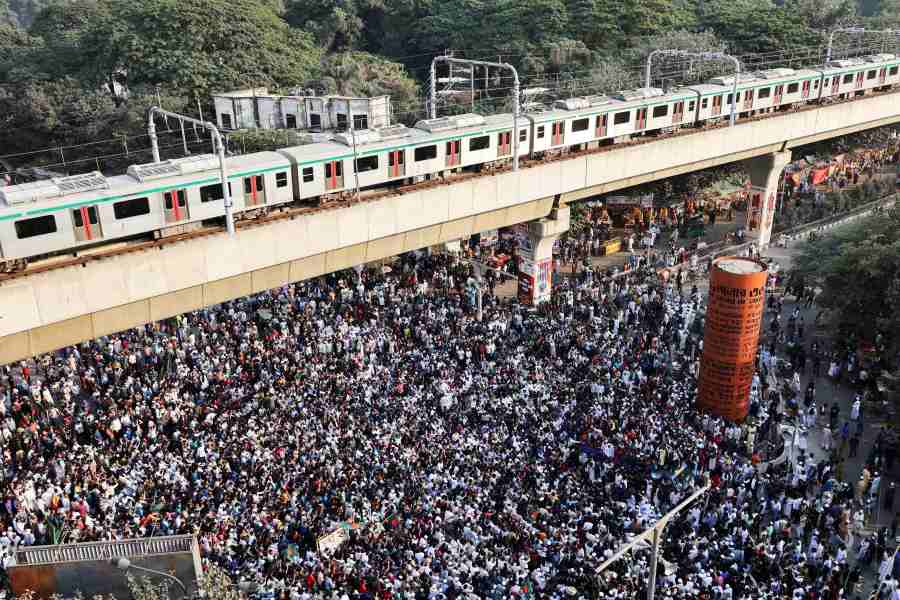
As news of his death spread on Thursday, protests escalated, turning violent in several parts of the capital. A fresh round of violence continued in Bangladesh on Friday.
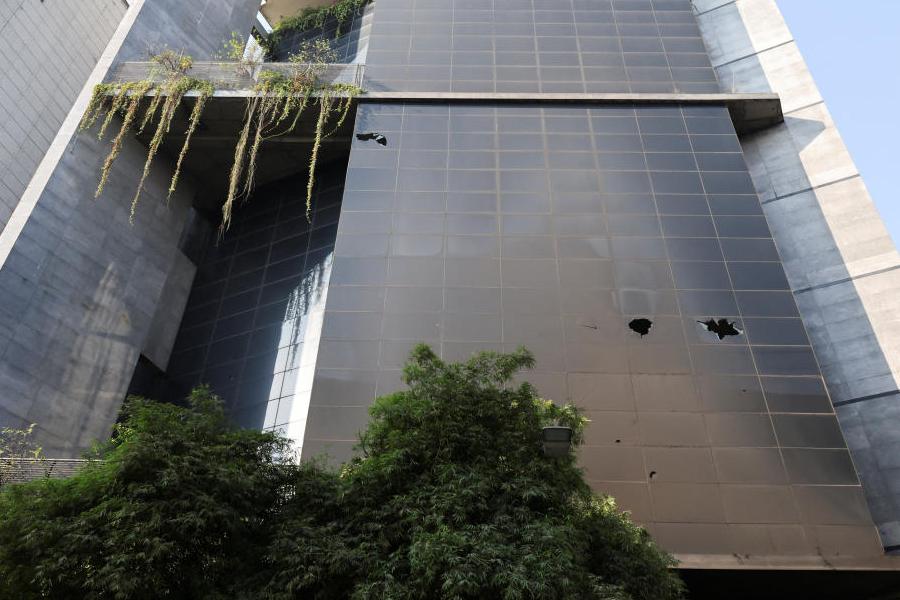
Late on Thursday night, a mob attacked the offices of leading newspapers Prothom Alo and The Daily Star at Karwan Bazar. The mob vandalised multiple floors and set fires outside the buildings, trapping journalists inside. Protesters accused the outlets of pro-India bias and of unfavourable coverage of the 2024 uprising that led to the fall of former prime minister Sheikh Hasina.
A Hindu man, Dipu Chandra Das, was lynched in Mymensingh on Thursday night.
Citing local and eyewitness sources, Bengali news outlet Barta Bazar reported that Dipu had been accused of making derogatory comments about Islam and Prophet Muhammad during an event at a factory marking World Arabic Language Day.
Chief Adviser Muhammad Yunus on Friday spoke by phone with the editors of both newspapers following the attacks.
Expressing sympathy to Prothom Alo editor Matiur Rahman and The Daily Star editor Mahfuz Anam, he said: “This unexpected and heinous attack on your institutions and journalists has deeply pained me. The government stands by you in this difficult time.”
In a statement posted later on X, the interim government said: “To the journalists of The Daily Star, Prothom Alo, and New Age: we stand with you. We are deeply sorry for the terror and violence you have endured. The nation has witnessed your courage and tolerance in the face of terror. Attacks on journalists are attacks on truth itself. We promise you full justice.”
The interim government condemned Dipu’s killing on X: “We wholeheartedly condemn lynching of a Hindu man in Mymensingh. There is no space for such violence in new Bangladesh. The perpetrators of this heinous crime will not be spared.”
In the port city of Chittagong, protesters attacked the Indian Assistant High Commission in the Khulshi area early on Friday, hurling bricks and vandalising the premises, according to police. Four people, including two police officers, were injured.
Chittagong Metropolitan Police Commissioner Hasib Aziz said police intervention led to a chase and counter-chase, and several people were detained.
International reactions followed the killing of Hadi. The United States embassy in Dhaka on Friday said on X: “The US Embassy joins the people of Bangladesh in mourning the loss of youth leader Sharif Osman Hadi and offers our deepest condolences to his family, friends, and supporters.”
Chief adviser Yunus called Hadi’s killing part of a broader conspiracy to derail democratic reforms and vowed swift justice. A one-day state mourning has been declared for Saturday, with special prayers announced across mosques after Friday prayers.
Inqilab Mancha, the organisation to which Hadi belonged, distanced itself from the violence. In a statement on social media, the group said: “They essentially want to turn Bangladesh into a dysfunctional state through vandalism and arson. They want to endanger the independence and sovereignty of this country.”
In a separate post, it urged restraint: “Through destruction and fire, certain groups aim to render Bangladesh an ineffective state. They seek to undermine the independence and sovereignty of our country.”
Former minister Mohibul Hasan Chowdhury, who served in the Hasina cabinet, accused the interim government of manipulating events. “He (Hadi) was a firebrand fanatic who was calling for the blood of others,” Chowdhury said, alleging that the Yunus administration aimed to provoke unrest in order to delay the elections.
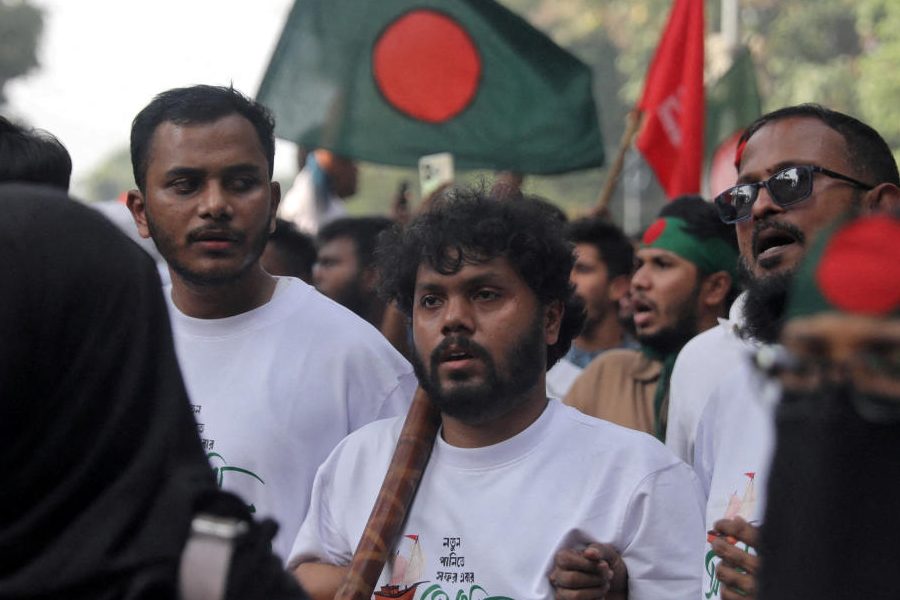
Leaders of the National Citizen Party, an offshoot of Students Against Discrimination, raised anti-India slogans during a mourning procession at Dhaka University, alleging that Hadi’s attackers had fled across the border.
Appealing for calm, the Yunus-led interim government has said: “This is a critical moment in our country's history. We cannot and must not allow it to be derailed by those few who thrive on chaos and reject peace.”
Referring directly to Hadi’s death, the statement added: “Honouring his sacrifice demands restraint, responsibility, and a firm commitment to reject hatred.”
Late on Thursday, demonstrators targeted symbols of political and cultural authority.
Protesters vandalised the already demolished structure of 32 Dhanmondi, the residence of Sheikh Mujibur Rahman, attacking it with hammers. The site had been largely demolished earlier this year and set on fire following the fall of the Awami League government on August 5, 2024.
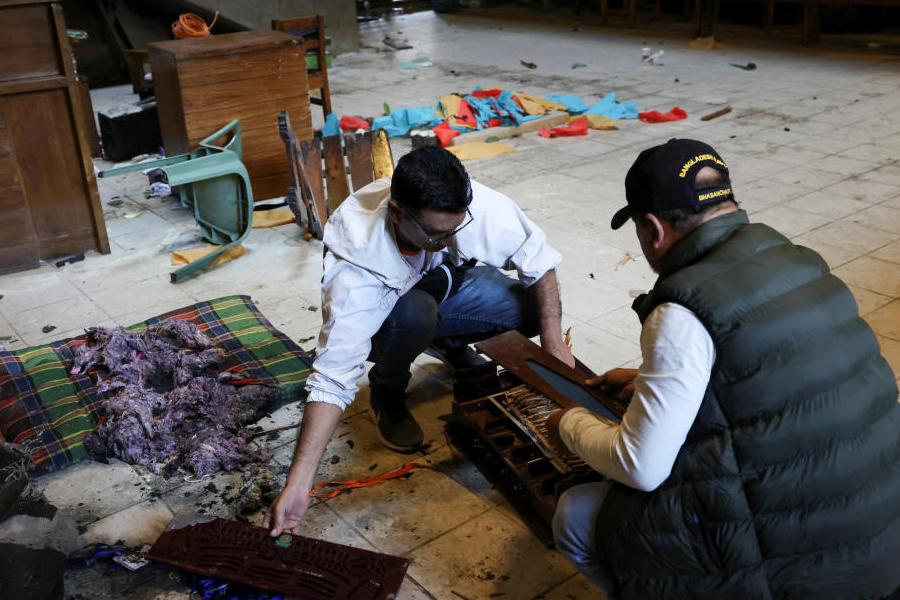
In Rajshahi, an office of the disbanded Awami League was demolished, while in Dhaka protesters attacked the office of cultural organisation Chhayanaut, dragging out furniture and setting it ablaze.
(Pictures: Reuters)