Does every generation read differently? If so, how are Tolstoy’s War and Peace and Bibhutibhushan Bandopadhyay’s Chander Pahar still read by the millennial? Perhaps these are undisputed classics that transcend time, geography, context and language to speak to several generations of readers. However, very often what one generation hails as a classic or at least path-breaking, is not seen quite that way by the next. This segment of books is quite fascinating since it did galvanise readers and public opinion for a period — sometimes as long as 30-40 years — before receding from libraries, bookstores and reading bucket lists.
As a youngster, I remember my mother reading and recommending to me a writer called Marie Corelli. She wrote romances, sagas and even a revenge thriller called Vendetta, which was immensely popular. In fact, she was the most popular writer of her time, the late 19th and early 20th century, Sir Winston Churchill being one of her admirers. Like any self-respecting teenager, I disregarded this recommendation, partly because that’s what a teenager does, partly because Corelli’s books were unavailable, and partly because none of my contemporaries had even heard of the writer, exactly 60 years after her death.
Not every popular or acclaimed writer can withstand the telling blows of Father Time. I now see some of the books that were ‘must-reads’ in the last decades of the 1900s have receded from reading memory. Bibliopath has put together a set of novels that have receded from public memory, and gather dust in libraries. However, some were quite exceptional and still feel relevant and readable. These might not be full-blown classics, but they certainly did captivate a generation of readers. While youngsters are free to spurn some of them like I did Corelli many summers ago, a couple might be worth visiting if only to know what preceded the Murakami/Grisham/Rowling years. And for the 40-plus generation, a few of these might be worth revisiting.

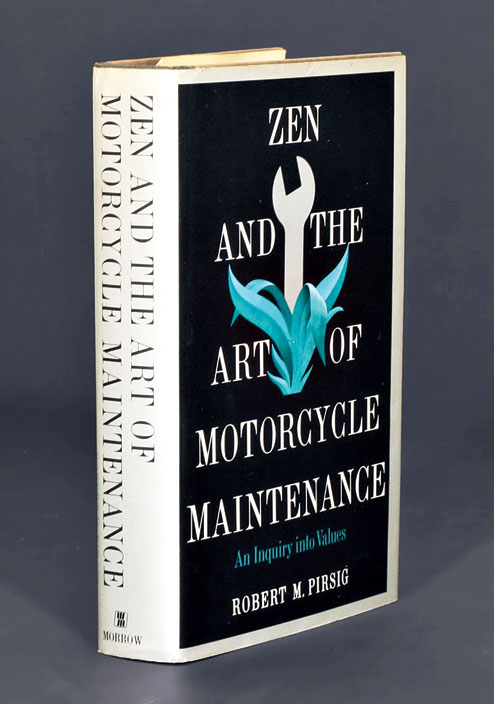
Zen and the Art of Motorcycle Maintenance by Robert
M. Pirsig: Everybody who grew up in the 1980s and 1990s has read or at least claimed to have read this road book on the list... perhaps the journey is a metaphor that has become irrelevant. Tracing a journey across America, the novel is dotted with deep philosophical discussions that made a lot of sense to the teenagers of that time. The maintenance of motorcycles is a metaphor for how one approaches life — does one just ride along and take the punctures and breakdowns in stride, or does one luxuriate in the joy of working on the insides of the motorcycle and enjoy a smooth ride? Deep. This is one book on the list the Bibliopath has not read, she has looked at it with some curiosity and wondered whether it is the motorcycle that came in between the novel and her. The author, Robert M. Pirsig, died earlier this year. He only wrote one more book, Lila: An Inquiry Into Morals.

On the Road by Jack Kerouac: A classic that is still clocking reader miles in the US, the book’s legend has faded a bit in other parts of the world. Jack Kerouac’s book defined the Beat generation since he based it on his famed contemporaries Allen Ginsberg and William Borroughs, among others. It defined the counterculture movement with its coolth and unfettered lifestyle. The book came back into the radar for some Indians through Deborah Baker’s A Blue Hand, which traced the Beats through India. On the Road is introspective, spontaneous and was often mentioned as a life-changing book. Sal Paradise, the alter ego of Kerouac, is one of the most philosophical figures in 20th century American literature, but what defines the book is the lightness of touch and the way the book makes the reader a co-traveller, across America and towards the inner self.

The French Lieutenant’s Woman by John Fowles: The masterful novel has a superb structure that juxtaposes the fictional love story between fallen woman Sarah Woodruff and Victorian era dreamboat Charles Smithson, with a non-fiction commentary on the social, gender and sexual conventions of the time. The 1969 novel was an audacious blend of fact, fiction and commentary. The unusual structure of the work is rendered even more fascinating by alternative endings. We clearly know which one is the realistic one, but every reader does root for the alternative that sees Charles and Sarah walk into the sunset together. The book was exceedingly popular for three decades after its release, not least because of an exceptional film adaptation (released in 1981), which featured a searing performance by Meryl Streep, opposite a young, drool-worthy Jeremy Irons.

Valley of the Dolls by Jacqueline Susann: This book held the record for being the highest-selling book by a woman, right till J.K. Rowling outsold her. The story of a set of young women in post-World War II showbiz, it had sugar daddies, beautiful, fragile women, ruthless ambition and the dolls. No, the ‘dolls’ were not the women, they were the mood-lifting drugs that some of these women were hooked to. Susann did write other page-turners, but none could match the pulse, the pace and the path-breaking nature of her debut novel. Valley of the Dolls is clearly not high literature, but it established and mainstreamed airport paperbacks by the likes of Harold Robbins, Sidney Sheldon, Judith Krantz, to name a few.

The Thorn Birds by Colleen McCullough: The Australian saga about the life and times of Meggie, and her abiding love for Ralph the priest was one of the coming-of-age novels for a whole generation of readers the world over. Portraying the hard and unsmiling life that was led in the Australian outback, the book captured the imagination of readers everywhere. Looking back, it’s hard to figure out why, since the book was over-written and Meggie was a long-suffering soul for the better part of the long, meandering novel. Many a southpaw was left in trauma by the image of Meggie with her left arm tied to her torso so that she would be compelled to use her right hand. For months. More worthwhile stories were being written in Australia around the time of The Thorn Birds, but this was the big Aussie novel that swept every reader to the Outback.