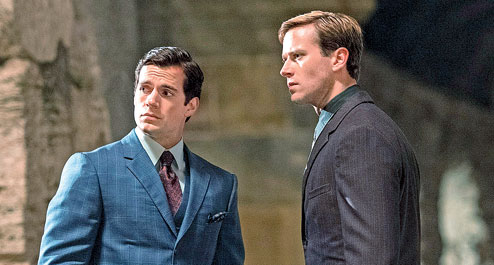

Guy Ritchie’s The Man from U.N.C.L.E. is a fast-moving, action-packed, sexy and stylish international adventure, shot through with humour, that is as much about the rocky relationship between two sparring super spies — Napoleon Solo (Henry Cavill) and Illya Kuryakin (Armie Hammer) — as it is about the job they have to do.
“It’s a zone I find fascinating, the way men interact with each other,” says Ritchie, who directed, produced, and co-wrote the screenplay, based on the hit 1960s TV series of the same name. “Even going back to Lock, Stock and Two Smoking Barrels (his 1998 cult film), I’m drawn to that male-to-male dynamic as kind of a genre unto itself.”
Dynamic would be the word for it, as the first time elite CIA operative Solo meets his formidable KGB counterpart, Kuryakin, they are trying to kill each other. Each has been sent to extract the same vital German asset from behind the Berlin Wall at the height of the Cold War, and taking out the competition in the process would just be the icing on the cake.
A BUDDY MOVIE BUT...
Days later, after being informed by their respective handlers that they will now be working together on the case, killing each other is unfortunately — albeit temporarily — off the table, leaving the sworn rivals to vent their national and professional antagonism in a bare-knuckled, bust-up-the-furniture, “getting to know you” fight designed to convey in no uncertain terms that they might be stuck with this deal, but they don’t have to like it.
So in some respects, it’s a buddy movie…apart from the fact that “they kick the living daylights out of each other as soon as they meet”, says Henry Cavill, who stars as Solo, the suave and often self-serving American agent.
Starring as Kuryakin, Armie Hammer offers the volatile but more conventional Russian’s point of view: “Kuryakin is the ultimate soldier, always in line and giving his best. Then he’s thrust into a position that he hates and there’s nothing he can do about it. This guy he’s working with, this Napoleon Solo, he’s so unorthodox. He doesn’t follow the rules. He doesn’t even seem to know there are rules.”
“What we found so irresistible,” says Ritchie, “was taking these polar-opposite agents and forcing them together so that they start out trying to annihilate each other and end up cooperating, but maybe still not entirely trusting each other. The story is largely the evolution of their collaboration. The fact that one represents capitalist America and the other represents communist Russia, and these two superpowers have to team up to neutralise a threat with global stakes, is a great premise that you can have a lot of fun with, and that’s really the spine of the story.”
The film opens in 1963. The US and the Soviet Union are locked in a tense, high-stakes game over nuclear arms supremacy, and the wartime research of former Nazi scientists is still at a premium on the not-so-open market. A 12-foot concrete wall divides post-World War II Berlin and it’s here, in its long shadows, that Solo and Kuryakin first size each other up in a breakneck, winner-take-all street chase.
Their prize is Gaby Teller, a whip-smart East German auto mechanic played by Alicia Vikander, who is also the estranged daughter of Dr Udo Teller, once Hitler’s favourite rocket scientist. Doc Teller has lately gone missing, launching both world powers into a race to find him before his very specific and very dangerous knowledge is channeled into weaponry that could obliterate whole countries. And Gaby may be the only bait that can flush him out.
1960S COOL MEETS TODAY’S VIBE
Opting to retain the initial property’s Cold War context, with all its cultural and political touchstones, Ritchie says: “It’s a tip of the hat to the series. We wanted to capture the essence and uniqueness of that time while making it immediately accessible to today’s audiences, and as original, attractive and fresh as possible.” The resulting tenor “is both period and contemporary, which feels like a very natural process to me”.
As film fans will attest, that’s another hallmark of the director’s work. In much the same way the Sherlock Holmes films took audiences into Victorian London without losing the edge that made them so sharp and current, The Man from U.N.C.L.E. distills everything that made the 1960s cool — from its art, fashion and music, to its attitudes and perspectives — into a spot-on but understated vibe that is both retro and undeniably 21st century.
In some ways, the 1960s depicted in The Man from U.N.C.L.E. is a rare and enticing moment in time that only really existed on screen. “For us, the ’60s were the coolest decade and The Man from U.N.C.L.E. was a part of that,” producer Lionel Wigram say. “We were always keen on doing a spy story. We loved the early Bond movies, which really made an imprint on our young minds, and then the Italian and French films of the time, like L’Avventura and La Dolce Vita, that had a particular flavour we found so stylish and interesting. Whether it’s the clothes, the cars, the movies, or the design, the ’60s really marked the beginning of the modern age.”
One reason that tales of espionage and secret agendas continue to thrill and entertain, generation upon generation, might be the cyclic nature of history and politics. “Without getting too deep,” producer Steve Clark-Hall suggests, “with the (Edward) Snowden case and the massive amount of recent revelations about the sort of spying that still goes on, I think it’s something that people are intrinsically fascinated by — the nature of relationships and the opportunity for betrayal, the complex alliances nations find themselves in, and not being sure who to trust. In some ways today’s world is reflective of the tensions of the ’60s that the movie plays on.”
SOLO VS KURYAKIN
The key, for Ritchie, in bringing all of this energy together — apart from the barbed banter and unshakeable cool of his charismatic leads — is what he calls “the balance of real danger, drama and action with a lightness of touch. It’s the juxtaposition of different moods that I find most creative and stimulating,” he says, noting that he makes the kinds of movies that would attract him as a viewer and a vital ingredient of that is the kind of humour that tends to percolate to the surface almost effortlessly. “Not that it should all be funny. I’m looking for the whole gamut of emotions. We start off writing more serious scenes, but what often happens on the day of filming is that the scenes start not taking themselves quite so seriously and the humour invariably finds its way in.”
“We had a great cast all around, led by Henry and Armie, and Alicia as Gaby,” he continues. “The guys have brilliant chemistry and Alicia is truly something special. And they really had to work for it. It wasn’t a soft job, not mentally or physically. Filming is collaboration and I want actors to own what they say. Granted, a director has the advantage of seeing the bigger picture and the actors have to trust that, but I’m always interested in the best idea in the room. As long as it doesn’t hold us back, and it seldom does, I’m up for everyone being creative.”
“It’s a great feeling knowing that, together, you’ve gone beyond what was originally on the page,” says Vikander. “You get to know your character better because you’re not only thinking about what they say, but about what they might say.”
Cavill, for whom working with Ritchie was the number one reason he signed onto the project, concurs. “His movies are fantastic and his filmmaking style is unique. There’s no over-rehearsing, so you can get in there and do it, and it feels very fresh and new when you shoot.”
“It really keeps you sharp. You have to do your homework and show up ready for anything because things can change,” adds Hammer, who likewise jumped at the chance to work with the acclaimed director. “I think he intentionally keeps the atmosphere light because you get the best work when everyone is free and everything is flowing. It’s an open, inviting, creative space and that’s what Guy tries to cultivate on the set.”
Cavill understands the quintessentially smooth Solo. “He’s not career CIA; in fact, he’s kind of anti-establishment. He acquired his skill set dealing art and antiques on the black market after sneaking his way into post-war European high society, and was so good that no one could catch him for years. It’s something he took a great deal of pride in. But eventually he was given up by a jealous girlfriend and the CIA, seeing the value of a man like him, offered an ultimatum: go to jail or work for us. So he ended up becoming an agent, very successfully but somewhat reluctantly. It’s better than being in jail and he can still wear natty suits.”
By contrast, Kuryakin’s rise at the KGB was the result of years of dedication, training and single-minded effort. “He’s a classic spy,” says Hammer of the youngest agent in the organisation to have attained such elite status. “He grew up in the system and rose through the ranks and he’s very by-the-book. His lifelong goal was to be a KGB operative and that’s the most important thing to him.”

The Man From U.N.C.L.E. releases today
I love Guy Ritchie’s films because.... Tell t2@abp.in